Ammonia-Bearing Compounds Discovered at Surface of Jupiter’s Moon Europa

NASA/JPL-Caltech
Description
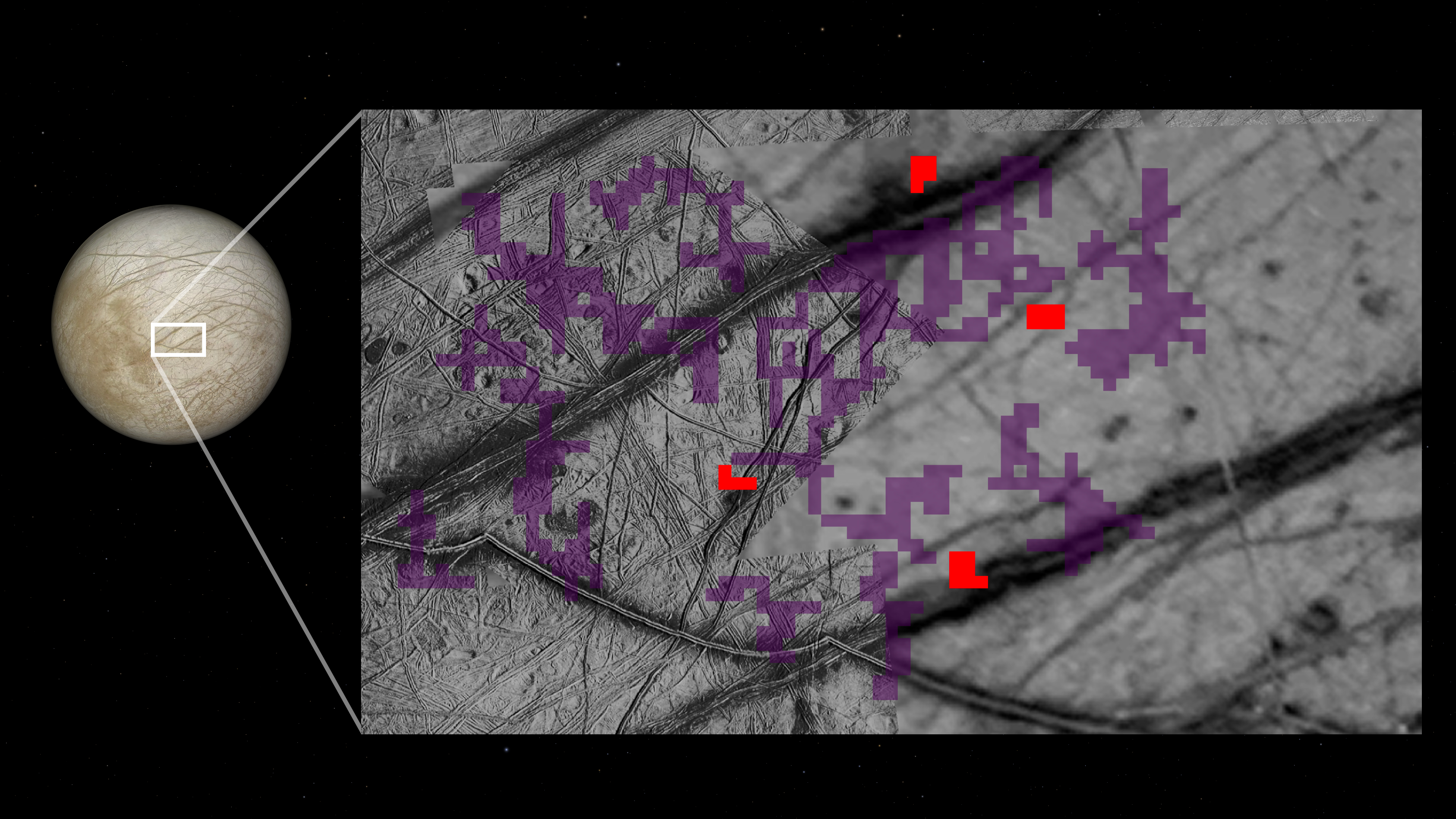
Advanced analysis of decades-old data from NASA’s Galileo spacecraft identifies ammonia-bearing compounds discovered on the surface of Jupiter’s moon Europa, as shown in this composite image. Zooming in on an area about 250 miles (about 400 kilometers) wide, the black-and-white mosaic to the right is composed of multiple images from Galileo’s Solid-State Imaging camera. Overlaid are representations of data from the spacecraft’s Near-Infrared Mapping Spectrometer (NIMS) instrument: Red pixels mark locations where ammonia-bearing compounds were detected; purple pixels indicate no detections of the compounds. The NIMS data was captured during Galileo’s 11th orbit of Jupiter in 1997.
Dark, crisscrossing bands in the underlying image represent fracturing of Europa’s icy surface. Detection of ammonia-bearing compounds near such features could indicate that they were actively placed there by cryo-volcanic processes bringing liquid water up from Europa’s vast subsurface ocean.
Launched in 1989 and managed by the agency’s Jet Propulsion Laboratory in Southern California, NASA’s Galileo mission concluded its extended mission to the Jupiter system in September 2003. Caltech manages JPL for NASA.