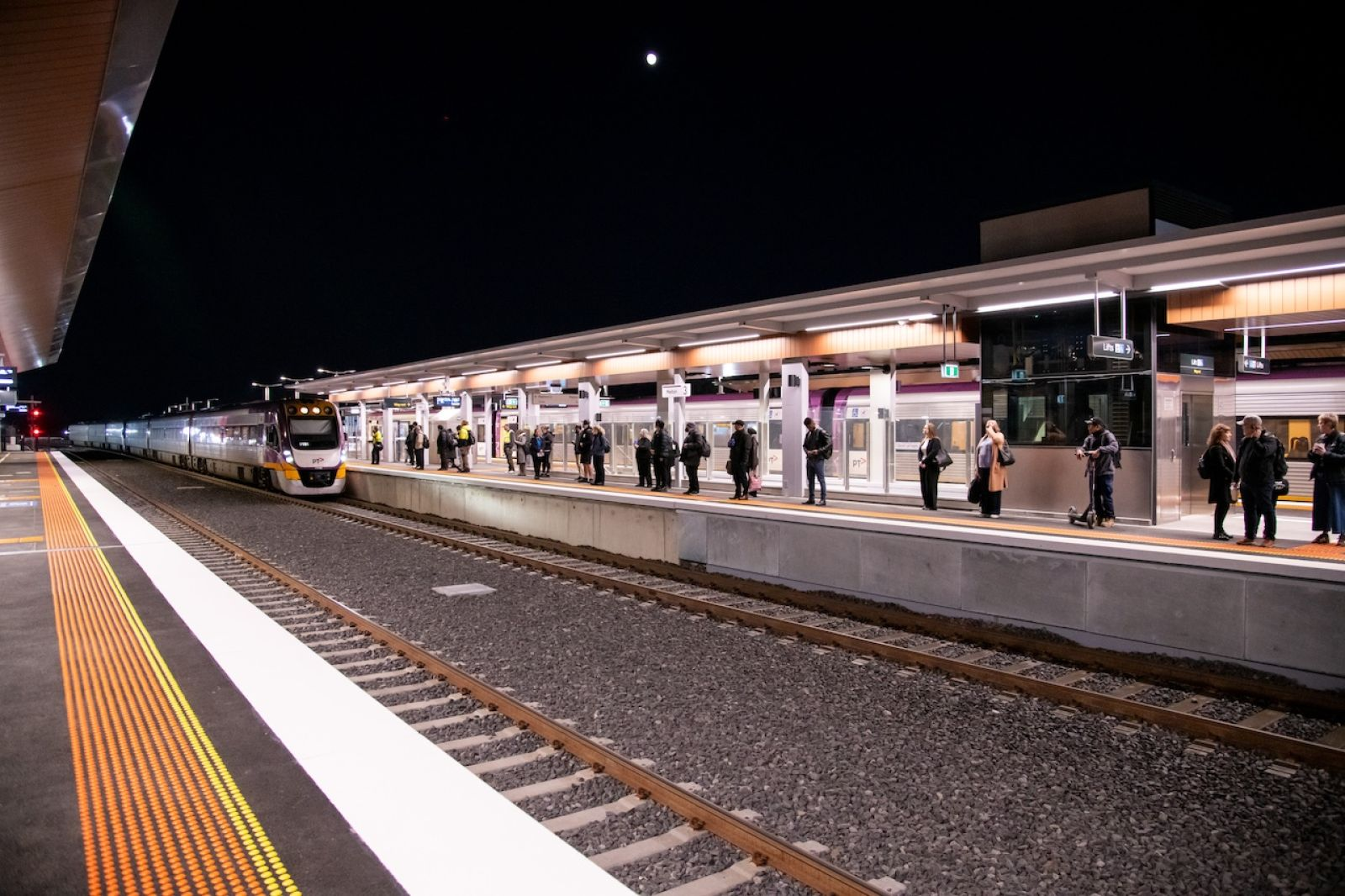
The Ballarat line is Victoria’s second-busiest regional service, carrying 4.68 million passengers in 2022–23 across 123km and 13 stops. The corridor is a shared bottleneck: Ballarat, Bendigo and Geelong trains all funnel through the same Sunshine–Melton section, so upgrading that shared trunk benefits every western regional line, not just Ballarat’s own patronage.
Bimodal trains: the Coalition’s pitch
On 1 September 2026, Opposition Leader Jess Wilson pledged $1.7 billion for 25 hybrid electric-diesel trains on the Melton and Wyndham Vale lines, promising more than double current passenger capacity and potential City Loop runs. The trade-off is a heavier, costlier unit than a pure EMU, with continued diesel emissions on unwired sections.
Full electrification: the incumbent plan — and the case against stopping halfway
Labor’s Western Rail Plan has targeted electrification to Melton and Wyndham Vale only, with $152.7 million committed to finalise design and costing, and the government unable to give a completion date even for that shortened scope. This is where the “half-mainline” critique bites hardest.
Electrifying Melbourne–Melton but not Melbourne–Ballarat creates a mode-change point partway along a single mainline: electric trains would terminate around 37km out, and passengers bound for Bacchus Marsh, Ballarat and beyond would still need a diesel V/Line service for the remaining ~85km — either via a physical change of train or a bimodal working that defeats much of electrification’s efficiency case in the first place.
Melton residents themselves have already experienced the reliability cost of this fragmented arrangement, with a 2026 telecommunications outage stranding commuters and local councils calling to fast-track full electrification specifically because a half-finished network offers no redundancy when something fails at the boundary.
Critics argue this delivers metro-style trains to the fastest-growing part of the corridor while leaving Ballarat itself — the actual destination generating much of the patronage — no better off than today, and arguably worse placed, since capital and political will spent on a partial build makes a future full extension harder to justify or fund.
The counter-argument is that staged electrification lets a cash-constrained government deliver benefits sooner to the highest-growth, highest-density section first; but on a single mainline serving one city at its end, a mode break partway along solves the problem for outer-suburban commuters while doing comparatively little for the Ballarat-bound majority the line exists to serve.
Why the same logic extends to Geelong
The case applies even more strongly to Geelong, Victoria’s busiest regional service at 10.22 million passengers in 2023–24. The same “half-mainline” objection applies if electrification stops at Werribee rather than continuing the full ~75km to Geelong itself: Werribee is already a metro terminus, so electrifying only that far essentially extends the existing suburban network without addressing the diesel V/Line service that actually carries Geelong’s much larger commuter base.
It reproduces the Melton problem in miniature — a mode-change point at Werribee, a transfer or bimodal working for the remaining distance, and the busiest regional line in the state still substantially diesel-reliant. Given Geelong’s stronger benefit-cost case (around 4.9, versus 2.0 or less for other regional corridors) and larger population base, stopping electrification short of the city itself arguably wastes the strongest economic argument in the state’s favour.
Renewables strategy reinforces the point
Victoria has legislated 65% renewable electricity by 2030 and 95% by 2035, and committed to 100% renewable power for its train network. Diesel — full-length or bimodal — sits outside that trajectory entirely, since burning diesel doesn’t get cleaner as the grid decarbonises.
A half-electrified mainline only partially captures this benefit, leaving the majority-diesel outer section (Melton–Ballarat, or Werribee–Geelong) permanently excluded from the state’s clean-energy transition regardless of future grid progress.
Bottom line
Bimodal trains offer genuine near-term capacity relief on both corridors, but electrifying only the inner, already-growing suburban section — Melbourne–Melton, or Melbourne–Werribee — risks solving the easier problem while leaving the higher-patronage destination city no closer to a reliable, fully electric, renewables-aligned service.