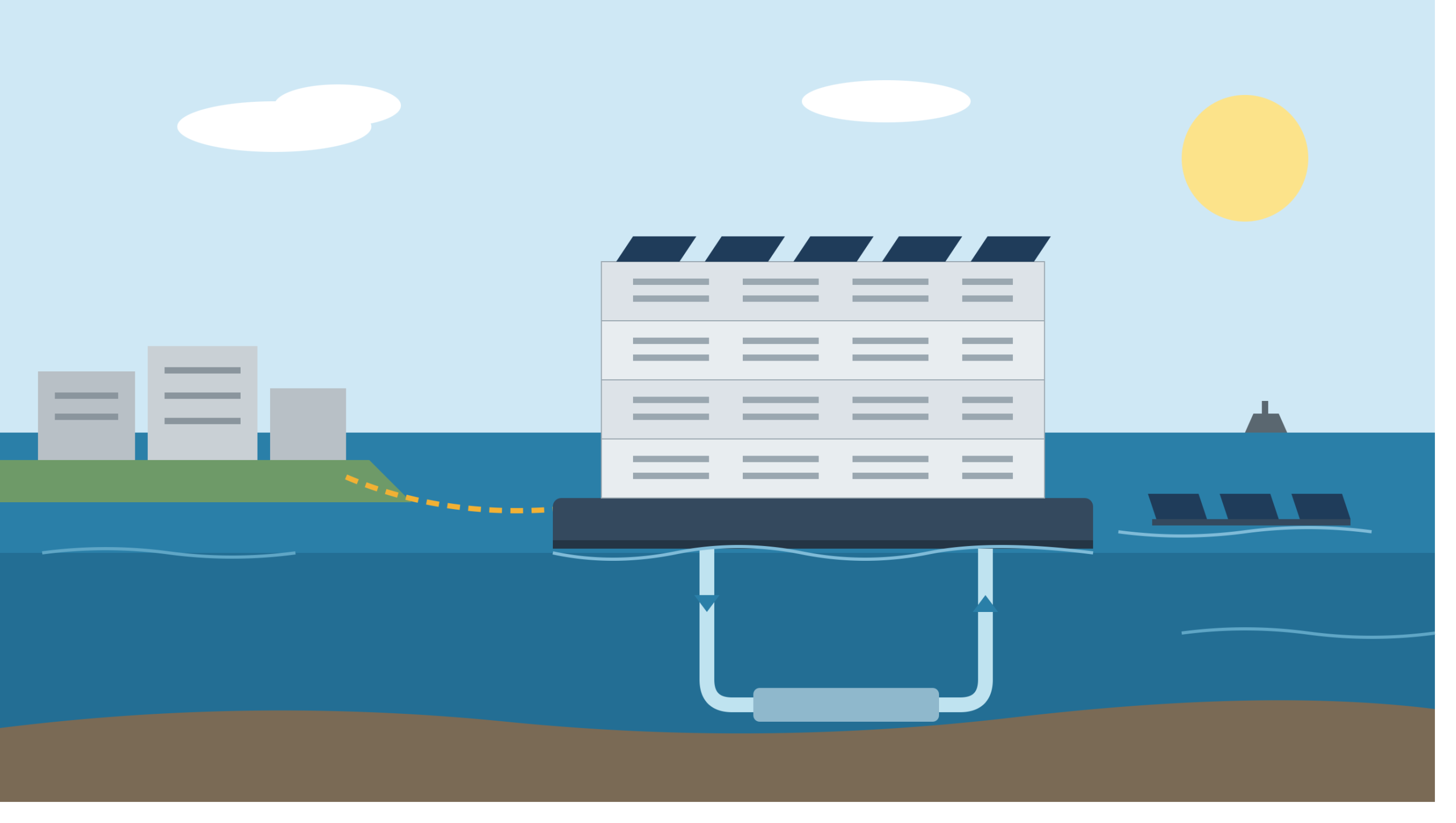
Singapore has too little land, tight limits on new data centre power, and strong demand for capacity. Keppel’s answer is to build offshore, and after several years of concept work the project is now under construction.
Origins
The idea has a long history. Keppel began exploring a floating data centre park in 2019 and secured regulatory approval in 2023. The thinking goes back further. Keppel Data Centres had invested US$10 million in the waterborne data centre startup Nautilus Data Technologies two years before it began scouting nearshore sites for hyperscale facilities. The original concept was a flotilla. Keppel’s CEO described 10-megawatt modules prefabricated onshore and plugged into a floating structure to form a “park”.
From concept to construction
Progress was slow and, for a time, quiet. After the regulatory green light, Keppel said it was negotiating with the site owner, and few updates followed. The loss of its offshore rig-building arm also raised questions about whether the group could still execute such a project. Keppel responded that it retained strong engineering expertise and would work with industry partners.
That uncertainty has now been settled. In its Q1 2026 earnings update, Keppel said construction of the 25 MW project, funded by Keppel Data Centre Fund II, had begun, with completion expected in 2028. The facility will be hosted at 25 Loyang Crescent and is committed to a global hyperscaler. Having an anchor customer secured before completion removes much of the demand risk for a novel asset type. Design and sustainability ambitions
According to Keppel’s June 2025 environmental impact assessment, the facility would be four storeys high, occupying 9,870 sqm of land and 7,580 sqm of sea space in Loyang. The concept has long leaned on seawater for cooling. Keppel has argued that this makes a floating facility considerably more energy efficient than a conventional land-based one. Earlier reporting suggested the proposed seawater district cooling system would be about ten times larger than the largest in the world, and the site is expected to focus on green energy, including potential solar at sea. The modular approach also carries a circular-economy pitch: newer modules can replace older ones, which can then be recycled for use elsewhere.
Power has been a more shifting question. Early plans envisioned onsite generation integrating LNG and possibly hydrogen. That fits Singapore’s energy mix, since about 95 percent of its electricity is generated from natural gas. Keppel also joined a 2021 MoU to explore the supply infrastructure needed to bring liquid hydrogen into Singapore. I couldn’t confirm from the sources I found whether the final 25 MW design retains the LNG and hydrogen elements, so I’d treat those as earlier-stage concepts rather than confirmed specifications.
Why it matters
The project is notable on three fronts. It is a first for Singapore. It also fits the market’s constraint: the reported 25 MW is modest, but in a market where CBRE expects occupancy to stay above 95%, any new capacity with a committed tenant is significant. And it is a test case for a broader idea. Floating data centres have been tried elsewhere, from Nautilus’s 6.5MW barge in Stockton, California, to a pilot planned off Yokohama, but few have reached hyperscale deployment. If Keppel delivers on schedule in 2028, it will show that offshore capacity can be a credible way to ease land and cooling constraints in dense coastal markets.
Open questions
Several things remain to be proven: construction and commissioning risk for a novel structure, the real-world performance of seawater cooling at this scale, and whether the model can be repeated beyond a single 25 MW facility. The original vision was a multi-module park, and the current project is a considerably smaller first step.


One thought on “Keppel’s Floating Data Centre: Singapore Goes to Sea”