
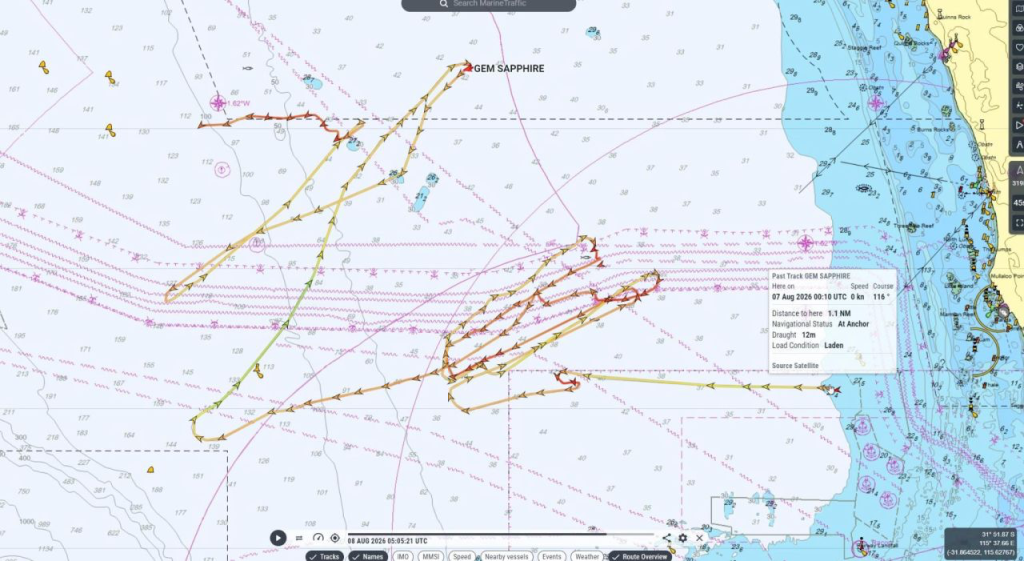
On Sunday 9th August emerged Shunt faults on two systems (Indigo West and Indigo Central) straight after each other and in close proximity to each other. Remarkably this also happened in the Submarine Cable Protection Zone off Perth Australia.
There was also maritime activity from a vessel near that location, coinciding with the timing of the shunts.
This is an alarming development due to the important role submarine fibre cables now play in support of the economy, especially the digital economy. Submarine optical fibre cables are the digital lifeblood of nations.
The first thoughts on this announcement is why is there a cable protection zone required right in the area of the Port of Fremantle shipping areas. It makes no sense to me at least that important submatine cables are connecting to locations adjacent to ports or maritime channels for ships to enter and leave ports.
Australia’s approach to protecting its submarine telecommunications cables rests on a small number of formally declared “protection zones,” each of which happens to sit near a major population centre and its associated port infrastructure — two around Sydney and one around Perth. This overlap between protection zones and port cities raises a natural question: are the zones really a function of proximity to a port, or a function of something else that ports happen to correlate with? And, more fundamentally, do these zones actually work? Examining both questions suggests that the zones are less about ports as such and more about the density of maritime activity that surrounds them, and that while the legal framework is widely admired, the practical enforcement behind it is considerably weaker than the “gold standard” reputation implies.
Australia’s Telecommunications Act 1997 permits the government to declare a protection zone around a submarine cable, within which certain damaging activities are restricted and breaches carry stringent criminal penalties. The Northern Sydney Protection Zone extends about 40 nautical miles offshore from Narrabeen beach to a depth of 2000 metres, while the Southern Sydney zone extends about 30 nautical miles offshore from Tamarama and Maroubra beaches to the same depth, and a comparable zone exists off Perth. Within these areas, activities such as trawling, dredging, scallop dredging, demersal longlining, ocean dumping, and scuttling ships are prohibited, precisely because these are the activities most likely to sever or damage a cable lying on or near the seabed. This detail is telling: the zones are not defined by distance from a port per se, but by the presence of the specific human activities — commercial fishing gear, anchoring, dredging — that threaten cables on the continental shelf. Those activities happen to cluster near major coastal cities because that is where fishing fleets, shipping lanes, and port-adjacent maritime traffic concentrate. In other words, proximity to a port is best understood as a proxy for traffic density rather than the underlying cause of risk.
This distinction matters for answering whether protection zones would be necessary if cables were landed away from major ports. If a cable came ashore in a remote location with little commercial fishing, minimal vessel traffic, and no dredging or port-related seabed disturbance, the hazards that protection zones exist to legislate against would be largely absent, and a dedicated zone would have much less practical work to do. This is broadly consistent with Australia’s own regulatory history: no new protection zones have been established since the original three were declared in 2007, with two in Sydney and one in Perth, even though Australia’s cables also land in less trafficked locations such as the Sunshine Coast and Darwin. The absence of formally declared zones at these secondary landing points suggests that regulators themselves have judged the risk profile there to be different enough not to warrant the same legal apparatus. That said, cables landing in quieter waters are not entirely unprotected — international obligations under the Law of the Sea still criminalise the wilful or negligent damaging of submarine cables wherever they lie — but the additional, more restrictive layer of a mapped and criminally enforced exclusion zone appears to be a response calibrated to high-traffic coastal shelf areas rather than to port proximity as such.
The second question — whether these zones are actually effective — is harder to answer cleanly, and the available evidence points in two different directions depending on what “effective” is taken to mean. On one hand, the legal architecture itself is well regarded internationally. The provisions are considered to effectively mitigate threats to submarine cables from commercial and recreational activity in Australia’s territorial waters, and the regime is considered world-leading, with features such as published cable zone maps, clearly banned activities, and serious criminal offences frequently cited as a model other countries could adopt. Australia was the first country to join the International Cable Protection Committee in 2011, and other countries and industry bodies regard its zones and regulations as the gold standard.
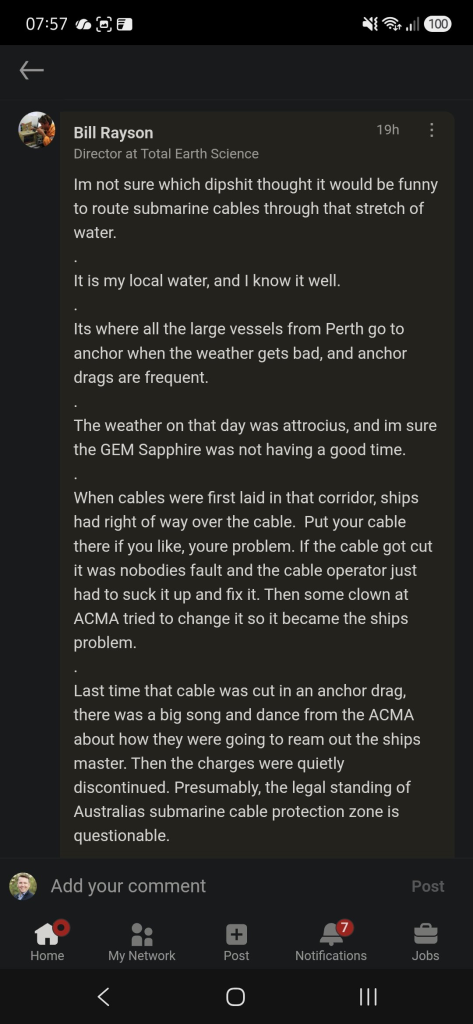
On the other hand, close observers of the policy note that this reputation rests more on the existence of the legal framework than on demonstrated enforcement outcomes. There are no metrics by which to judge the actual efficacy of the protection zones, which makes claims of effectiveness difficult to substantiate one way or the other. More concerning is the enforcement gap: penalties only function as a deterrent if there is a genuine perception that violators will be caught and punished, and this has not been the case in Australia. The Australian Federal Police told a 2010 review of the relevant legislation that their mandate didn’t extend to monitoring the zones and that they weren’t equipped to do so regardless; actual patrolling presumably falls to Maritime Border Command, for whom cable protection is just one of many competing priorities. A 2010 ACMA review recommended determining whether active monitoring of the zones was necessary, but this recommendation was never followed through, leaving a persistent ambiguity about who, if anyone, is actively watching for violations.
What appears to have kept Australia’s cables relatively safe in practice, then, is not primarily active enforcement of the zones but redundancy and self-interest elsewhere in the system. Multiple subsea cables land at dispersed points including Sydney, Perth, the Sunshine Coast, Port Hedland, and Darwin, and cable operators maintain their own business continuity plans, since a severed cable means unhappy customers and reputational damage regardless of what protections are legally in place.
Taken together, this suggests a nuanced conclusion. Protection zones are best understood as a targeted response to areas of concentrated maritime risk rather than to port proximity itself, which means they would likely be unnecessary, or at least far less elaborate, for cables landing in quieter, low-traffic locations. And while Australia’s legal framework for protecting cables is genuinely innovative and internationally influential, its practical effectiveness is largely untested and possibly overstated: the deterrent value of criminal penalties depends on credible enforcement that, by the regulator’s own historical admissions, has not been reliably provided. The resilience Australia has enjoyed so far appears to owe as much to network redundancy and industry self-interest as to the protection zones themselves.
Should we now reconsider in Australia how we approve the delivery of cable systems into martime trade locations instead adopting a new method of not within 30-40 kms of a major maritime port?
Why does Australia always mess these things up?
Laying cables through a port area in Perth is not smart and yet we try and blame the ship.
Does seem to be a stupid idea and when you look at events this year 3 cable cuts or damages in the perth area according to chatgpt.