
Australian start-up WinDC has partnered with US-based infrastructure provider Armada to deploy modular, portable data centres at renewable energy sites, as part of a strategy to use curtailed generation to support AI workloads. The companies said the partnership will see the rollout of 11MW of modular AI infrastructure across renewable energy locations in New South Wales and other parts of the National Electricity Market, as well as Western Australia. The first unit has already been delivered to Australia.
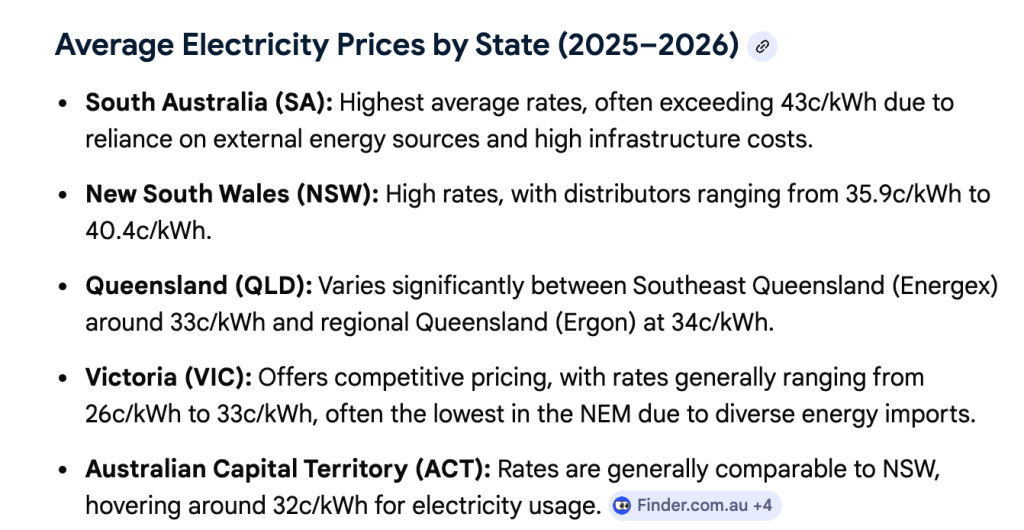
New South Wales has the highest power rates nationally an average of 40 cents per Kwh. Why would you decide to develop market offerings in the highest priced state in Australia?
A better solution would have been to install these around SA and QLD renewable energy developments.
Separately, WinDC is seeking to raise AUD 176 million in a Series A funding round, according to reporting by Australian Financial Review, as it looks to finance its initial deployments and scale its modular data centre model.
The partnership centres on deploying shipping container-sized data centre units directly at wind, solar, and battery sites, allowing compute infrastructure to operate using energy that would otherwise be curtailed due to grid constraints. WinDC claimed Australia curtailed 7.2TWh of renewable energy in 2025, up from 4.5TWh the previous year, with the figure forecast to exceed 10TWh in 2026 as transmission capacity struggles to keep pace with generation growth.
This is not new with listed DXN already doing this across the world and Australia. There are a few data centre builders in regional areas who are already in the market and have access to renewable energy.
Vertiv also have a platform they are installing across national fibre network deployments, so I am struggling to understand what the unique value is for this project and company?
Rather than relying on new transmission infrastructure to move electricity to urban data centre hubs, the WinDC-Armada model places compute capacity at the point of generation, effectively converting excess energy into digital workloads.
This is where the value lies but not in NSW where it is very expensive to run any data centre developments and power usage.
“Australia has the wind, the sun, and the land to be a genuine force in global AI infrastructure. What has been holding us back is the grid,” said Andrew Sjoquist, founder and CEO of WinDC. Under the agreement, Armada will design and manufacture the modular units, which are currently produced in the US and Europe. The companies said they plan to explore local manufacturing in Australia once sufficient deployment scale is reached.
Nothing to see here!