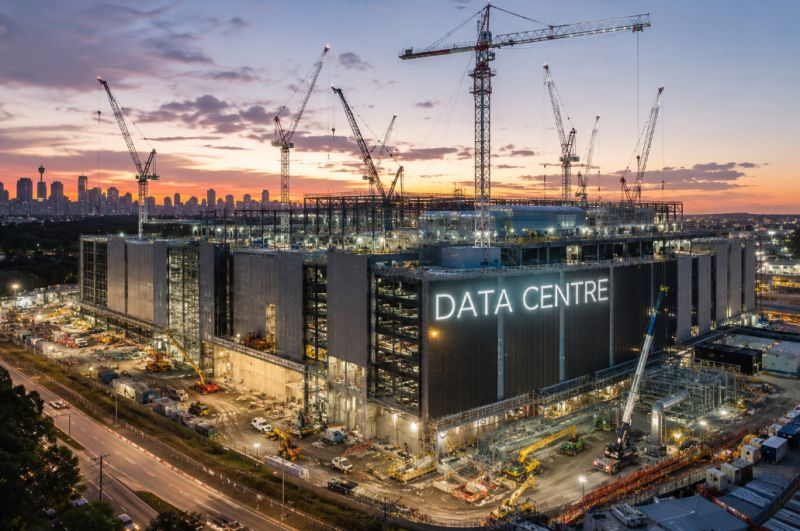
NEXTDC has quietly added to its Lovely Banks holding outside Geelong. Two further parcels totalling 38 hectares, bought for around $67 million, have been added to the 169 hectares the company acquired in June for $165 million. On paper it’s a modest top-up. In context, it’s anything but.
The timing is what stands out. In October, NEXTDC cut its capital expenditure by A$750 million and put new land acquisitions and development projects on hold for the foreseeable future. That followed a sharp downgrade to FY2027 earnings guidance after power infrastructure delays at its M3 Melbourne campus.
The company has since said it is pausing projects that aren’t backed by customer contracts and reviewing land it doesn’t need in the short term. Yet these two transactions settled at the end of October. The likeliest reading is that they were contracted before the pause. Even so, it suggests that Lovely Banks sits in a different category from the rest of the land bank.
Why? Power. The site draws NextDC because the transmission line running past it can supply a hyperscale load. It’s close to major transmission infrastructure and the Moorabool Terminal Station. In an Australian market where grid connection, not land, is the binding constraint, secured proximity to high-voltage capacity is the scarce asset. Land is the cheap part.
For Australia and Victoria, the bigger point is that Geelong is emerging as a serious national location for AI-era infrastructure. HyperDC has announced a 350MW investment west of Lovely Banks, and ByteDance is reportedly looking at Geelong or the Latrobe Valley for a $15 billion build.
Geelong also has power infrastructure, proximity to Melbourne and connection to subsea cable routes. That last point deserves more attention. Hyperscale and AI workloads are only as valuable as the connectivity that feeds them, and diverse, resilient fibre and landing-station capacity into the Victorian west will be a defining enabler of whatever gets built.
Telecommunications capacity into Geelong is the other half of the equation, and it is arriving from more than one direction. Inligo’s Unite Cable System is the low latency high capacity terrestrial backbone linking Darwin, Adelaide, Melbourne, Sydney and Canberra, and Geelong is built into its design. Stage 1A includes the Ballarat to Geelong and Geelong to Melbourne links. Unite already in build is expected to connect Geelong in 2027.
On the subsea side, SUBCO’s SMAP system adds a second, independent source of capacity (although not as direct and high latency). It is a 400 terabit-per-second system with two cable landing points at Torquay, near to Geelong’s growing tech sector, backed by more than $500 million of SUBCO investment. As data centre developments move more to the regions subsea systems like SMAP will depend more heavily on third party terrestrial networks to access the $billion investments in regional Australia.
For a hyperscale or AI campus, that combination of terrestrial and subsea routes is what turns land and a transmission line into an investable site. Power gets a project approved, but diverse, high-capacity telecommunications connectivity is what makes it commercially viable.
Zoom out, and Geelong is a symptom of something bigger: Victoria is now setting the pace for data centre investment nationally. Melbourne has overtaken Sydney in total forecast data centre capacity, with the national pipeline reaching 26.8GW, up 5.2GW in six months. Deloitte Access Economics puts New South Wales and Victoria at 71% of all data centre investment, and describes Victoria’s dominance as particularly stark.
The industry’s own analysts link this growth to the state government’s positive efforts to attract investment. That effort includes a $5.5 million Sustainable Data Centre Action Plan, designed to unlock up to $25 billion in private investment. It pairs new energy, water and land-use obligations with a single Investment Front Door and coordinated regulator input.
Leadership in this sector will ultimately be judged on delivery, not announcements, and the test is whether power, planning and community licence keep pace with the capital. If Victoria gets that right, sites like Lovely Banks and wider Geelong won’t be a land-use controversy. They’ll be the foundation of the state’s next economic chapter not only for Victoria but for Australia.

The current government under the LP have really done a fantastic job at attracting Data Centre development to the state and this latest investment in the Geelong area is significant. Not sure of the size but if you add the current developments then the amount of planned capacity in Geelong is more than Singapore has. Data Centres are the future jobs, imagine the number of construction jobs required to build this and the number of jobs to maintain and operate. Linked the Deakin University high tech programmes for train would be possible creating work for those who live in geelong.
Fantastic and very well done.