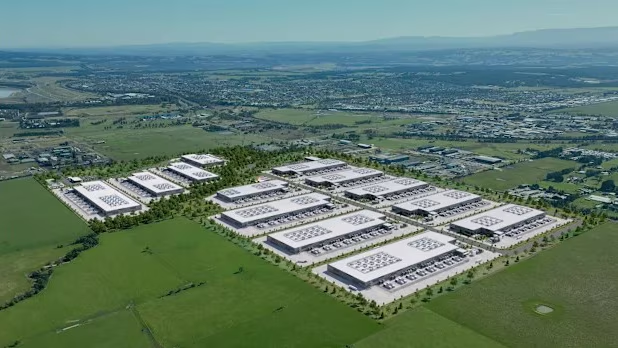
Melbourne has quietly become one of the standout stories in the entire Asia-Pacific data centre market, and the numbers back up the hype. CBRE’s most recent regional analysis found Melbourne posted 37% year-on-year growth in live data centre capacity in 2025 — the second-fastest growth rate of any market in the region, behind only Malaysia’s Johor, and well ahead of established hubs like Singapore and Hong Kong, which grew just 6-8% over the same period. CBRE described the region as undergoing “a significant reordering,” naming Australia alongside India as a lead driver of that shift.
Equinix’s Global Interconnection Index goes further still, naming Melbourne the fastest-growing edge metro in the world— interconnection bandwidth growing at a 45% compound annual rate to reach a projected 102 terabits per second by 2026, up from 35 Tbps in 2023.
The scale being built reflects this momentum. Knight Frank’s latest Asia-Pacific Data Centre report puts Melbourne’s live IT capacity at 337.1MW, up 25.4% year-on-year, backed by a committed-and-under-construction pipeline of 934.8MW and roughly $13 billion in investment. AI workloads made up 95% of all new capacity transacted in Melbourne in the first half of 2025, and the city now hosts dedicated cloud regions from all four major US hyperscalers.
Melbourne’s connectivity backbone is expanding in step with the compute. Inligo Networks, Australian-owned with its Australian headquarters in Melbourne’s CBD, is rolling out the Unite Cable System to link Melbourne with Sydney, Adelaide, Darwin and Canberra, while also connecting into Australia’s main subsea cable gateways at Darwin, Sydney and Melbourne — stitching the country’s AI hubs into one high-capacity network rather than isolated pockets. Melbourne headquartered Telstra, is building a parallel intercity dark fibre link, the Aura Network, connecting Melbourne, Canberra, Sydney and Perth to serve the same east-coast AI hub cluster. Together, this gives Melbourne’s compute buildout a genuine low-latency backbone to the rest of the country rather than operating as a standalone cluster.
The committed project pipeline underlines where this is heading. NextDC has disclosed 1,200 megawatts of planned capacity for its M5 site alone, alongside its M4 Fishermans Bend campus. Keppel has advanced a $10 billion, 720-megawatt campus near the former Hazelwood power station. Nvidia’s partnership with Firmus Technologies on Project Southgate is valued at $2.9 billion, with its Melbourne phase alone worth $4.5 billion. Syncline Energy is building a 2.4-gigawatt precinct at Plumpton, and NextDC’s $165 million Lovely Banks acquisition signals a serious push into the Geelong corridor too.
Growth rates, land availability, power access, hyperscaler commitment, and now dedicated fibre connectivity all point the same way: more data centres, at greater scale, are coming to Melbourne and Victoria over the next five years than almost anywhere else in the region.