It has been almost a week since the devastating blaze adjacent to Glasgow Central Station forced the indefinite closure of Scotland’s busiest rail hub. Passenger services have been cancelled, diverted, or curtailed across the network. Freight has escaped the worst of the disruption – Britain has all but abandoned parcels and light logistics by rail. RailFreight.com UK Editor Simon Walton argues that this episode is a wake-up call for the country at large.
The disruption wrought by the Glasgow fire illustrates something fundamental about modern railways. When trains stop running, the instinctive assumption is that the railway must somehow be at fault. In reality, rail transport is frequently disrupted by events entirely beyond its control. Fires, floods, collapsing walls, and other “railway adjacent” incidents often prove just as disruptive as signalling failures or engineering overruns.
When the railway becomes the victim
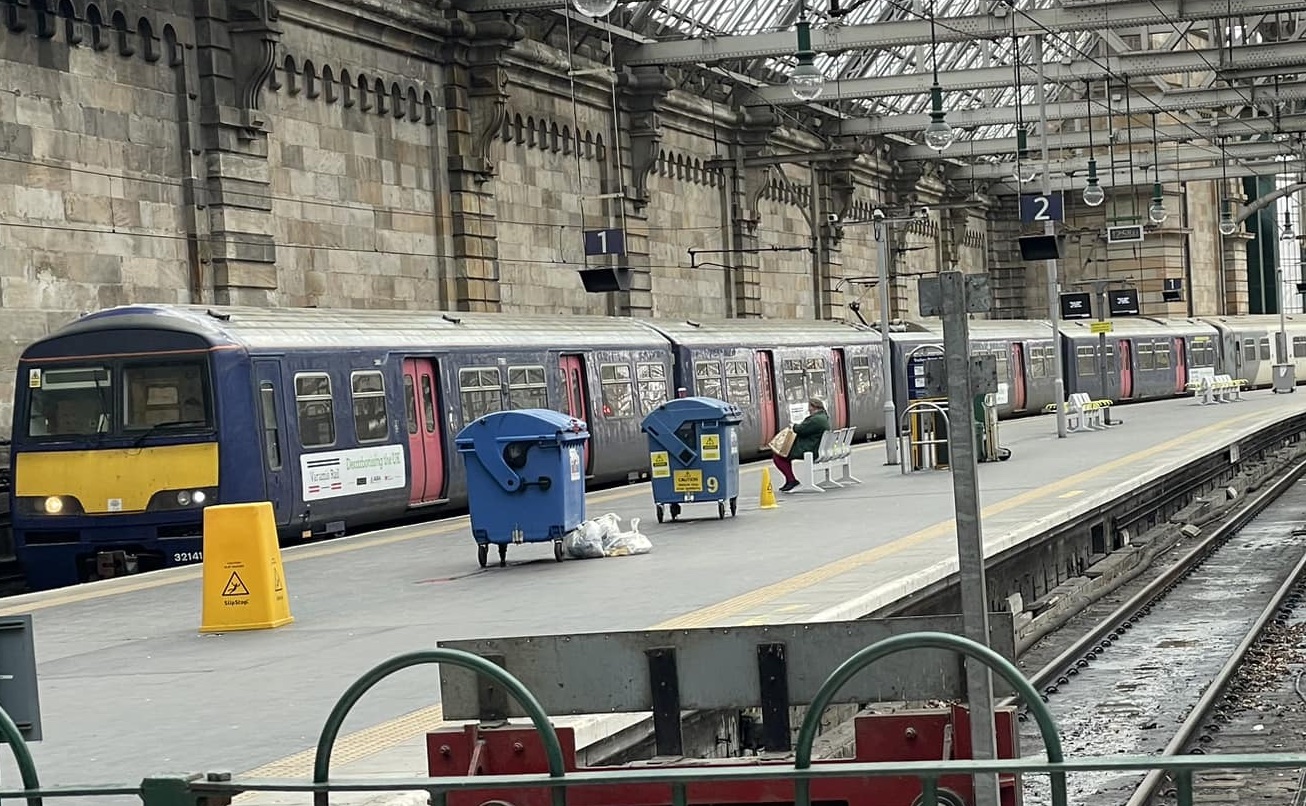
It wasn’t so long ago that trials by the express freight operator Varamis Rail showed that light logistics could once again find a home in Scotland’s busiest passenger station. One of its trains rolled into platform one – ironically, the tracks nearest to the inferno on the other side of the retaining wall. National infrastructure agency, Network Rail has already explored the potential for logistics operations at major stations, including Glasgow Central. Had those ambitions already been realised, the disruption caused by Sunday’s fire might have been far more consequential for freight.
Indirectly, the economic consequences are equally stark. “Clearly, businesses that are caught inside an exclusion zone will struggle to trade,” warned Stuart Patrick of the Glasgow Chamber of Commerce. “I don’t think we can underestimate just how important Central Station is as a transport hub across the whole of Scotland. I’ve heard some suggest many days or indeed even weeks.” However long the disruption lasts, responsibility clearly does not lie with the railway itself. Yet public perception often assumes otherwise. Trains are expected to run regardless of circumstance. Other industries tend to receive greater understanding when events beyond their control bring normal operations to a halt.
Impedance beyond the railway boundary
History offers plenty of examples where disruption originates outside railway infrastructure. In January 2021, Storm Christoph triggered widespread flooding that disrupted rail-delivered biomass supplies to Drax Power Station, highlighting how weather events can ripple through national logistics chains. Other incidents have been even more literal intrusions onto the railway. The partial collapse of a retaining wall onto the approach lines to Liverpool Lime Street railway station halted services at one of Britain’s busiest city terminals. What appeared at first glance to be a railway problem turned out to be an infrastructure failure entirely outside railway control. A trader had disregarded warnings about loading containers against a boundary wall and, well, you can guess the headlines.

Elsewhere, a major industrial blaze blocked routes out of Bradford when a tyre recycling plant caught fire beside the line. Flames and the particularly acrid smoke halted services for hours while emergency crews battled the blaze. The railway simply became collateral damage in a wider urban emergency. Such events underline a simple truth. Railways operate within complex landscapes of cities, industry, and infrastructure – often in much closer proximity to industry than other forms of transport. When those surroundings fail, burn, flood, or collapse, the railway inevitably becomes an unintended casualty.
Fire, tech and the risks of modern logistics
Glasgow itself has long carried the nickname “Tinderbox City”. Fires have periodically scarred Scotland’s largest urban settlement, although the railway network has largely escaped major damage. One exception was the destruction of Botanic Gardens railway station in 1970, a curious footnote in railway history, and no casualties – helped by the fact that the station had already been closed for more than three decades.
Fire has always been an enemy of the railway. In the days of steam traction, lineside fires were an almost routine hazard. Diesel and electric traction reduced that risk dramatically, although the threat has never entirely disappeared. Fire, though, has been at the seat of some of the most tragic disasters in modern British history. The inferno at Bradford Football Club’s Valley Parade stadium in 1985 remains a horrific national memory. Two years later, the blaze at King’s Cross Underground station killed thirty-one people and forced sweeping changes in safety culture across the transport industry.
Both events ultimately led to profound reforms. The hope now is that the Glasgow blaze, mercifully not deadly but hugely disruptive, might prompt similar reflection about the risks present in the modern urban environment. Questions are already circulating about the possible origins of the fire that destroyed the Union Corner building beside the station concourse. Social media footage has drawn attention to a vape shop within the premises, although investigators have yet to determine any definitive cause.
Lithium-ion batteries, however, are already attracting scrutiny across multiple industries. These compact power sources now sit inside everything from smartphones to electric scooters and vehicles. They are efficient and powerful, but they can also burn fiercely if damaged or overheated.
The wake-up call is loud
Transport operators around the world have had to confront this reality. Railways along the China–Europe Silk Road corridors once restricted the carriage of electric vehicles because lithium batteries were classified as dangerous goods. Those rules have gradually eased, but only under strict conditions governing battery charge levels, documentation, and vehicle preparation.

Shipping has faced similar anxieties. Fires aboard specialist car carriers such as the Felicity Ace, the Morning Midas and the Fremantle Highway have drawn global attention. Investigators have not conclusively proven that electric vehicles started those fires, but the presence of lithium-ion batteries can make such blazes far harder to extinguish once they begin. Two of those ships were sunk. Back in Glasgow, Central Station is not going to sink into the Clyde. However, the debate is already shifting towards regulation. Some voices are calling for tighter controls on high street vape retailers, whose products rely on precisely the same battery technology now under scrutiny in transport logistics.
There’s a coincidental anniversary. This week marks the 150th anniversary of the invention of the telephone system by Edinburgh-born Alexander Graham Bell. It was a communication breakthrough that transformed commerce and railways alike. It also, quite literally, helped raise the alarm when the fire began in Glasgow last weekend. Scotland has often led the world in technological innovation. If the aftermath of this disruptive fire results in safer regulation of modern battery technology, the country may once again find itself shaping global standards. Perhaps the wider lesson of Glasgow Central will also be remembered. When trains stop running, the railway is not always to blame. Sometimes the disruption arrives from somewhere entirely outside the tracks.