On International Bystander Awareness Day (Thursday 13 March), Transport for London (TfL) will harness the power of virtual reality to give people the skills and confidence to support fellow passengers who are being targeted by all forms of abuse and harassment on the network.
TfL continues to act against hate crime and sexual offences and harassment, with thousands of transport staff, police and TfL enforcement officers working across the network to stamp out these incidents.
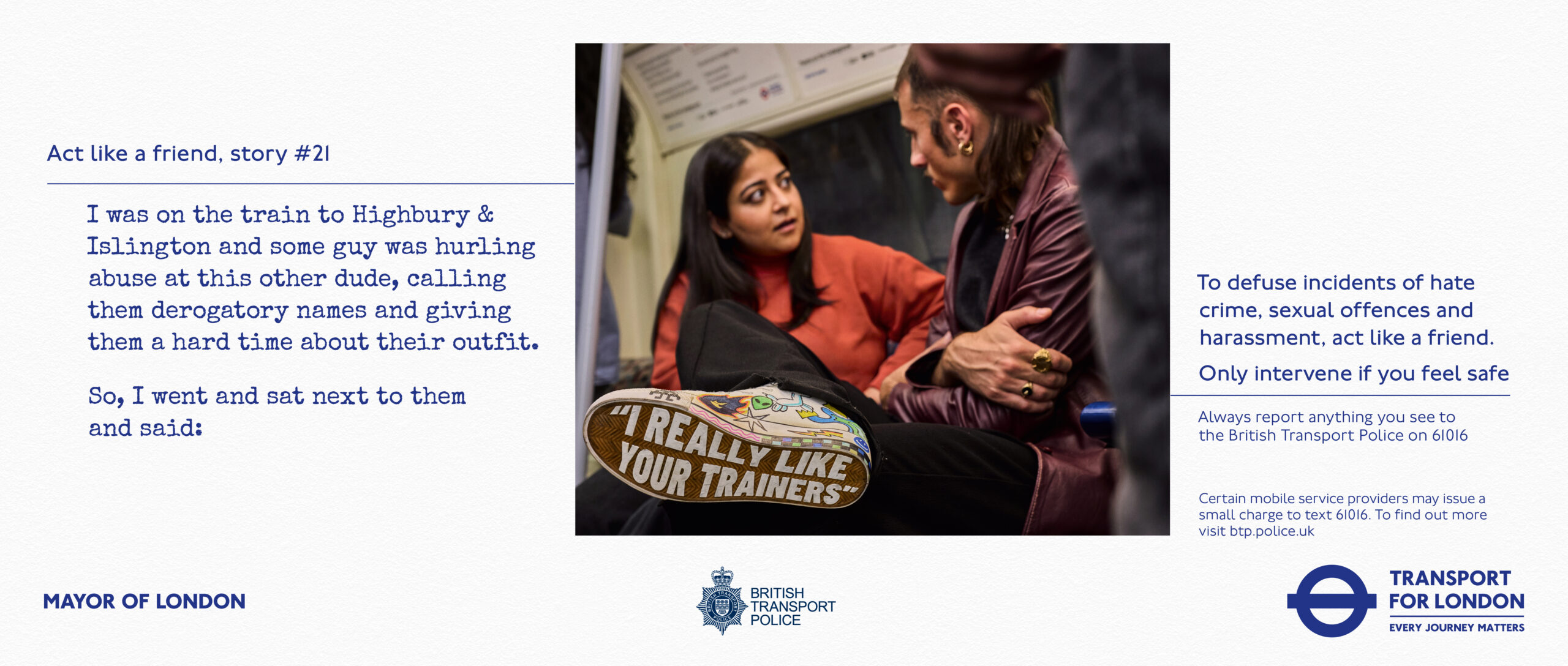
To mark International Bystander Awareness Day this year, awareness events will be held at Victoria station and Stratford bus station with representatives from TfL, British Transport Police (BTP), and the Metropolitan Police Service (MPS). Virtual reality headsets will show a situation with a TfL customer being targeted by abuse, with the public learning to be an ‘active bystander’ and act like a friend to the victim by striking up conversation or checking in with them after the incident and helping them to report it.
People will also have the opportunity to find out more about how TfL works with its police partners to help keep Londoners safe, and how to report an incident. TfL continues to encourage people to report incidents, as every report helps build up a picture that can help convict the people responsible and informs TfL’s intelligence-led policing operations.
TfL previously helped to fund bystander awareness training sessions for the public with the charity Protection Approaches, and launched a campaign in the autumn encouraging people to ‘act like a friend’ to those they see being targeted.
Deputy Mayor for Transport, Seb Dance, said: “Ensuring Londoners’ safety is the Mayor’s number one priority, and tackling hate crime and abuse on our transport network is central to this mission.”
“We all have a role to play in stamping out hate crime and supporting victims, which is why I encourage all Londoners to take part in these awareness events and learn how to safely intervene and provide support. Together, we can build a safer, fairer London for everyone.”
Siwan Hayward, director of Security, Policing and Enforcement at Transport for London, commented: “When we see another passenger being targeted by abuse on a bus or train, or in a station, it can be hard to work out in that moment what to do for the best, both for the victim and ourselves.
“Being an active bystander isn’t about confronting the perpetrator – it’s about distraction and helping the targeted person, if that feels safe, and these virtual reality headsets are a great way to explore how to do that in case we ever encounter a real-life situation.”
In October, during National Hate Crime Awareness Week, TfL launched a new campaign, including in cinemas and on ITVX, encouraging people to ‘act like a friend’ towards those who experience hate crime and sexual offences and harassment on the London transport network. A complementary campaign also launched to target perpetrators, with hard-hitting messaging focussing on the consequences of committing crime on the TfL network and how perpetrators are likely to be caught.
TfL is ensuring that staff are trained to respond to and support customers. All London Underground customer-facing staff, TfL enforcement officers, bus operations, river services, and Cable Car staff have received sexual harassment training. Equality, Diversity and Inclusion training is also being delivered to 25,000 bus drivers, covering how to spot harassment, offer assistance, and report incidents.
Last October, as part of the Mayor’s commitment to improving safety and confidence, TfL launched a new taskforce in partnership with the BTP, MPS, and operators to tackle hate crime, sexual offences, and harassment across London’s public transport network. Its priorities include reducing hate crime and violence against women and girls, improving reporting and public confidence, and sharing best practice and co-creating evidence-based interventions.
TfL has also worked with the Mayor’s Office for Policing and Crime (MOPAC) to complete women’s safety audits across five London boroughs, including cycling routes. These audits capture the experiences of women, girls, and gender-diverse people to inform how spaces are planned and managed. The findings of the audits are currently being reviewed to help inform future design and planning.
Last year the Mayor of London, Sadiq Khan, announced a further £875,000 for 21 grassroots projects to fight hate crime, intolerance and extremism in all its forms in the capital as part of his Shared Endeavour Fund. This is part of the Mayor’s record £16m in funding to tackle hate crime and has so far helped 190,000 Londoners across every borough to recognise and critically assess intolerant, hateful and extremist messages and empower them to safely challenge these narratives.
Image credit: TFL