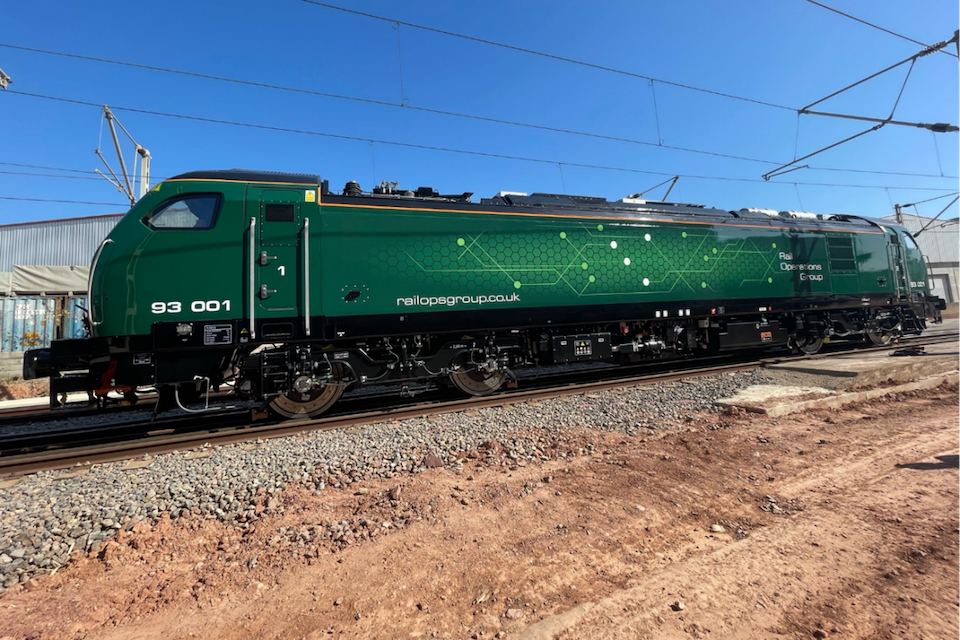
Rail freight operator DB Cargo UK has successfully trialled a tri-mode locomotive on an intermodal service linking Peel Ports Liverpool with an independently operated terminal in Central Scotland. The Stadler Class 93 hauled a revenue-earning container train from Royal Seaforth Dock on Merseyside to Mossend at Bellshill, near Glasgow, demonstrating the locomotive’s flexibility across electrified, diesel, and battery power. The trial highlights the growing role of intermodal rail in connecting UK ports with inland logistics hubs and supporting the economy’s import-export flows.
The trial working was supported by a non-running Class 66 diesel locomotive and conducted in collaboration with the locomotive owners, Rail Operations Group (ROG), and the national infrastructure agency, Network Rail. DB Cargo used unit 93006 to operate the Peel Ports round-trip service on Tuesday 10 February, part of ongoing fleet trials designed to explore future motive power options and enhance operational efficiency for containerised freight.
Intermodal growth at Seaforth and Mossend
Seaforth terminal has seen significant intermodal expansion in recent years, reflecting the UK’s broader government-backed efforts to shift freight from road to rail (an ambition that still has a significant journey to undertake). The Port of Liverpool has invested in new infrastructure and handling capacity to accommodate longer, heavier trains, improving connectivity for international container flows. Meanwhile, Mossend is undergoing a major transformation to become Mossend Intermodal Railfreight Park, a national hub designed to link Scotland’s most populous and industrialised heartlands with deep-sea port services, supporting both domestic and cross-border logistics chains.

“The trial of the Class 93 was conducted as part of our review of future fleet investment, and we were impressed with its performance,” said Mark Sargant, DB Cargo UK Head of Operations. “We also invited representatives from the train driver union ASLEF to evaluate the locomotive’s handling on real network conditions.”
Performance on demanding gradients
The Liverpool departure involves negotiating a steeply graded tunnel under the suburbs of Bootle and Walton before joining the West Coast Main Line, Europe’s busiest mixed traffic route and the spine of rail freight operations for much of the UK. Fully laden intermodal containers proved no obstacle for the Class 93, which handled a consist of around 1,500 tonnes with strong acceleration and successful standing starts. Brian Ferguson, ROG General Manager, noted: “Each successful run reinforces confidence in what is a truly versatile locomotive for the modern railway, capable of supporting heavier and longer intermodal services that are increasingly critical to the UK economy.”
From its factory in Valencia, Spain, Stadler has supplied ten units to Rail Operations Group, with further options available. The Class 93 builds on the design of the successful Class 68 diesel and Class 88 electro-diesel, combining three power sources in a single locomotive to overcome the challenges of partially electrified networks, as is indicative of the UK.
Tri-mode capability for flexible freight
“Further trials are planned over the coming months as we continue to strengthen our partnership with DB Cargo UK,” said ROG’s Ferguson. Across Great Britain (there is no rail freight in Northern Ireland), the sector is still dominated by Class 66 diesels, a 1980s design from North American manufacturer EMD. However, European-built tri-mode locomotives offer new possibilities for efficient, low-carbon operations, particularly on non-electrified ‘last mile’ lines into terminals such as Seaforth.
For a combination of pulling power and speed, the Class 93 can operate in four traction modes: pure electric from 25kV AC overhead lines, diesel, battery, or hybrid diesel-battery. Twin Lithium Titanate Oxide (LTO) battery packs provide up to 600kW of boost power and enable carbon-free battery-only operation without reducing tractive effort. A Stage V-compliant Caterpillar 900kW diesel engine ensures flexibility across non-electrified routes, terminal yards, and also provides useful availability for diversions.