There is a much longer history behind the current concern about submarine cables off Perth than might first appear.
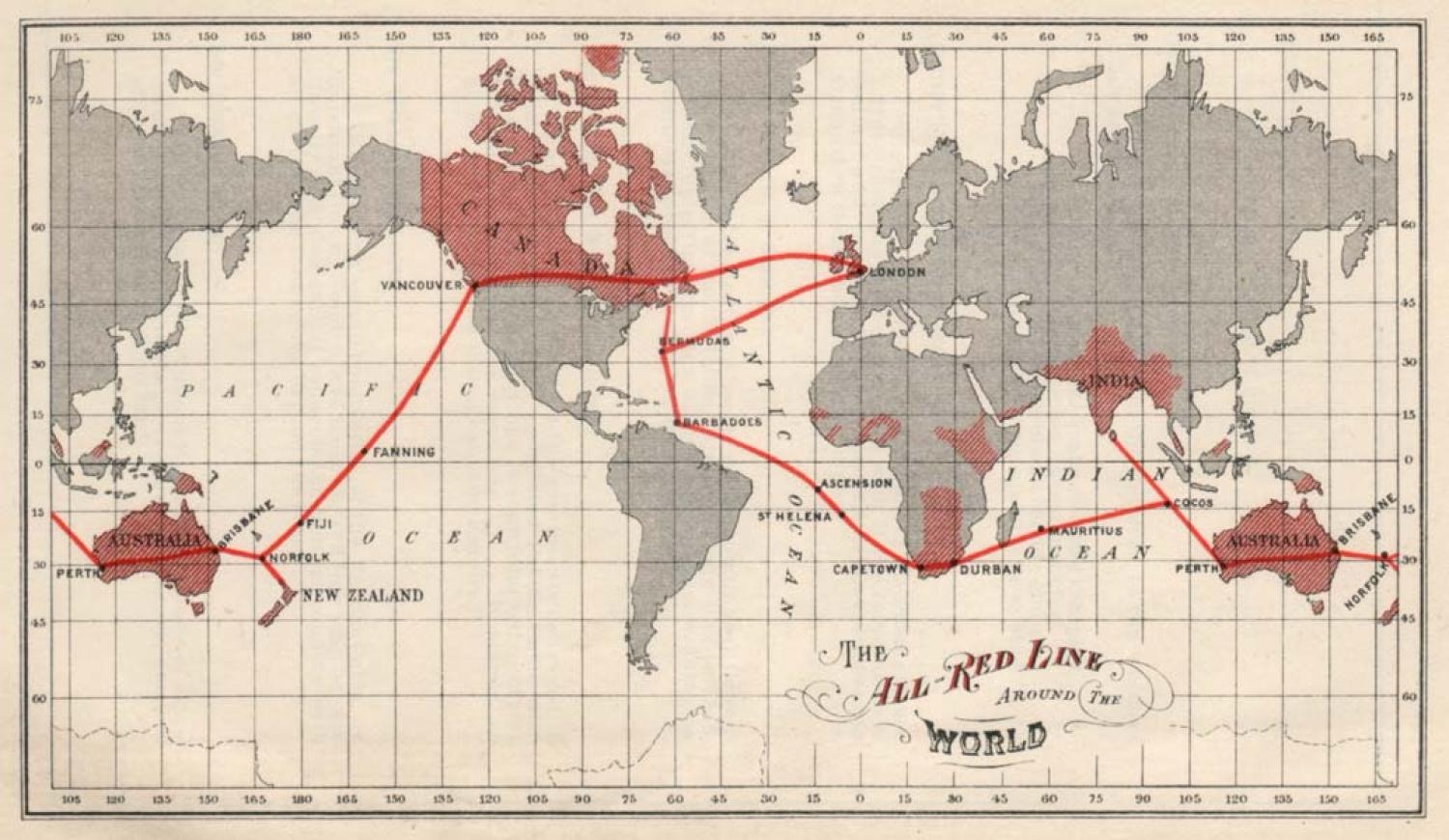
Australia’s dependence on submarine communications cables is not new. The original international telegraph network reached Australia in the early 1870s, when the Darwin–Java submarine cable was connected with the Overland Telegraph Line. Western Australia itself had already embraced telegraphy, with the Perth–Fremantle line opening in 1869, followed by the expansion of the network across the colony.
By 1877 the east–west telegraph connection linked Western Australia with the eastern colonies and ultimately the international network. In other words, Australia’s strategic dependence on cables goes back more than 150 years.
What has changed is the scale of what those cables carry. Today’s submarine fibre-optic systems are effectively the digital arteries of Australia. The Australian Navy’s Sea Power Centre has previously warned that Australia’s military, government, commercial and private communications rely overwhelmingly on submarine cables, with satellites unable to provide an equivalent substitute for the enormous volume of data involved.
The recent damage to Indigo West and Indigo Central is therefore particularly concerning because both cables reportedly suffered faults within a short period of one another and in close proximity, inside the Perth Submarine Cable Protection Zone. There was also reported vessel activity in the vicinity at around the relevant time. The owner, SUBCO, referred the matter to the Australian Federal Police, and the AFP has confirmed that it received a report of crime and is assessing it.
However, it is important not to jump from “suspicious circumstances” to “sabotage”. At present there has been no public finding that the August 2026 damage was deliberate, no publicly identified perpetrator, and no conviction. The investigation needs to establish whether this was an accident, negligence, deliberate interference, or something more serious.
There is also a very relevant precedent.
In August 2021, the Australia–Singapore Cable was damaged off Perth after the container ship Maersk Surabaya allegedly dragged its anchor through the protection zone. The AFP charged the ship’s master over the incident. However, the Commonwealth Director of Public Prosecutions subsequently discontinued the prosecution in December 2022. So, while there was an Australian prosecution for cable damage, there was no conviction in that case.
That history is important because it demonstrates that the threat does not necessarily require a hostile state or sophisticated sabotage operation. A large commercial vessel, an anchor, bad weather and the wrong combination of circumstances can be enough to cause millions of dollars of damage.
The bigger question raised by the VibeWire article is therefore a good one: are we putting critical infrastructure in locations where the risks are unnecessarily concentrated?
The Perth Protection Zone extends about 112 kilometres offshore and covers the cables to a depth of 2,000 metres. It prohibits or restricts activities such as certain types of trawling and other seabed operations.
But a protection zone is fundamentally a legal protection, not an invisible force field around a cable. It does not physically prevent an anchor, fishing gear or a deliberate act from reaching the seabed.
And there is another issue that deserves much more attention: redundancy is only useful if the cables actually have geographical separation.
If two supposedly independent international cables use the same approach corridor into Perth, one incident can potentially compromise more than one system. That reduces the value of having multiple cables in the first place. The recent Indigo West/Indigo Central incident is a timely warning about this.
Looking forward, Australia should be thinking about cable security in several layers:
- Greater geographical diversity: new international cables should not automatically follow the same landing and offshore corridors simply because those routes are convenient.
- More cable routes: Australia needs redundancy between different landing points, not merely multiple cables running beside one another.
- Better monitoring: AIS information, satellite surveillance, radar, seabed sensors and other technologies should be combined to identify vessels behaving unusually around protected infrastructure.
- Faster investigation: when a cable fails, authorities need to be able to determine quickly which vessels were nearby, what they were doing and whether their movements were consistent with an accident.
- A stronger repair capability: Australia should have assured access to cable-repair vessels, spare cable and specialist equipment rather than relying heavily on overseas resources.
- Clear government responsibility: there should be no uncertainty about which agency takes charge when a critical submarine cable is damaged or suspected of being deliberately attacked.
- International cooperation: cable protection cannot be treated solely as a domestic telecommunications issue. These are strategic assets connecting Australia to Singapore, Indonesia and the wider global network.
The historical lesson is actually quite simple. Australia’s leaders in the nineteenth century understood that communications infrastructure was strategically important because whoever controlled the communications network had enormous economic and political advantages. The technology has changed from Morse code to fibre optics, but the strategic principle has not.
The Perth cable incidents should therefore not simply be treated as another telecommunications fault. Nor should we immediately label them an act of foreign sabotage without evidence.
Instead, they should be treated as a warning.
If a single anchor can damage critical infrastructure carrying Australia’s international communications, and if two supposedly separate systems can be affected in the same general area, then the question is no longer simply “Who damaged the cables?”
The more important question is:
Why have we allowed so much of Australia’s digital connection to the outside world to become vulnerable at the same physical points — and what are we going to do about it before the next incident?
That is the strategic issue Australia needs to address now.
Indigo’s cable have been laid into a port area where outages can be expected on a semi regular basis. No cables should be laid into Perth in that area. We can also see Darwin being a better solution to Asia than Perth as it is shorter.
We are hoping the cables being connected into Darwin will be delivered as this represents the best opportunity for Australia connecting with Asia.