Bombs are still falling in Iran. Unsurprisingly, transport along the International North-South Transport Corridor is severely impeded by the ongoing conflict. That is to the detriment of Russian exporters, who cannot find an all-encompassing replacement for the trade routes crossing Iran.
Some Russian companies have quit the INSTC altogether, whereas others are reportedly still trying to make it work, albeit with much difficulty. The ongoing attempts to use the INSTC are likely motivated by limitations on other corridors. Russian media report that alternative routes can only absorb 70% of the freight that typically moves along the INSTC.
Moreover, the costs associated with transportation on other corridors is 20-30% higher. Lead times to India and Iran could be twice as long, up to 60 days. This hurts the profitability of grain, metals and chemical exports, according to Russian media. The total financial damage of a pause in INSTC operations could be around 40-60 million US dollars monthly for Russian logistics companies.
The total turnover of freight on the Russia-INSTC route could fall by as much as 25% this year, a Russian analyst claims, depending on the length of the conflict.
The INSTC
The INSTC connects Russia to the Indian Ocean via three branches: a western branch through Azerbaijan, a central route across the Caspian Sea, and an eastern one through Kazakhstan and Turkmenistan. All three branches cross Iran before reaching Indian Ocean ports.
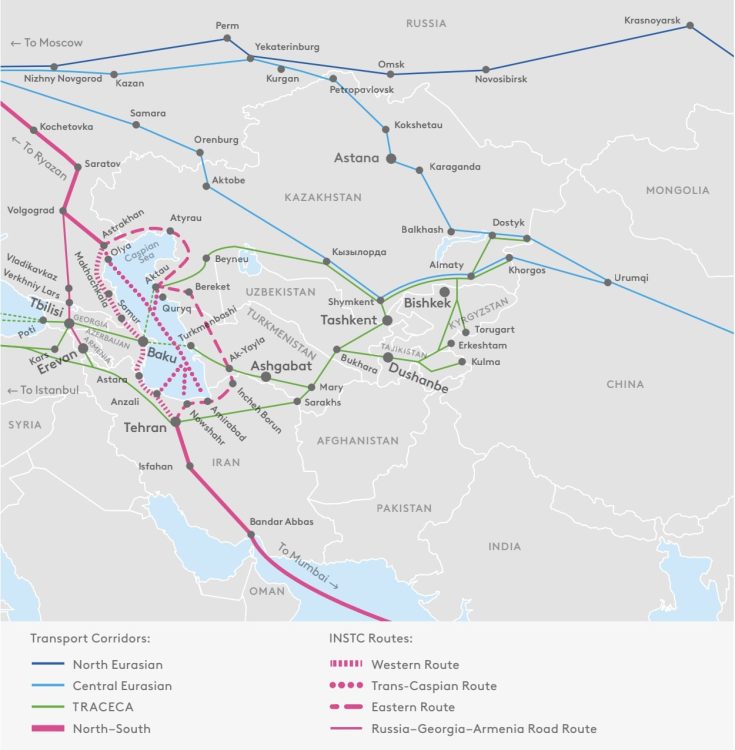
The western part of the route is most popular with Russian exporters of timber and grain, while the eastern part is most popular with paper, pulp, construction materials, and food products. Oil and vegetable oil are primarily shipped through the Caspian ports.
Shipments along the INSTC declined in 2025 to 9.9 million tonnes. By comparison, 12.9 million tonnes moved along the route in 2024.