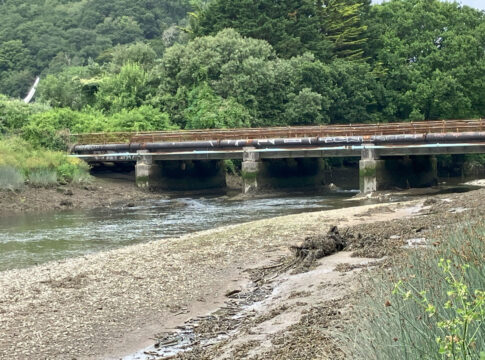
Passengers travelling later this month are being urged to plan ahead as Network Rail carries out vital strengthening work on the River Plym railway bridge which will see 180 metres of track replaced and the bridge strengthened to carry heavier, more frequent trains for decades to come.
The work will take place between Saturday 21 February and Sunday 8 March on the bridge, which is to the east of Plymouth city centre. Further improvement projects will also take place in several other areas in south Devon.
River Plym bridge, near the A38 Devon Expressway, carries the railway between Plymouth and Totnes. 134 steel rail bearers will be installed between the existing cross-beams on the bridge and 24 FFU rail bearers will also be laid along the length of the bridge. FFU is a synthetic wood that’s lighter and more durable than traditional timber, it lasts six times as long and requires less maintenance.
A temporary dam will be installed to provide the required access to the river. Only half the river will be dammed at any time to ensure the flow of the river isn’t interrupted and fish aren’t disturbed. Consent has been obtained from the Marine Management Organisation and Environment Agency.
During the work, buses will replace some trains:
Saturday 21 to Friday 27 February and Monday 2 to Sunday 8 March – buses replace trains between Totnes and Plymouth.
Saturday 28 February and Sunday 1 March – buses replace trains between Teignmouth and Plymouth. Trains still run from Newton Abbot to Paignton.
Throughout the work a non-stop bus service will run from Tiverton Parkway to Plymouth.
Passengers are also reminded that all lifts at Exeter St Davids are being upgraded and remain out of use until May.
Dan Parkes, Network Rail principal portfolio manager, said:
“The type of trains and amount of traffic now using our bridges means they need greater structural support, so this is vital work make sure they can continue to run safely for years to come.
“We’re sorry for the disruption but we’ll be busy in other areas as well to upgrade this heavily used section of railway and get as much work done as we can.
“The work is only possible by everyone across the railway industry working closely together and we’re very grateful for their support.”
GWR Station Manager for Plymouth, Sharon Holloway, said:
“Most long-distance services will continue to run – trains between Exeter and London, Cardiff, and the North will operate as normal, and Plymouth to Penzance services are unaffected.
“Local services between Exeter and Totnes or Paignton will also run on most days, except the weekend of 28 February to 1 March when we’ll have a limited timetable.
“Replacement buses will bridge the gaps, but journey times will be longer, and we urge passengers to check before they travel and allow extra time.”
CrossCountry’s Regional Director, Bethan Jelfs, said:
“We are grateful for our passengers’ patience while Network Rail complete this important work in Devon.
“We are asking passengers to check their journeys carefully, including where trains are being replaced by road services when the lines are closed.”
Parking at both Tiverton Parkway and Totnes stations will be significantly reduced during this time and the car parks will also be extra busy.
Separate track maintenance work will also mean buses replace trains between Liskeard and Looe from Monday 23 February to Friday 6 March
With the railway temporarily closed, work will also take place in other areas to:
- Finish resurfacing the Plymouth-bound platform at Totnes station– first section took place March 2025
- Complete track and drainage maintenance
- Carry out vegetation management
- Replace 400 metres of rail near Newton Abbot
- Replace a track crossing near Ivybridge
- Complete surveys as part of preliminary work to upgrade the signalling system in the area
For more information on train services please visit: www.gwr.com/upgrade.
Image credit: Network Rail