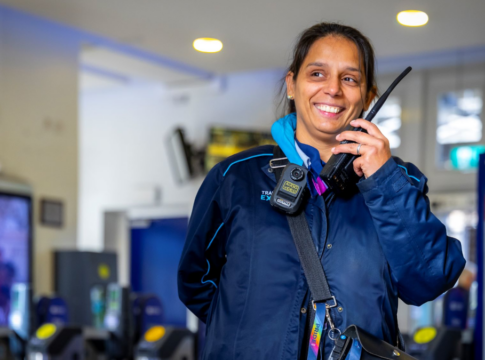
Train operators in public ownership say the roll-out of body-worn camera (BWC) kits has become vital to increasing safety, deterring anti-social behaviour and supporting legal investigations into incidents on the rail network.
Operators such as c2c, Greater Anglia, LNER, Northern, Southeastern, South Western Railway, and TransPennine Express have deployed thousands of BWC kits across the network.
Northern has invested in more than 1,300 while TransPennine Express is expanding its arsenal to 700, including upgrades to newer models and distribution across its catering teams.
Across the c2c network, employees have access to 370 while at South Western Railway the figure is 848.
The roll-out of BWC kits at Southeastern is on-going, with 1,522 in the pipeline – which will bring the total number across publicly owned train operators to 4,740.
They have been issued to frontline staff including conductors, station teams, revenue protection officers and onboard hosts to help:
- Reduce staff assaults and abuse.
- De-escalate aggressive or threatening behaviour in real-time.
- Capture clear visual and audio evidence to support British Transport Police (BTP) investigations and prosecutions.
- Reassure passengers and promote a safer travel environment.
- Combat fare evasion and anti-social behaviour, particularly in high-risk areas.
Phil Jones, crime reduction manager at Northern, said: “While traditional CCTV remains important, BWCs offer a personal, mobile perspective that fixed surveillance systems cannot do.
“Their presence alone often acts as a deterrent to would-be offenders and the footage and audio recordings provide critical evidence that can support the judicial process and improve transparency.
“At the end of the day, this is about protecting staff and improving passenger confidence.”
BTP says body worn video helps to protect both staff and passengers alike and is an important part of a zero-tolerance approach to abuse and aggression against rail industry employees.
They say it is a visible deterrent and provides clear video and audio evidence, often giving better context than CCTV, to help accurately capture what was said and done during an incident.
Train operators work closely with BTP to report incidents of abuse and aggression so patterns and hotspots can be identified and used to inform targeted policing and prevention activity.
Image credit: DfT Operator Limited (DFTO)