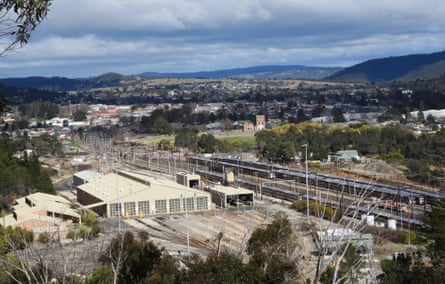
One of New South Wales’ few remaining large railway yards has been put up for sale, with locals pushing for state and federal government intervention to reinvigorate the rail industry.
Lithgow’s locomotive workshop, owned by Pacific National and reported to have an asking price of $35m, includes maintenance pit bays and outbuildings. It was ceded to the freight operator in 2003 when the state privatised its freight services and has been little-used since.
Now, former railway workers, the local council and transport experts are fighting for the site to be revitalised. Lithgow is the last stop on Sydney’s electrified rail network and the start of inland freight routes, and the yard could deliver jobs and innovation to the regional hub, the proponents say.
Lithgow’s mayor, Cass Coleman, whose father and grandfather both worked for the railways in the city, said the 11.6-hectare site was a “wasted” resource with the potential to become the rail manufacturing capital of Australia.
She wants the state and federal governments to acquire the site as the community plans its transition from coalmining to a net zero future.
According to the council, the coal mining and coal-fired power industry generates almost 50% of the city’s economic activity and about 1,100 jobs. But the nearby Mount Piper coal-fired power plant is due to close by 2040.
Coleman said people who worked at “the Loco” before privatisation remember the workshop in its busy heyday. She is worried that new private owners could view the site as an opportunity for land banking.
Dr Michelle Zeibots, a transport planner from the University of Technology Sydney’s school of civil and environmental engineering, said the rail workshop could be up and running in under a month, with minimal costs.
She said future lease holders could draw on local expertise and attract overseas talent, enabling more rail manufacturers to operate at scale in Australia.
According to state and federal policy mandates, all rail rolling stock must now have a 50% minimum Australian-made component. Zeibots said there was a shortage of maintenance facilities in NSW for key train components such as wheels and traction motors. Many of these are sent to Victoria for repair.