Campaigners in Aberdeenshire argue that restoring rail links to Fraserburgh and Peterhead is not just a passenger project. They say it is a vital economic and freight infrastructure upgrade for Scotland’s energy heartland. Fraserburgh and Peterhead are now Scotland’s “strongest candidates” for new rail links, according to the Campaign for North East Rail. The group argues that reinstating lines to the coastal towns would provide critical freight capabilities, as well as passenger services, helping to underpin the north-east’s economic transition from oil and gas to renewables.
Aberdeen has spent fifty years as Europe’s oil capital, building a freight and supply ecosystem that moved materials, equipment and personnel efficiently to the North Sea. Now, as the city pivots towards renewable energy, campaigners argue that a rail network designed to handle freight could be a game-changer for the region’s evolving industrial profile. Stations in north Aberdeenshire were closed to passengers in the 1960s, and freight services ended in 1979 — after oil production had begun. Campaigners say the historic cuts were a huge missed opportunity. Today, the economic and commercial logic for freight is clearer than ever.
Carbon capture centre could be rail served
The Campaign for North East Rail relaunched its call just before the SPE Offshore Europe energy conference in Aberdeen in September, and renewed its call as the Scottish National Party, which formed the current Scottish Government, held its annual conference in Aberdeen. Wyndham Williams, co-chair of the campaign, says the region is unmatched in Scotland for a credible new rail project. “Nowhere has a stronger case,” he said. “Peterhead and Fraserburgh offer both large population centres and major industrial sites. It is highly credible, and freight is a critical part of that equation.”
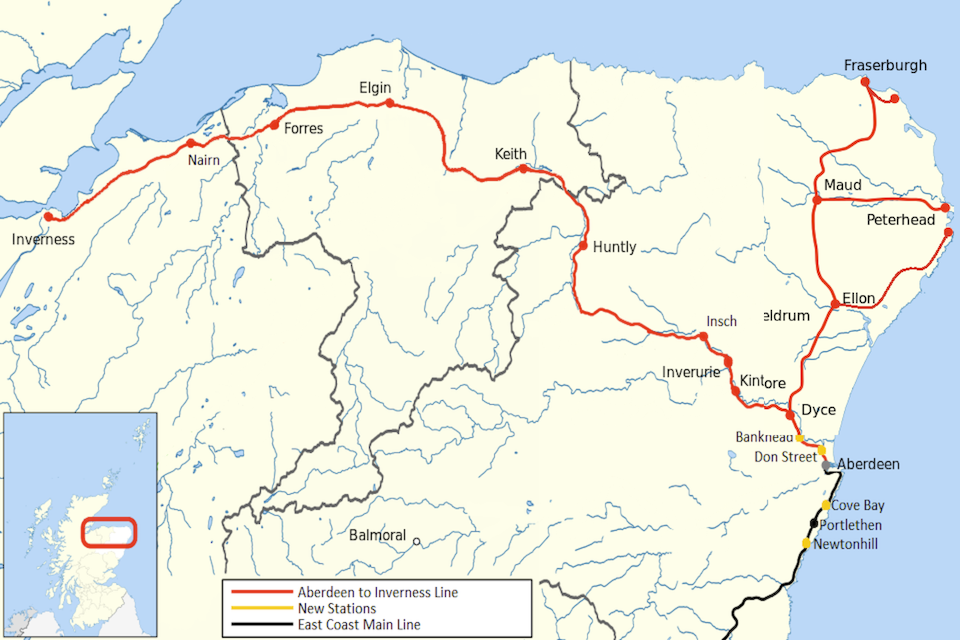
Towns such as Ellon, Pitmedden and Newmachar would also benefit from reopened stations, and freight remains a viable addition to the mix. Williams points to ongoing and planned investments, including the carbon capture and storage upgrade at the St Fergus Gas Plant near Peterhead, which will generate substantial freight flows. “Supporting the Government’s just transition policy isn’t just rhetoric,” he added. “Freight connectivity will allow Buchan to contribute strongly to Scotland’s net-zero ambitions, moving materials efficiently and safely by rail instead of road.”
Policy flies in the face of net-zero ambitions
Transport expert David Spaven, author of a new study of “Scotland’s Lost Branch Lines”, agrees. “Fraserburgh and Peterhead are further from the rail network than any towns of their size in Britain. Reinstating these lines for freight should be next on the agenda,” he said, noting the campaigners’ thorough planning.

A study by the campaign found the area ranks among the most deprived in Aberdeenshire, reinforcing the economic case for investment. Campaigners estimate reopening Peterhead station for freight-capable operations would cost around £450 million (€530m), with an additional £200 million (€236m) to extend services to Fraserburgh. It should be noted that more than one billion pounds was recently spent on road infrastructure recently, building a bypass around Aberdeen.
While the Scottish Government has provided some backing for feasibility studies, the recent rejection of a long-discussed and much smaller project – a reinstatement of a rail link to St Andrews – has frustrated advocates, who argue that freight infrastructure investment should align with both net-zero and economic development targets. Ridership has already shown that earlier projects – such as the Levenmouth Line – are a positive economic driver. For the economically underperforming Buchan region, the argument remains. A freight-ready railway can unlock investment in energy, manufacturing, and renewables, reduce road congestion, and deliver tangible economic and environmental benefits. For campaigners, the Buchan Line is no longer just a historic curiosity. They see it as a vital mixed-traffic artery waiting to be reborn.