The UK Government’s Comprehensive Spending Review, announced on 11 June by Chancellor Rachel Reeves, included a headline £20 billion for transport. While much of this was previously committed funding, the review contained important signals for the rail freight sector, particularly through major infrastructure projects and policies that drive demand for logistics services.
Though not a freight-focused package, Chancellor Rachel Reeves gave some solace to rail freight operators. Several schemes outlined in the review have strong implications for capacity, intermodal growth, and bulk logistics. It may not have been an open cheque book for freight, but that was no surprise to the sector.
Transpennine and East West Rail offer freight capacity
One of the biggest announcements was an additional £3.5 billion for the Transpennine Route Upgrade, the long-running scheme to modernise the corridor between York, Leeds, and Manchester. Though often seen through a passenger lens, the route is also a vital east–west freight artery, particularly for container traffic between northern ports and inland hubs. Electrification and capacity upgrades will support more efficient, faster, and lower-emission freight flows across the Pennines.

Chancellor of the Exchequer Rachel Reeves. Image: © The Labour Party
The East West Rail project between Oxford and Cambridge also received a further £2.5 billion, enabling continued construction of this strategic corridor. Plans for the line include freight capability from the outset, offering potential new cross-country freight options that bypass congested London routes and support development across the Oxford-Cambridge Arc. There may have been disappointment at no direct mention of funding the long-awaited Ely Area Capacity Enhancement, but the national infrastructure plan is due next week. Hope springs eternal.
Bidston Line sees long-awaited investment
On the other hand, a notable freight-related commitment came in the form of £445 million for rail infrastructure in Wales over 10 years. While modest, the inclusion of Padeswood Sidings, near Wrexham, is significant. Upgrading this facility will help unlock capacity on the Bidston Line, a route that has seen conflict between freight and passenger services.
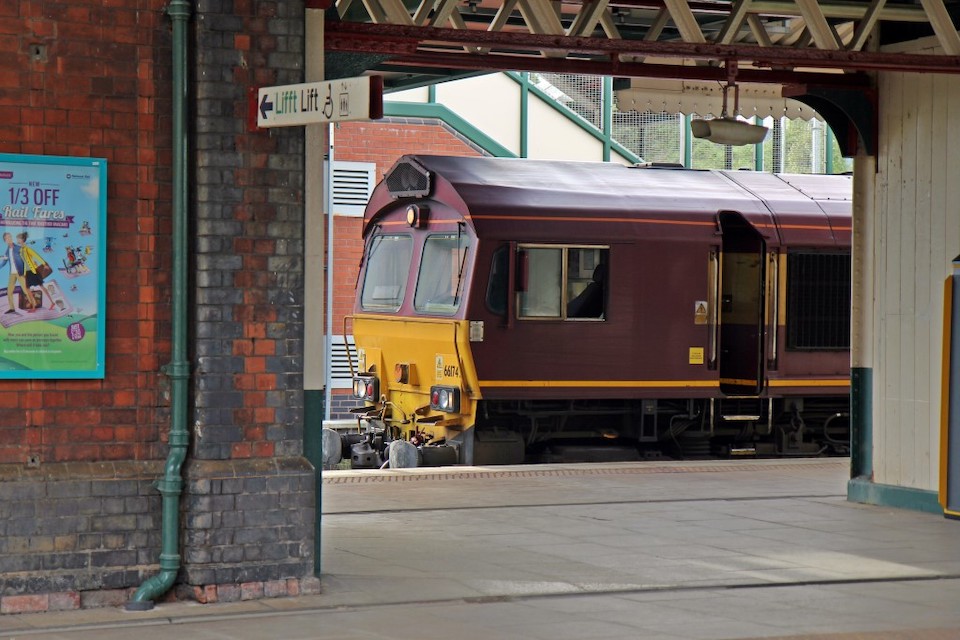
An EWS class 66 diesel freight locomotive stands at Wrexham General station awaiting a green signal.
Image: © Geograph UK
The line connects North Wales with Birkenhead and the Mersey ports, making it a potentially key regional freight corridor. Increased capacity will help meet growing demand and improve reliability for cross-border traffic into Merseyside and beyond.
Construction and clean energy drive logistics demand
While the Spending Review’s transport commitments are largely passenger-focused, the wider policy landscape points to long-term freight demand. The Chancellor’s plans include large-scale investments in housebuilding, industrial development, and new energy infrastructure, including nuclear power.
These sectors rely heavily on the movement of aggregates, steel, cement, and other construction materials—areas where rail freight is already expanding its role. If planning reforms and site development proceed as promised, they could generate a sustained increase in rail-served logistics needs.
Opportunities are clear – delivery is less so
Reeves also committed to mass transit and local rail schemes in cities including Manchester, Leeds, Birmingham, and Newcastle, alongside a four-year funding package for Transport for London. Though focused on urban mobility, these projects could unlock shared-use infrastructure and indirectly benefit freight, particularly in areas where freight and passenger services overlap or compete for paths.
While rail freight wasn’t at the centre of the Chancellor’s announcement, it wasn’t left out either. Industry observers are calling for detail and delivery. Commitments are needed for new paths, terminal access, and infrastructure tailored to freight operations. With decarbonisation and economic growth both dependent on efficient logistics, the case for sustained investment in rail freight has never been stronger. Then again, so are the demands on the national purse, and transport is not the only one in the queue.