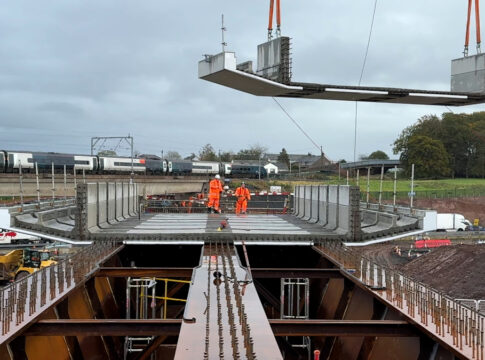
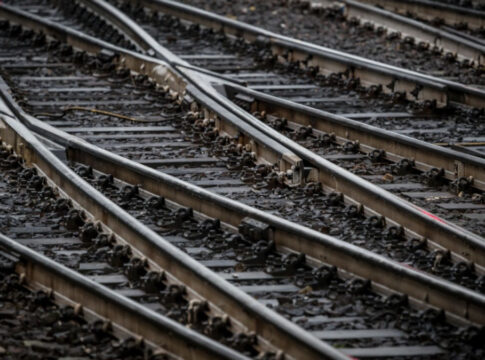
The Iberian gauge rail section between Moixente and L’Alcúdia de Crespins, south of Valencia, will be doubled with an investment of 27,4 million euros. This 16.8-kilometre section is an essential part of the route of the Valencia-Madrid rail highway service, which will benefit from higher capacity.
The rail highway service connecting Valencia and Madrid runs on a double line for most of its journey. However, a short stretch between Xàtiva and La Encina is still on single track. The situation will be partially improved with the doubling of the Moixente-L’Alcúdia de Crespins line.
Launched in the summer of 2024, the rail highway service between Valencia and Madrid is a cooperation between TransItalia and Tramesa to transport semi-trailers, coming from Genoa via ship, by rail. Despite a few troubled months due to the floods that hit Valencia last November, ambitions remain high, as there are talks to extend the service to Valladolid and Zaragoza.

Handling a train for the Madrid–Valencia rail highway. Image: LinkedIn. © TRAMESA – GAA
Rail highways and rolling highways
When it comes to moving trucks onto the railways, there are different types of services.
Rolling highway services focus on accompanied combined transport, where the whole truck,
including the tractor, is loaded on wagons. Truck drivers remain with the vehicles and often travel
in separate passenger carriages attached to the freight train. These services are mostly used for
transalpine traffic, and two of them were recently discontinued.
Rail highway services, on the other hand, entail the transport of semi-trailers or
containers without including the tractor or the driver. These services seem to be on the rise,
both domestically and across borders, throughout the European Union. One of the countries most
active in developing rail highway services is Spain, with two active ones and several in the works.