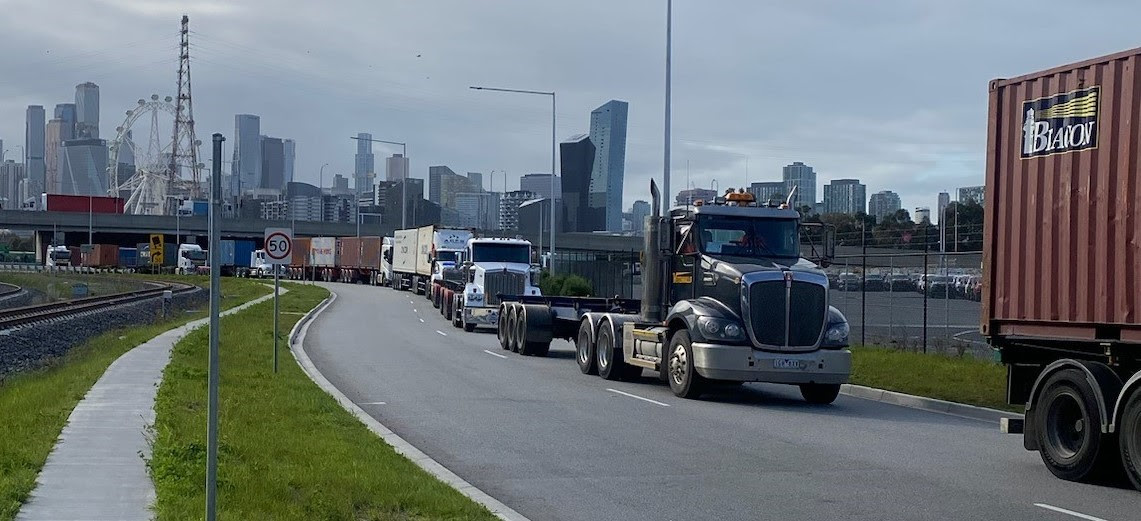
For more than a decade, Victoria has promised a network of inland rail terminals that would take shipping containers off trucks and put them on trains before they ever reach central Melbourne. The Port Rail Shuttle Network (PRSN) — linking terminals at Altona, Somerton and Dandenong South to the Port of Melbourne — was meant to be running by late 2022. It still isn’t, and a 2023 Victorian Auditor-General’s Office (VAGO) audit found the project running an average of 17.6 months behind schedule, with contract dates pushed back six times at Altona and fourteen times at Somerton.
The $58 million shuttle network, jointly funded by the Commonwealth and Victorian governments, is designed to intercept containers before they cross the city by truck. Around 87 per cent of import containers travel to destinations within 50 kilometres of the port gate, so even modest rail diversion was expected to save up to 300,000 truck trips a year on Melbourne’s roads. None of that is happening yet: there are currently no regular freight rail services moving metropolitan containers to and from the port.
The cost of the delay isn’t really a construction bill — it’s a bill for what doesn’t get built in time. VAGO’s audit was blunt about the mechanism: every month the shuttle network sits unfinished, the same number of containers — or more, given ongoing freight growth — keeps moving by road instead of rail. That has three compounding effects on the state.
The first is congestion. Container trucks are larger and slower than general traffic, and their concentration on approach roads to the port and surrounding freight corridors adds directly to peak-period delay. With the port’s container trade forecast to keep growing for decades, every year the shuttle network is delayed locks in another year of truck growth that a functioning rail alternative could have absorbed.
The second is road wear. Heavy vehicles do disproportionate damage to pavement compared with light vehicles, and truck registration charges are not designed to fully recover that cost. Rail, by contrast, has its own dedicated track and passes its maintenance costs back to operators through access charges. Every container that stays on a truck rather than shifting to a train is, in effect, an unrecovered cost passed on to the general road-maintenance budget.
The third is safety and amenity — more truck kilometres mean more crash exposure and more noise and vibration through residential areas near freight routes, both of which the department’s own modelling treats as quantifiable “externalities” of road freight.
The government’s own economic modelling put the annual externality savings from rail freight diversion (across a related, smaller subsidy scheme) at up to $4.9–5.8 million — but that is dwarfed by what the shuttle network itself was meant to unlock at full scale. VAGO’s broader conclusion was pointed: even once built, the network is unlikely to hit its target of carrying 30 per cent of Melbourne’s container trade by 2050, partly because of the delays themselves, and partly because a growing share of port freight moves through Webb Dock, which still has no rail connection at all.
Until Altona, Somerton and Dandenong South are actually running trains, the congestion and road-damage costs of an all-truck container network keep accumulating — quietly, but not cheaply.
The pattern is not confined to metropolitan Melbourne. The $55 million Ballarat Intermodal Freight Hub, part of the Ballarat West Employment Zone and designed to move roughly 15,000 containers a year to the Port of Melbourne along with 300,000 tonnes of grain annually for a nearby flour mill, has faced its own prolonged setbacks. Despite Victorian and Australian government funding of $27.75 million each being secured years earlier, planning, procurement and approval processes pushed the start of construction back by around two years, and the site subsequently sat largely idle after an initial “start” while the state struggled to find an operator despite multiple expressions-of-interest rounds. Construction on the rail line and civil works — including 3km of new track and decommissioning a level crossing — is now under way, with completion targeted for later this year.
As with the shuttle network, the cost of the Ballarat delay is measured less in dollars spent than in trucks kept on the road. Grain and containers that could have moved by rail from western Victoria have instead continued travelling to the port by road for years longer than planned, adding to heavy-vehicle traffic on regional highways and the approaches to Melbourne, and deferring the same kind of congestion, road-wear and safety benefits the shuttle network is meant to deliver. Together, the two projects illustrate a broader theme in Victoria’s freight strategy: ambitious rail-diversion targets that consistently outpace the state’s ability to get the underlying infrastructure built and operating on schedule.