Knorr-Bremse Rail Systems UK and Chiltern Railways presented interim findings from their year-long Low Adhesion Monitoring System trial to attendees at this week’s ADHERE (ADHEsion REsearch) Seminar in Birmingham.
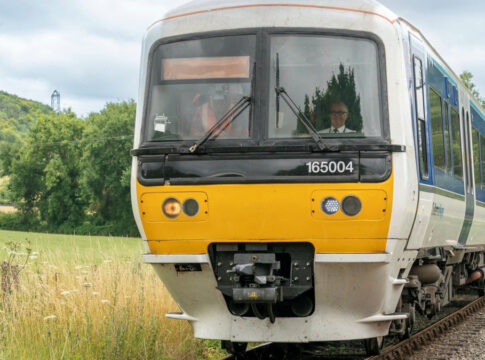
Developed by Knorr-Bremse and jointly engineered with Chiltern Railways, with support from Angel Trains, the system has been installed on Class 165 unit 165004 – the first in class (FiC) train to be equipped with the technology – operating on the Chiltern Main Line and London to Aylesbury route.
Since entering service in September 2025, the test unit has been continuously capturing detailed operational data including real-time adhesion, braking and wheel slide data, without impacting existing onboard train systems, highlighting a major step forward in understanding and managing low railhead adhesion.
Over the course of the trial to date, (up to and including 4 February 2026), the train has covered more than 88,000 miles across single, double and multiple unit formations, with the system recording over 500 wheel slide events and 850 traction slip events, with proportionately more slides occurring when the unit operated as a single set. The majority of journeys have been completed in double formation, providing a broad dataset across varying operating conditions, including autumn leaf fall and periods of adverse weather.
Attendees at ADHERE were presented with a detailed analysis of historical braking performance data captured during the trial, including the number and geographical distribution of low-adhesion hot spots identified across both routes, the frequency and location of Wheel Slip Protection (WSP) activity, and correlations between brake demand, speed and adhesion levels. The system is also providing insight into infrastructure-related factors and braking expectations under different operational scenarios.
The trial represents the first time the industry has been able to derive an actual measured value of wheel-rail adhesion at the point when WSP is active. Rather than simply confirming that the rail was slippery because WSP intervened, the system can determine how slippery the railhead actually is. This capability has the potential to transform understanding of conditions at the rail-wheel interface, enabling a move from reactive response to proactive adhesion management.
John May, digital services business development manager at Knorr-Bremse Rail Systems UK, said: “This trial marks a significant milestone in how the industry understands and manages low adhesion. For the first time, we are able to move beyond assumption and inference to calculate real, in-service adhesion values at the point where Wheel Slip Protection is active. The scale and quality of data we are now capturing is unprecedented, and it is giving us a far clearer picture of how adhesion varies by location, season and operating conditions.
“By working with Chiltern Railways and our industry partners, we are building the foundations for a more proactive, data-led approach to improving braking performance, safety and operational resilience across the network. The trial helps train operators and Network Rail understand when and where there is low adhesion in near real time. Hot spots of low adhesion can be identified so that drivers can be made aware and rail head cleaning can be planned.”
By quantifying adhesion under live braking conditions, the project is delivering critical evidence to support the work of the RSSB’s Adhesion Research Group in deepening the industry’s understanding of low-adhesion behaviour and its impact on train performance. The data gathered will enable Knorr-Bremse, working closely with ARG and the University of Huddersfield, to calculate real-time adhesion levels with a level of precision not previously achieved in service.
Louis Schmandt, technical engineer at Chiltern Railways, ARG member and Chiltern’s project lead, said:“This trial is a significant step towards ARG’s goal of developing a first in class ‘adhesion expert train’ that is able to accurately predict the low adhesion risk of any location at any given time throughout the year to a very high degree of accuracy.
“Notably, data is not just being captured during the Autumn season, but all year round and for the first time, adhesion levels are being monitored outside of the limiting thresholds of WSP activity, providing a much more complete overall picture. This brings the potential of being able to target low adhesion mitigation measures more effectively as well as better inform driver behaviour during the Autumn, possibly eliminating the need for Autumn leaf-fall timetables.
“In the long term, there is the potential to feed this low adhesion data as an additional input into WSP systems to enable them to work more proactively, anticipating when a WSP activation might be initiated rather than reacting to a deviation in speeds across different axles. This trial ultimately forms part of the industry’s broader goal of creating a seasonally agnostic railway, where there is no negative impact on railway performance and safety during the Autumn season and the ancient problem of ‘leaves on the line’ is firmly consigned to the history books.”
If the trial continues to demonstrate its value, the partners hope to expand participation to additional operators later this year, with the potential for a broader fleet rollout beginning in 2026/27.
Image credit: Knorr-Bremse Rail Systems (UK)