Britain’s economy continues to shrink, and employment figures disappoint. Sometimes, the only growth seems to be inflation figures. Rail freight is once again shouldering more than its fair share of the recovery load.
The Christmas peak offers a timely reminder that rail freight does more than move a Santa’s sleigh worth of presents. It sustains skilled jobs across the country, underpins regional economies, and, according to RailFreight.com UK Editor Simon Walton, it quietly bucks the national trend.
A Christmas rush but not a seasonal industry
Every December, rail freight briefly becomes visible. Trains are loaded with retail goods, food and drink, parcels and packaging materials. There’s also the aggregates for building, the biomass for heating, and a hundred less photogenic commodities. It all rolls deeper into the national consciousness, usually accompanied by the familiar observation that rail is “helping Christmas along”.
The implication, however unintended, is that rail freight is a seasonal helper. It’s something that steps in when roads are under pressure, before slipping back into obscurity once the decorations come down. The reality is rather different. Rail freight does not switch on for the twelve days of Christmas. What the festive peak reveals is a sector that is already deeply embedded in Britain’s supply chains. It responds to demand with scale, reliability and reach. This is not the exception. It’s just business as usual.
Jobs that don’t vanish with the decorations
The year-round reliability of rail freight matters, because Britain’s wider employment picture remains fragile. Job creation is increasingly uneven, insecure and concentrated in fewer parts of the country. Against that backdrop, rail freight employment looks quietly robust. It sustains skilled, long-term roles across Great Britain, from drivers and signallers to engineers, terminal staff, planners and logistics specialists. These are jobs rooted in place, linked to physical infrastructure and difficult to offshore.
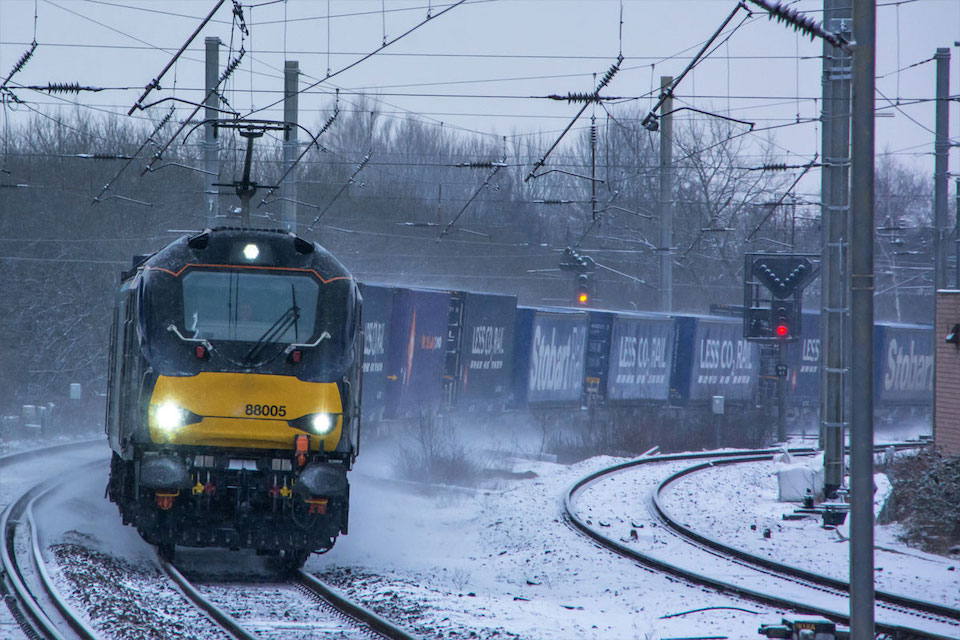
They are also spread far beyond the traditional centres of economic gravity. Ports such as Felixstowe, Liverpool and Grangemouth anchor freight activity in coastal and industrial regions. The latter is a case in point. For all the economic gloom around Grangemouth’s petrochemical industry (lost oil traffic, for example), the port and freight terminal have been quietly sustaining jobs and continuing commerce. In an economy struggling to generate stable work, rail freight continues to do exactly that – largely without fanfare.
Regional economies and the quiet multiplier effect
The employment story does not stop at the railway boundary. Each freight path supports a wider web of economic activity: warehouses, maintenance firms, haulage companies, manufacturers and exporters. This quiet multiplier is rarely captured in economic performance figures. It links ports to inland economies, supports industrial clusters and keeps supply chains viable in places where alternative sources of investment (and employment) are limited.
When commentators talk about “hard-working people” or “levelling up” (actually, that term has been quietly abandoned), they often do so in abstract terms. Rail freight delivers it in practice. It’s there, through physical connections that tie local jobs to national and international markets. That contribution is rarely captured in the headlines. It is, however, very much felt in communities where rail freight remains one of the few sources of dependable economic momentum.
Bucking the trend without carolling about it
Set against the wider economic backdrop, the contrast is striking. Growth remains elusive, business confidence is fragile, and many sectors are treading water at best. Rail freight, by comparison, continues to show cautious but real momentum. Terminal investment is proceeding, and port-centric logistics are expanding. Just look at the poster child of the sector, London Gateway, and its additional rail terminal. Customers are increasingly turning to rail for resilience as much as sustainability.

This is not growth fuelled by subsidy or short-term stimulus – although both would be welcome and be money well spent. It is demand-led, customer-funded and shaped by commercial reality. In that sense, rail freight feels curiously out of step with the national mood. That’s not because it is booming, but because it is still functioning as an engine of productive economic activity.
Policy blind spots in plain sight
Despite this contribution, freight remains doggedly marginal in the policy conversation. Rail reform debates still default to passenger priorities. Capacity discussions rarely start with freight. Employment benefits are seldom factored into decisions about paths, investment or timetable planning.

The Christmas peak risks reinforcing the wrong lesson. Easily made media stories portray rail freight as a useful seasonal supplement. Generalist reporting fails to recognise it as a permanent economic asset. In an economy desperate for skilled jobs, resilient supply chains and regionally distributed growth, this feels like an opportunity missed in post-industrial Britain, where the value of work is measured in spreadsheets, not machine tools blunted with relentless use.
Not a Christmas miracle, just a permanent asset
The real lesson of festive freight is not that the sector rises to the occasion. It is that it already carries far more of the economic load than it is credited for. Rail freight supports jobs that last beyond the season, regions that rarely dominate the headlines, and supply chains that continue to function even as the wider economy falters.
That should place it closer to the centre of economic and transport policy – not at the margins, rediscovered each December and forgotten again by February. If rail freight can buck the trend in a shrinking economy, the question for policymakers is a simple one: what might it deliver if it were properly recognised as part of the solution? ’Tis the season, after all.