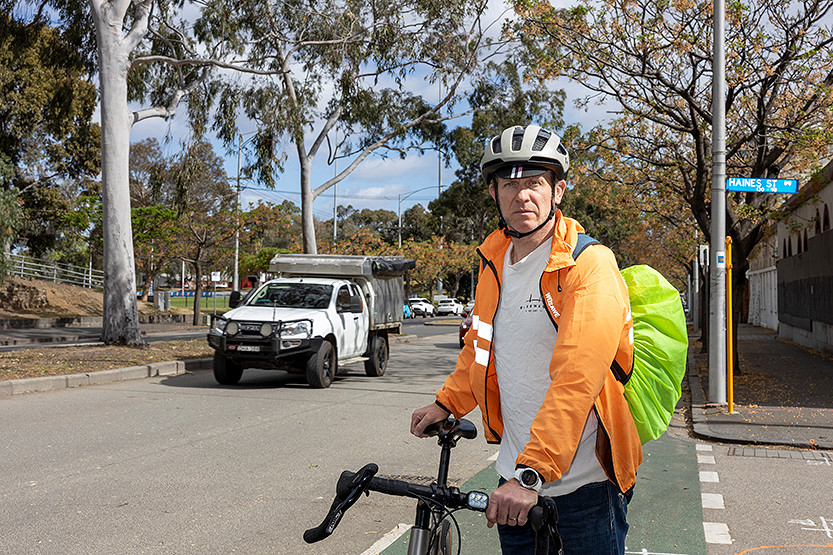
John Symons is an economist and the president of the Melbourne-based cycling advocacy group Bike West, which has committed to a lifelong battle to change people’s attitudes towards cycling infrastructure.
The effect that road width and the density of roadside trees have on road safety may not keep most Melburnians awake at night, but for John, it does.
He has cycled for more than 40 years across 20 different countries and says that Australia is one of the most challenging places to ride due to roads being designed to prioritise cars.
North and West Melbourne are prime examples, with quiet residential streets encircled by major arterial roads that connect the city to the western suburbs. Much of the cycling infrastructure is built on roads designed to accommodate large numbers of cars.
This has led to countless traffic-related incidents, with a blind spot at the intersection of Arden and Leveson streets resulting in a string of accidents this year, and a cyclist dying after colliding with a truck on Macaulay Rd in September.
John believes that bikes are an afterthought and that there needs to be an attitude shift in road design, placing cyclist and pedestrian safety at the forefront of the planning process.
“From a cost–benefit perspective, prioritising pedestrian and cyclist safety is a complete no-brainer, but that doesn’t seem to be enough to shift the needle for governments,” he said.
This issue isn’t just a personal grievance for John, but something he has spent decades researching.
John is an economist at Victoria University whose work focuses on environmental economics and the economic analysis of investments to achieve the Sustainable Development Goals (SDGs) in health, education, and road safety.
He is concerned that poor cycling infrastructure will have significant social and economic impacts, and that if the Victorian Government and the City of Melbourne do not deliver sufficient cycling infrastructure, congestion could reach the levels of Mumbai in the coming decades.
The United Nations suggests that governments allocate 20 per cent of transport budgets to active transport (cycling and walking infrastructure). However, the Victorian Government allocates only two per cent, according to Climate Council estimates.
John believes the tendency for governments to prioritise motorists over cyclists is linked to a cognitive bias formally known as motonormativity, and colloquially referred to as “car brain” – a mindset that assumes car ownership is a given.
“Once you start noticing the bias towards cars, you see it everywhere,” he said. “Every intersection, every street corner, reflects the assumption that drivers must never be inconvenienced.”
“To make streets safer, we don’t necessarily need complex infrastructure. Simply reducing speed limits to 30 kilometres an hour or introducing modal filters can make a huge difference.”
Modal filters are physical street designs, such as kerbs or bollards, that restrict motor vehicle through-traffic while allowing pedestrians and cyclists to pass. However, John believes that the design of the roads could be improved, too.
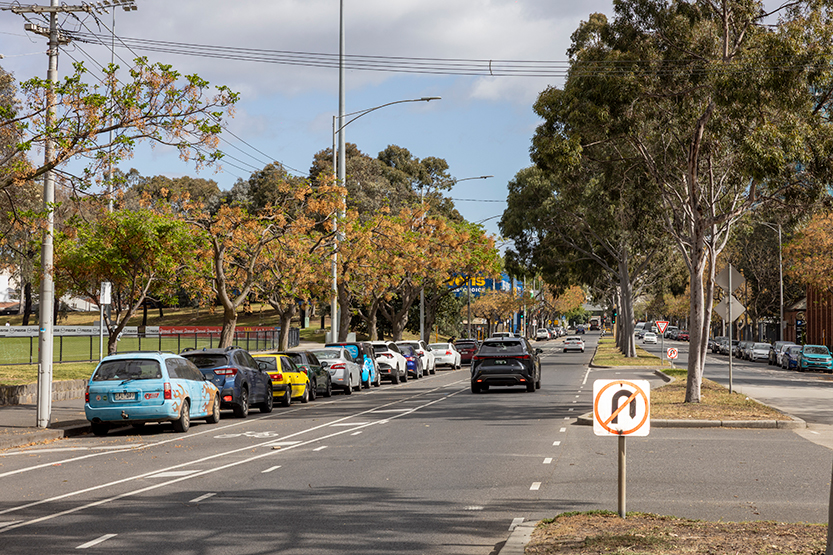
He drew attention to Arden St, which has a 40 km/h speed limit. However, because of the width and scale of the road, he said that it feels unnatural for motorists to drive so slowly.
If Arden St was narrower and had more greenery and pedestrian activity, he believes that a speed limit wouldn’t be necessary – people would naturally drive slower due to the design and street conditions.