What would it take for Britain’s rail freight industry to step up to cover the UK Government’s ambition to increase rail freight by 75 per cent by 2050? The answer is “not much” – if you’re an optimist. The target is so modest it could be swallowed by organic growth without even making a ripple in the economic statistics. There are words of caution, however, from someone never knowingly accused of optimism – the RailFreight.com UK Editor, Simon Walton.
To meet that growth figure, the annual rate required is just two and a quarter per cent. That seems perfectly achievable. You need only read the past pages of RailFreight.com to find that level of growth in the industry. Surely, an easy target, readers might say. Well, only if those readers are not the commercial development managers of freight operating companies, working hard at trying to win new business.
Big assumptions, small sector
Assuming that 600 freight trains run every day in Great Britain, that growth target is met by adding just an extra 13 trains a day, every year. That is just one new train a month on average, with a little Christmas bonus. It doesn’t seem much, but, as timetable planners will tell us, critical parts of the network are already at capacity, and there isn’t a whole lot of slack in the system.

Would the British railway network need to be enhanced by 75% to cope? No, of course not. Rail freight is a tiny fraction of the overall traffic. According to the Office of Rail and Road, the passenger timetable accounts for 24,000 trains every day. So, for that rail freight target to be met, let’s just say the actual enhancement is three-quarters of two and a quarter per cent. Don’t reach for your calculators, we already have. It’s 1.7%. In other words, perfectly achievable – as long as you don’t try to get through Ely or come up the West Coast Main Line.
Industry, politics and the world economy
Most of those dozen or more trains will likely be aggregates and intermodal. The dominant load sectors seem unlikely to change over the next 25 years. The goods carried by the railways have historically been slow to change, and have only really reflected the outside pressures of industrial innovation, political policy, and global economic factors.
It was industrial innovation, in the shape of a very British revolution, that brought us the railways in the first place. We’re only just over celebrating the 200th anniversary of the first passenger train (and it was built for freight with passengers as an afterthought). It’s been the innovation of the containerisation of international trade and the demise of widespread heavy industry that has reshaped the rail freight demographic in recent decades.
Political policy has played an even greater role in reshaping the railways. It was an early 1960s report of almost that name which finally pulled down the curtain on a network that had operated to almost Victorian practices, right up until then.
With the wheel-tappers and shunters consigned to history, the coming age of intermodal and block trains better served Britain in a post-industrial age. It’s been that way ever since. Now, in the environmentally friendly second quarter of the twenty-first century, rail is being asked to recover from the retrenchment and grow again. If not quite with the mania of the mid-nineteenth century, then certainly with a steady hand on the throttle.
There is a big catch
That 1.7% growth in rail freight will have to be found somewhere. It’s not coming from economic growth, unless there’s a dynamic shift in performance between now and 2050. The period 2000-2025 saw the UK economy grow at an average annual rate of 2.5% (Office for National Statistics). That, however, was almost all due to early years performance. The last ten years have seen the rate of growth slide to 1.5%. In the last five years, it has slipped below one per cent. Lately, it has grown within the margins of statistical error, or not at all. That rail freight has held up at all is remarkable.

So, where might rail look for more business? Obvious targets are the ports, of course. With ever bigger container ships docking at ever bigger terminals, the potential for intermodal traffic is immense. Why else would a French shipping line have bought out a British rail carrier earlier this month? CMA CGM, more often the subject of our shipping sister WorldCargo News) has its eyes set firmly on unloading its ships and getting its boxes to the logistics hubs of Britain as fast and reliably as possible. They surely intend to make good use of that newly acquired Freightliner capacity.
The aggregates industry, too, is a prime candidate. Slipping under the radar (but not under the gaze of RailFreight.com), Tarmac opened a new terminal in Derby last week. We may not be mining for coal anymore, but we are digging up the inert minerals under our feet with undiminished enthusiasm.
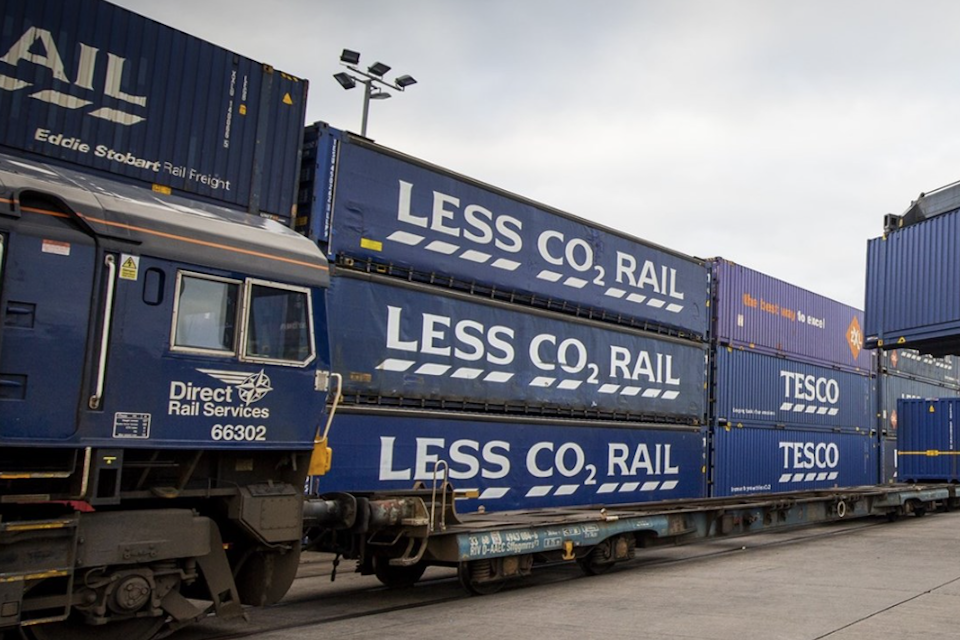
The biggest prize may come in the smallest packages. Light logistics (parcels) is a traffic that is only set to grow. As we visit shops less and online stores more, we feed the growing harvest of logistics parks around the country. The modern warehouse (of which there is still a severe shortage) is a place of technological wonder. The largely automated picking and packing takes place at breakneck speed, ready to dispatch a myriad of wares by the truckload.
The road haulage sector is not, however, about to give up that market share. As the vastly dominant means of moving goods, Britain’s deindustrialised and decentralised economy relies on truckloads, not trainloads, to a greater extent than ever (supermarket customers in Inverness are at liberty to disagree).
It may well take legislation to alter that position. A sustained period of growth is needed in the UK economy – and growth of the sort that plays into the hands of rail freight. Without it, then even that modest target of two and a quarter per cent a year seems more challenging than first surmised.