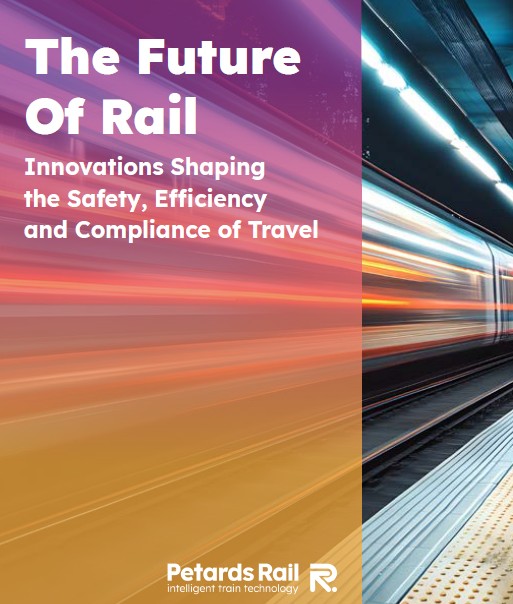
Petards Rail recently released its new whitepaper – The Future of Rail: Innovations Shaping the Safety, Efficiency and Compliance of Travel.
The whitepaper looks into the changes across the rail industry, including cyber resilience and AI-powered monitoring, highlighting how modernisation will create a safer and smarter network.
Network Rail has predicted that Britons will take an extra one billion journeys by the mid-2030s, and as such, the whitepaper showcases how urgent the need for change really is, to support growth, resilience, and sustainability.
Key findings include:
- The UK rail industry contributes £43 billion GVA to the economy every year, providing 710,000 jobs and gaining £14 billion in tax revenue.
- Digital transformation is urgent: With a projected billion extra UK rail journeys by the mid-2030s, modernisation is essential to boost capacity, improve passenger experience, and cut costs.
- Cybersecurity is now safety-critical: The convergence of legacy OT with modern IT has expanded vulnerabilities. Regulations such as the Cyber and Resilience Bill and IEC 62443 standards demand rail operators treat cyber risk on par with safety risk.
- Data intelligence enables predictive rail: Predictive analytics and IoT sensors are moving rail from reactive to proactive maintenance, cutting failures by up to 30% and delivering significant cost savings.
- AI and smart monitoring are transforming operations: AI-enabled tools are improving passenger flow management, fault detection, and obstacle recognition, while products like Petards’ EyeTrain achieve up to 98% accuracy in passenger counting.
- Collaboration drives resilience: The future of rail depends on stronger collaboration between operators, technology providers, and regulators to deliver interoperable systems, ensure compliance, and accelerate innovation across the network.
The report identifies four main focus areas for the sector:
- Cybersecurity: Becoming stronger against digital threats through standards like IEC 62443 and compliance with the UK’s Cyber and Resilience Bill.
- Artificial intelligence and smart monitoring: Using AI for predictive maintenance, passenger flow management, and obstacle detection in real-time.
- Digital transformation: Using IoT connectivity and predictive analytics to update operations, break down data silos, and optimise traffic management.
- Regulatory compliance and sustainability: Navigating evolving rules around safety, decarbonisation, and accessibility, including the commitment to achieve net-zero emissions by 2050.
The whitepaper warns that legacy systems used with modern IT increase the attack surface for cyber criminals, while also stressing the opportunities of digitalisation to reduce delays, improve passenger satisfaction, and cut carbon emissions.
David Muse, chief technical architect at Petards Rail, said: “Innovation has always been critically important in the rail industry. This whitepaper shows how cybersecurity, AI, and digital transformation will be the foundations of a smarter, safer, and more sustainable railway. The rail sector must move decisively from hindsight to foresight, embracing predictive, data-driven tools to meet the demands of tomorrow.”
Image credit: istockphoto.com/Mlenny