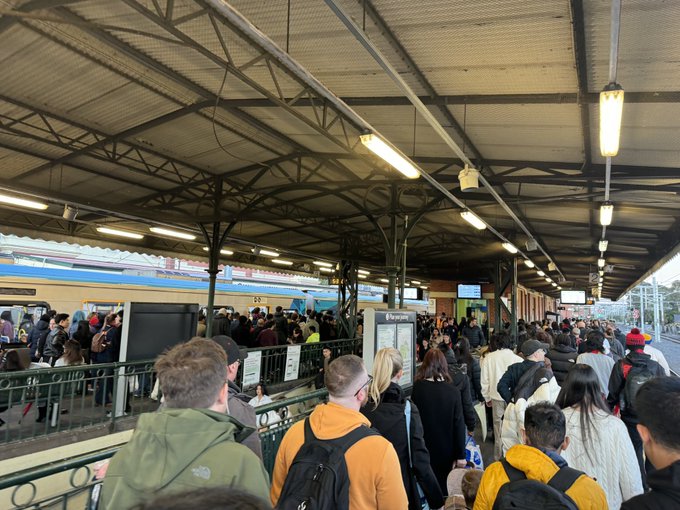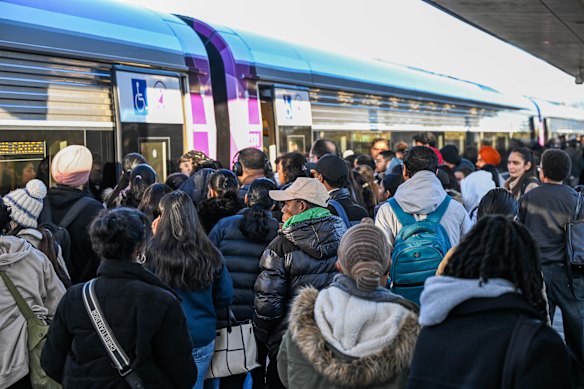
Tomorrow’s a big day for trains on Victoria’s Gippsland line. The timetable is changing and passenger train frequency between Melbourne and Traralgon is increasing from one every hour to one every 40min. Let’s go down memory lane to put this in an historical context.
Background
Traralgon is 158km east of Melbourne on the broad gauge line to Bairnsdale and Orbost. The line was electrified to Traralgon in the 1950s to aid haulage of heavy coal traffic from Morwell and Yallourn, but was de-electrified in the late 1980s as that traffic declined.
Passenger trains beyond the suburbs have increased over the years. In the 1920s there was a basic service beyond Warragul of two trains each way each day taking about 4 hours to reach Traralgon with one or both extending to Bairnsdale depending on the day of the week.
By the 1950s there were 2 trains to Sale or Bairnsdale plus another two Traralgon local trains – giving four per day to Traralgon taking from 2.25 to 3 hours. This basic pattern remained through the 1970s although a few more local Warragaul local trains had been added.
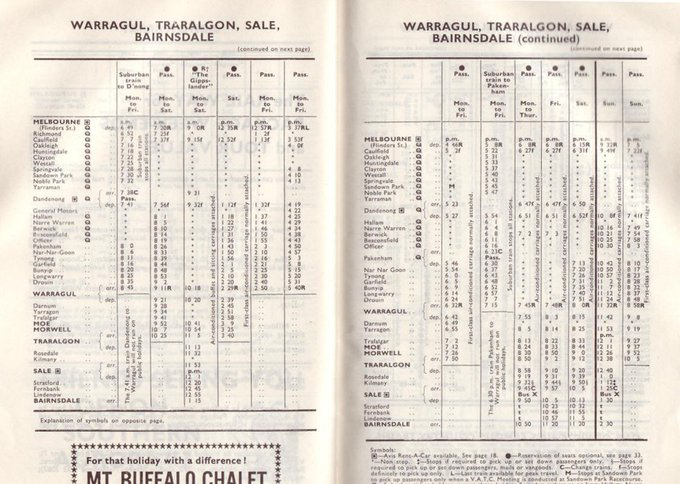
Like all main lines across Victoria, frequencies on the Traralgon line got a boost from the 1981 ‘New Deal for Country passengers’. This timetable from 1987 shows seven trains to Traralgon each weekday with two continuing to Bairnsdale and a third to Sale.
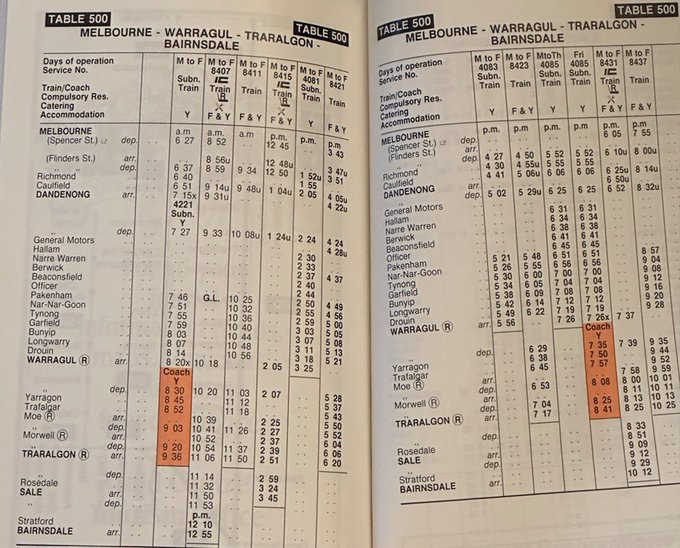
Regional Fast Rail in the mid 2000s boosted trains further and it was then that the basic pattern of one train per hour that we see today originated. Until now, the weekday timetable saw 20 trains per day between Melbourne and Traralgon, 3 of which continue to Bairnsdale.
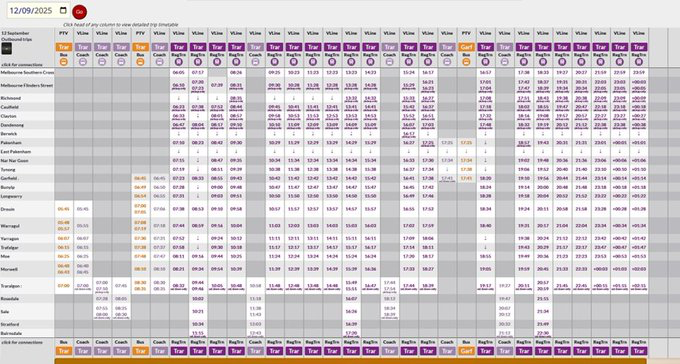
From tomorrow, there will be 25 trains per day to Traralgon, one every 40 minutes even on Sundays, three of which continue through to Bairnsdale. Depending how you look at it, that’s a 25% increase from last week, a 250% increase from 1987 or a 525% increase since 1977.
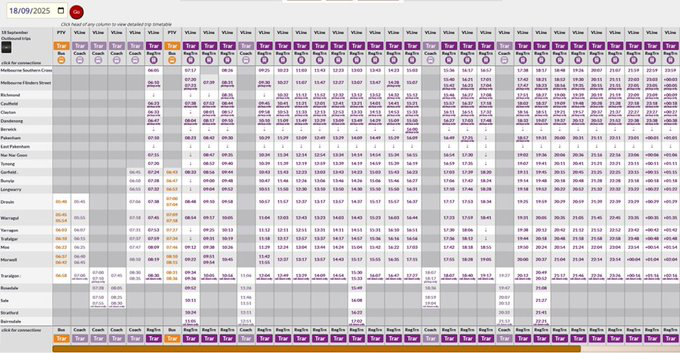
That rate of increase in train service frequency is a pretty much consistent annual 2.6% compounding growth rate over the past century.
Excellent Review by Railmaps lost on twitter