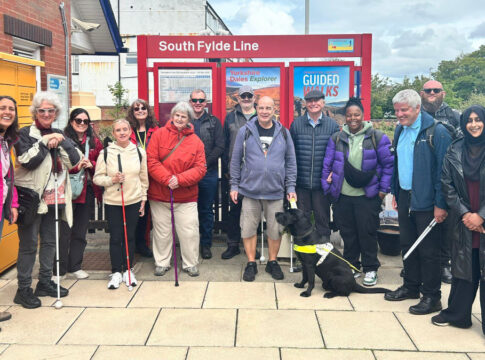
Sight Loss Councils, led by blind and partially sighted (BPS) volunteers, are sharing their rail travel stories as part of this year’s Railway 200 celebrations, marking 200 years since the birth of the modern railway. They are also encouraging others to travel by train to build confidence and independence.
Sight Loss Councils (SLCs), funded by Thomas Pocklington Trust, are regional groups led by blind and partially sighted volunteers. These volunteers use their lived experience to shape inclusive services, influence decisions, and improve accessibility in local communities.
Access to public transport has been a key priority for SLCs. This follows feedback from blind and partially sighted people during the 2023 Listening Month consultation, where 65% of BPS respondents identified it as a top concern.
Blind and partially sighted people – who are unable to drive – are heavily reliant on public transport for daily life, to socialise with friends and get to work. Making transport accessible enables them to be more confident, safe, active and independent. When local transport is not accessible, many risk becoming isolated.
As part of the Railway 200 celebrations, Birmingham and Black Country SLC member Steve Keith, who is registered blind, shares his personal story of how improvements in rail travel have helped him feel safer, more confident, and more independent – recalling how older train doors could previously be opened before stopping at a station, putting him at risk of walking out of a moving train.
He explains: “Modern trains are far more accessible and customer-friendly, especially from a disabled passenger’s point of view. It’s now much easier for me to visit family in Scotland 400 miles away, and to meet friends in Birmingham city centre.
“Tactile paving at the edge of platforms has also made a big difference. It might sound small, but knowing I won’t accidentally walk off the edge has a very real impact on how, and when, I choose to travel.”
Passenger assistance has also had a major impact on BPS passengers’ ability to travel independently and safely, alongside improvements in signage and station navigation. Passenger assistance provided by train companies aims to offer assistance with a range of measures, including but not limited to navigating stations, boarding and alighting trains, and finding seats.
Steve explains: “Since the introduction of Passenger Assistance, my journeys have become much simpler – and most importantly, safer. A member of staff now guides me around the station and onto the train. Thanks to the passenger assistance app, they can also notify my destination station about where I’m seated. This makes it much easier for staff to find me when I arrive.”
As transport has evolved over the past 200 years, so too has accessibility. Since their inception in 2017, Sight Loss Councils have witnessed some positive changes for blind and partially sighted people through their collaborative work with transport operators and wider partners. SLCs have for example:
- Joined forces with national sight loss charities to campaign against ticket office closures, resulting in a government U-turn.
- Held national SLC volunteer conferences with around 100 volunteers, joined by National Rail and The Rail Delivery Group for a transport operator Q&A panel.
- Collaborated with Govia Thameslink Railway (GTR) to trial and roll out an accessibility app at 236 stations, conduct station assessments, produce accessible guides, and host local events. This builds on earlier work with National Rail to produce the first audio wayfinding guide at Bristol Temple Meads.
- Launched an art exhibition created by BPS people in partnership with Greater Anglia to raise awareness and understanding of their art, and how sight loss impacts daily lives.
- Delivered vision awareness sessions for station and passenger assistance staff, and hosted Try a Train events nationwide to build travel confidence among BPS passengers.
Try a Train events are designed to help participants build confidence in travelling by train, from navigating stations to getting to know the train layout.
Carl Martin, Accessibility Lead at Govia Thameslink Railway, said: “Working alongside blind and partially sighted people who have that vital lived experience is so important to us. The power of their expertise in helping us plan and introduce a navigational guiding app across all our stations, along with other initiatives, is invaluable in increasing independent travel.”
But there is still much work to be done and challenges remain. For example, there is a lack of consistency across the country around accessible and easily navigable stations, ticket machines and apps for bookings, and passenger assistance services including for trips that cut across multiple regions.
Steve shared: “I’d love to see more staff trained to use the Passenger Assistance App properly. There have been times when my journey was cancelled on the app without explanation, leaving me stranded and unsure how to exit the platform safely.”
Sight Loss Councils plan to continue working with operators nationwide to improve accessibility and raise awareness by sharing their lived experiences and expertise as BPS passengers.
Learn more about Sight Loss Councils and their work at www.sightlosscouncils.org.uk.
Image credit: Sight Loss Councils