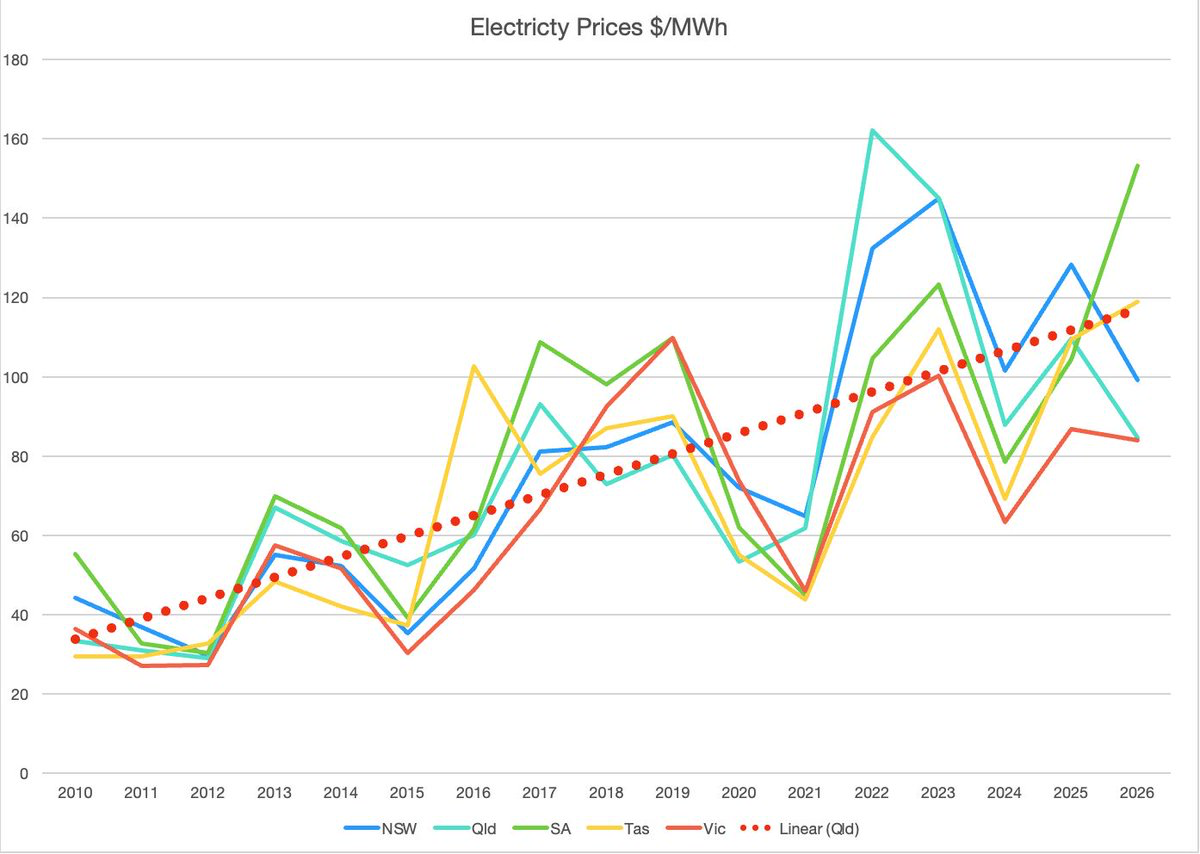
Lots of people are now saying renewable energy is cheaper.
Why then have our electricity prices done this since we started installing it?
Thanks to Mark Gell for the graphic. (Senator Canavan)
Renewable Energy Is Generally Cheaper — But with Nuances
1. Lowest Cost of New Builds
The latest GenCost 2024-25 report from the CSIRO (in collaboration with AEMO) confirms that renewables remain the lowest-cost and most practical option for new electricity generation in Australia. PV Magazine AustraliaClean Energy Council
2. Firmed vs. Standalone Costs
- Firmed renewables (wind/solar plus storage and firming) currently cost slightly more than underground black coal in some scenarios: $116/MWh vs $111/MWh. However, this is a temporary snapshot. The Australian
- Stand-alone renewables, like solar and wind alone, are significantly cheaper:
- Solar is as low as $48/MWh
- Wind around $80/MWh The AustralianRenewEconomy
- By 2030, firmed renewables are projected to drop to $76/MWh, while coal is expected to increase to $103/MWh. The Australian
3. Long-Term Savings and Bill Impacts
Renewables exert downward pressure on electricity prices — for instance, modeling shows that without renewables and battery storage, wholesale prices in 2024 could have been up to $80/MWh higher. ceig.org.au
Moreover, the Clean Energy Council cautions that delaying renewable expansion could lead to a 30% increase in household bills and 41% for small businesses by 2030. Clean Energy Council
4. Integration Costs & Grid Challenges
Factors like new transmission lines and storage infrastructure add costs to integrating renewables — so while generation can be cheap, overall grid transformation remains expensive. PV Magazine Australia The Australian
Some media analyses suggest costs will rise due to infrastructure and intermittency.
Who to believe?