Rail freight operations across northern England were brought to a standstill on Monday (23 June), after a major fire broke out at the disused Hotspur Press building in central Manchester. The building, directly adjacent to Oxford Road station and within metres of the Castlefield Corridor tracks, was engulfed in flames, triggering an immediate shutdown of one of the UK’s most critical mixed-traffic rail arteries.
The fire, which broke out mid-afternoon, forced the evacuation and closure of Oxford Road station. Thick smoke drifted across the city centre, and access to the corridor was suspended for emergency safety reasons. Services between Manchester Piccadilly and Deansgate were halted, with a ripple effect felt across the wider rail network. Freight services at Trafford Park use the corridor and are significantly affected.
Key freight artery closed
The Castlefield Corridor is one of the busiest and most congested sections of track in the UK. Linking Manchester Piccadilly and Oxford Road with Trafford Park and the West Coast Main Line, it is a key artery for domestic and intermodal freight services. Monday’s closure resulted in the suspension or diversion of multiple freight trains, including time-sensitive overnight intermodals and local bulk flows locally from Trafford Park, and at the nearby Ditton intermodal terminal in Widnes. It’s not clear if other freight facilities in Salford and Manchester are also affected.
Video (above) shared by the Manchester Evening News clearly shows the proximity of the burning structure to the railway. While Oxford Road station is just out of frame, the Castlefield tracks are visible beside the flames. The corridor is already under scrutiny for its lack of capacity, and the fire incident adds further pressure to improve resilience and contingency options. According to RailFreight.com sources, the incident was reported at 1646 with rail services suspended at 1725 after flaming debris started falling on the tracks.
Infrastructure impact and safety concerns
At time of writing (Monday evening 23 June), services on the corridor remain suspended. The National Rail enquiries service, infrastructure agency Network Rail and Transport for Greater Manchester report that safety inspections are required before any reopening can proceed. Concerns centre on the structural integrity of the fire-damaged building and its proximity to the live railway. It is unclear how long services will be disrupted, but National Rail updated suspensions until at least 2300 on Monday night.
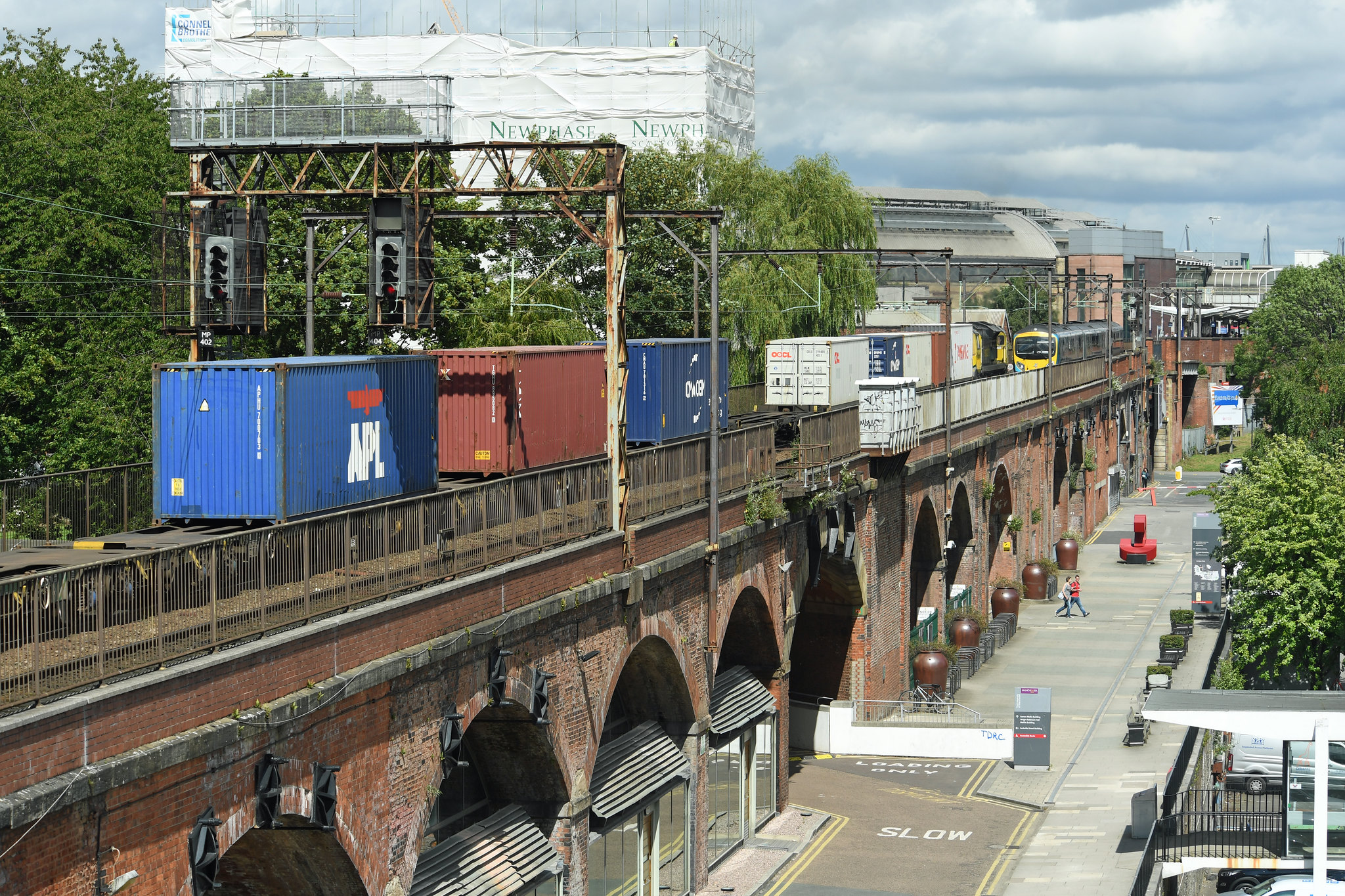
Freight operators, including Freightliner, DB Cargo UK, and GB Railfreight, are all said to have reported delays and diversions. In any case, the schedules for overnight services have been thrown into disarray. The incident underscores the vulnerability of freight operations on passenger-heavy urban corridors with limited route redundancy.
Redevelopment zone under scrutiny
The Hotspur Press building, originally built in 1801 as Medlock Mill, became a printing works until 1996. It has been derelict for decades but is part of a wider redevelopment zone in Manchester’s Southern Gateway. A student accommodation tower with retained heritage elements was approved in 2024, and plans are underway to transform Oxford Road station as part of the Castlefield Corridor capacity enhancement and regeneration.
Oxford Road station, itself a listed structure with a distinctive wooden canopy, has long been earmarked for redevelopment to support capacity upgrades. The fire may now complicate both heritage and transport planning around the site, particularly if structural damage has implications for adjacent rail infrastructure.
Knock-on effects likely to persist
National Rail has advised that services will not resume before 2300 on Monday, with disruption expected to continue into Tuesday. Passenger operators are urging clients to anticipate further delays and possible service alterations.
For the rail freight sector, Monday’s events are a stark reminder of the fragility of key routes through urban environments. The Castlefield Corridor, already operating at capacity, has little room for manoeuvre in the face of sudden disruption. Calls for investment in alternative freight capacity around Manchester—such as the long-proposed Northern Hub enhancements—are likely to resurface with renewed urgency.