Four of Britain’s rolling stock leasing companies (ROSCOs) are supporting cross-industry research projects led by the Rail Safety and Standards Board (RSSB). These initiatives aim to enhance both the operational efficiency and safety performance for the entire rail industry.
Working together, Angel Trains, Beacon Rail, Eversholt Rail, and Rock Rail have signed a Memorandum of Understanding (MoU) with RSSB creating a framework for research for the future with collaboration on long term topics. The agreement is underway, with a forum set up to govern the work and co-funding in place for key research projects in the first year:
- Enhanced trailing arm bush prototype testing. This innovative new train suspension design aims to reduce costs for the industry by reducing track wear, while further improving the ride comfort of rail travel.
- Review of AC electric rolling stock power limitations. To improve system capacity and optimise train performance without the need for major new investment.
- Framework for assessment of technologies to deliver reliable braking in low adhesion. Supporting a strategic approach to mitigating low adhesion conditions that impact rail operations and safety, by enabling the assessment of new and existing solutions for low adhesion management.
- Improving the assessment of rolling stock crashworthiness. Modelling the potential consequences of a train-train collision, train-object collision, train-buffer collision and train derailment to help make rail safer.
To support the research, the ROSCOs are also supplying expertise, evidence and data into the projects. The first research projects are ongoing, with delivery expected to be complete in 2025 and 2026.
Richard Walker, RSSB’s deputy director research, said: “These four important research projects, collaboratively funded for the first time in partnership with multiple ROSCOs, are going to bring benefits to the whole rail industry.
“The commitment from our partners, Angel Trains, Rock Rail, Eversholt Rail and Beacon Rail shows the ROSCOs’ dedication to supporting improvements to GB rail.
“Enhanced safety, increased frequency, and reliable train services are essential to meet the expectations of passengers and customers. These projects will make key contributions toward achieving these goals.”
Matthew Prosser, asset management director at Angel Trains, commented: “We’re really pleased to be a part of these four important research projects with RSSB. Angel Trains is committed to the success of the UK rail industry, and we look forward to seeing the benefits this research will bring in enhancing rail safety and performance.”
Paul Sutherland, client services director at Eversholt Rail added: “Signing this MOU has set up a means by which the RSSB and the Roscos can focus on a variety of topics relating to rail vehicles and their interaction with the infrastructure. This will unlock safety and performance benefits and inform work on future rail technology. Eversholt Rail are proud to be working in collaboration on these projects.”
Research projects:
Enhanced trailing arm bush prototype testing
Testing of the Enhanced trailing arm bush (E-TAB) prototype on a dynamic test rig and building the case for an in-service trial.
Review of AC electric rolling stock power limitations
Investigating the background and rationale for traction power parameters to which AC electric rolling stock and electrification systems are operating – maximum train current, minimum voltages, automatic current or power limitation as a function of line voltage, and power frequency harmonics. The aim is to determine if there are benefits from changing these parameters to make better use of the 25kV AC traction power network (improve system capacity) and optimise train performance.
Framework for assessment of technologies to deliver reliable braking in low adhesion
In partial response to Recommendation 9 of the RAIB Salisbury report, this project will produce a technical framework which will set performance targets and assessment criteria against which low adhesion mitigations can be assessed. This will support a strategic approach to deploying existing low adhesion mitigations and provide for the assessment of new solutions for low adhesion management.
Improving the assessment of rolling stock crashworthiness
o Modelling the potential consequences of a train-train collision, train-object collision, train-buffer collision and train derailment. The model will consider the train type (crashworthiness), train speed, train length, size of object, and loading.
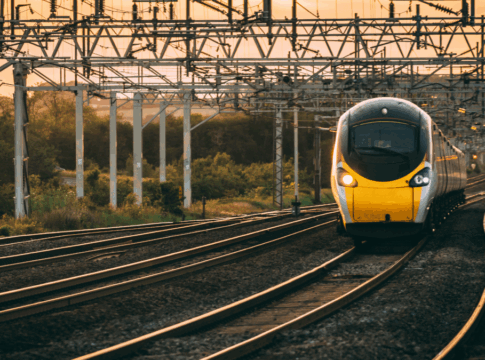
Image credit: iStockphoto.com/Marc-Scruton