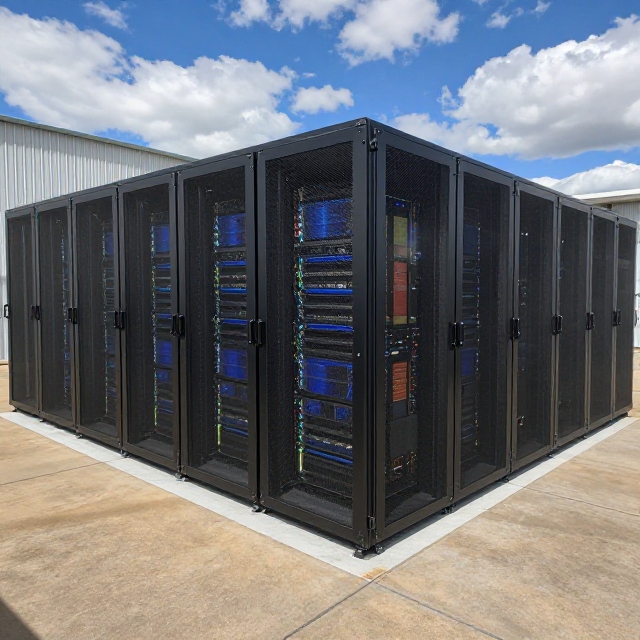
Rather than a uniform expansion across all 54 nations, African data centre growth is heavily concentrated within four primary geographic powerhouses.
1. South Africa: The Primary Continental Engine
South Africa remains the undisputed heavyweight of the African data centre market, commanding roughly 70% of the continent’s total data centre capacity.
- The Core Markets: Johannesburg serves as the ultimate continental powerhouse, while Cape Town operates as a critical secondary hub. Durban is also emerging as a tactical coastal alternative.
- Industry Leaders: The market is anchored by major international and local operators, including Teraco (A Digital Realty Company), Africa Data Centres, Vantage Data Centers, and Equinix.
- The Catalyst: South Africa’s mature financial sector and its position as the primary landing zone for a massive web of subsea cables make it the default entry point for global cloud giants.
2. Nigeria: West Africa’s Digital Gateway
With the largest population on the continent, Nigeria is rapidly scaling its infrastructure, centered almost entirely in Lagos.
- Key Areas: Areas like Eko Atlantic City are becoming major targets for high-capacity facilities.
- Industry Leaders: Global heavyweight Equinix entered the market via its acquisition of MainOne, alongside strong footprints from Rack Centre and Nxtra by Airtel Africa.
- The Catalyst: A roaring fintech sector and an urgent mandate to localise data for a population of over 220 million people are driving hyperscale demand.
3. Kenya: East Africa’s Renewable-Powered Hub
Kenya acts as the primary digital anchor for East Africa, with Nairobi (including tech-focused developments like Tatu City) serving as the regional nexus.
- Industry Leaders: Driven heavily by expansions from Africa Data Centres, Nxtra, and institutional real estate backing.
- The Catalyst: Kenya stands out globally for its renewable energy profile, utilizing vast geothermal resources to power facilities. This green energy advantage is highly attractive to multinational corporations aiming to meet strict ESG (Environmental, Social, and Governance) targets.
4. North Africa: Strategic Gateways to Europe
Positioned at the crossroads of Europe, the Middle East, and Africa, Egypt (Cairo and Alexandria) and Morocco (Casablanca and Rabat) form a vital northern digital corridor.
- The Catalyst: Egypt is historically one of the world’s most critical transit points for international subsea fibre. Meanwhile, Morocco acts as a highly stable, low-latency nearshore gateway for European enterprises looking to tap into African markets.
Key Drivers Accelerating Market Growth
The momentum behind these hubs is fueled by several converging macroeconomic trends:
- Subsea Cable Connectivity: The recent deployment of massive subsea cables—such as Google’s Equiano and Meta’s 2Africa—has brought terabits of international capacity to African shores, driving down bandwidth costs and demanding robust onshore data centres to handle the traffic.
- Data Sovereign Laws: Governments across Africa are increasingly implementing data protection laws (similar to Europe’s GDPR). These regulations mandate that sensitive financial, health, and citizen data must be stored within national borders, sparking a building boom for localized facilities.
- The Cloud and Mobile Boom: Africa’s mobile-first population is driving massive consumption of video streaming, e-commerce, and digital banking, forcing global cloud providers (like Microsoft Azure, AWS, and Google Cloud) to establish a local presence to lower latency.
The Road Ahead: Challenges and Opportunities
Despite the explosive growth, the African data centre market faces localized hurdles. Power grid instability, high real estate costs in dense urban zones, and water scarcity (required for traditional cooling systems) present persistent operational challenges.
However, these bottlenecks are inspiring creative solutions. Operators are increasingly investing in proprietary solar and geothermal power, energy-efficient cooling technologies, and modular “edge” data centres designed to bring connectivity to secondary cities.
As billions of dollars in institutional capital continue to pour into the continent, Africa’s data centre market is no longer just a sector to watch—it is the foundational engine powering the continent’s economic future.