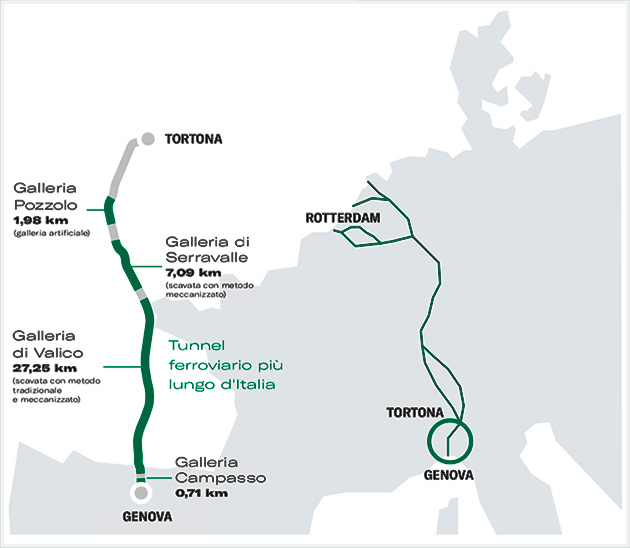
The Terzo Valico is a key rail project for Italy and the Rhine-Alpine axis, but its completion has been postponed multiple times. The latest update claims that the new line linking the port of Genoa to Tortona will be operational in mid-2028, which would be seven years after the original deadline set when works started 14 years ago.
The new schedule was shared by Calogero Mauceri, Special Commissioner for the Terzo Valico Project. In an interview with Italian media Primocanale, he underlined how there is only about 900 metres left to dig. This should be done by spring 2027, with another year needed to install railway equipment in the tunnels, he said.
More specifically, there are 240 metres left to excavate along the Castagnola–Cravasco section and 640 more for the Castagnola–Vallemme. The delays along the latter were due to issues with firedamp deposits, which forced workers to stop and change the digging method, ditching the much faster tunnel-boring machines.
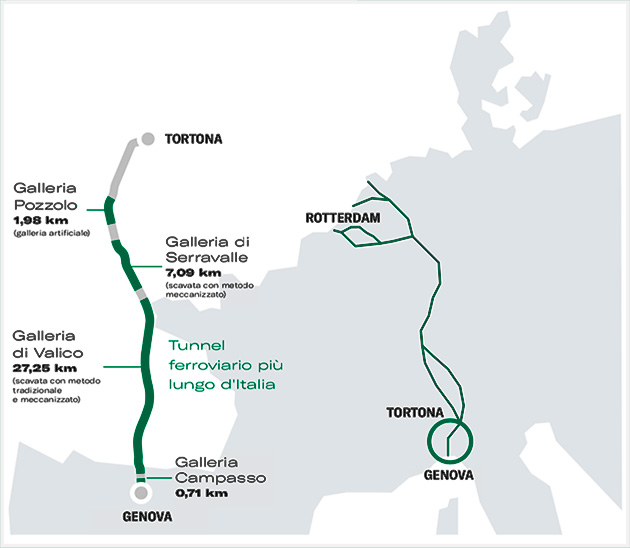
Terzo Valico
The purpose of the Terzo Valico is to create a valid rail connection between the port of Genoa and the rest of the TEN-T Rhine-Alpine Corridor, which runs north to Rotterdam. The name, which means Third Passage, comes from the fact that it will be the third line crossing the mountains behind Genoa. The first one was the Genoa-Turin line built in the mid-1800s, while the second one is the Giovi bypass, built in 1889.
The age of the two existing lines alone highlights the need for a much more modern infrastructure around Genoa, especially because it is the starting point of Europe’s busiest freight corridor. Construction started in 2012, with the first deadline set for 2021. As the years went by, the end of the work kept slipping, and it is not set for mid-2028.
Despite being a significant project, the Terzo Valico will not solve all the existing problems. Once trains reach Tortona, they will still encounter a bottleneck on the way to Milan. The Voghera-Pavia line, starting right at the end of the Terzo Valico, should be quadrupled, but Italy is struggling to secure the funds. In other words, the full potential of the project would be reached only if the rest of the corridor is up to date as well.