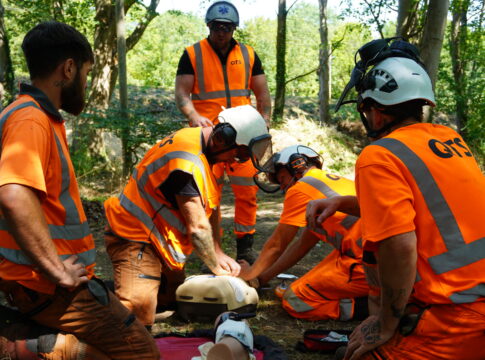
Leading rail contractor, QTS Group, has introduced a new series of practical first aid drills, designed to test the team’s response in a live safety emergency and put the team through a workplace medical emergence on site.
Led by Andrew Sullivan, assistant HSQE advisor at QTS Group, teams are run through a series of realistic, on-site scenarios covering major bleeds, CPR and defibrillation, burns, spinal injury, crush injury and electrocution.
Andrew designed the drills using experience built up over 17 years in the security industry, along with time spent managing a mechanised arboriculture division in remote sites and more recently training as a volunteer rescue team medic.
Rather than focusing on first aid techniques alone, these scenarios focus on the non-technical skills, testing how a whole team manages an emergency including communication, delegation, calling the emergency and evacuating a casualty once they have secured the scene.
For every minute a casualty does not receive effective CPR, their chance of survival drops by roughly 10%, and within ten minutes survival is unlikely. A catastrophic bleed can prove fatal within five minutes on site, while UK ambulance response times can range from eight to sixteen minutes even in ideal conditions.
Since 2016, the Office of Rail and Road has recorded 860 RIDDOR-specified injuries, incidents serious enough to be legally reportable under UK workplace safety regulations, across the rail infrastructure, along with 23 rail industry workforce fatalities over the same period.
Wales & Western alone has recorded five workplace cardiac arrests, two of them fatal. In the UK, only around one in 12 people survive an out-of-hospital cardiac arrest, and Category 1 ambulance response times can reach 15 minutes, longer on remote sites.
Andrew Sullivan, assistant HSQE advisor at QTS Group, said: “Classroom training gives our teams the knowledge, but these scenarios let them turn that knowledge into practice. That’s something you can’t replicate in a nice, safe, quiet classroom.
“Out on site you’ve got the noise, the weather, trains passing, a casualty who might be screaming or bleeding. We build all of that pressure into the scenario to make it as realistic as we can.
“Emergencies are rarely managed by one person on their own, it’s a teamwork issue, and it can be the difference between life and death.
“As we say, you don’t rise to the occasion, you fall to the most basic level of your training. So we drill the basics over and over again, make sure the team knows exactly what they’re doing, and make it second nature. That gives the casualty the best possible chance.”
The drills build on QTS Group’s existing health and safety framework, which includes a dedicated in-house team. The initiative is a further step in that ongoing programme, designed to test and strengthen how effectively that framework translates into on-site practice under real pressure.
For more information on QTS Group’s approach to health, safety and training, visit https://www.qtsgroup.com/
Image credit: QTS Group