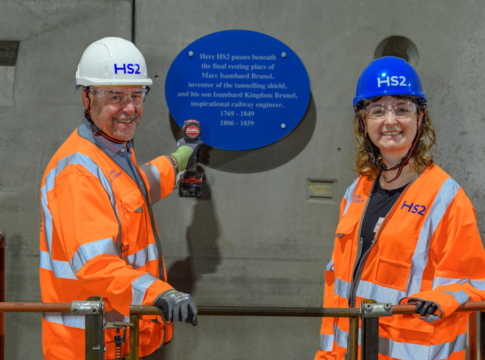
HS2 Ltd has revealed a new plaque installed 40 metres underground, marking the spot where the high-speed railway passes beneath the tomb of the Brunel family – one of the world’s greatest engineering dynasties.
The two tunnel boring machines constructing the Euston Tunnel between Old Oak Common and central London travel underneath Kensal Green Cemetery, the first of the ‘magnificent seven’ cemeteries established outside of central London between 1833 and 1841. The Brunel family, and notably Sir Marc Isambard Brunel, and his son Isambard Kingdom Brunel, were buried there.
Mark Wild, HS2 Ltd Chief Executive, joined Katherine McAlpine, director of the Brunel Museum, and engineers from Skanska Costain STRABAG, the joint venture delivering this section of the rail project, to celebrate the pioneering engineering family by installing a plaque on the tunnel wall.
Sir Marc Brunel invented the tunnel shield method, patenting the rectangular tunnelling shield in 1818, inspired by the boring mechanism of the shipworm. This was successfully used in 1825 to excavate the Thames Tunnel in London, the world’s first underwater tunnel. Over 200 years later, HS2 Ltd continues to use tunnel boring machines adorned with tunnelling shields, based on the revolutionary work of Sir Marc Brunel.
Isambard Kingdom Brunel, Sir Marc’s son, continued with revolutionary tunnelling projects, building the Box Tunnel for the Great Western Railway, which at the time was the longest railway tunnel in the world. Despite being considered an impossible and dangerous engineering project by its critics, the Box Tunnel between Chippenham and Bath, is considered one of Brunel’s most celebrated structures. Isambard Brunel is widely regarded as one of the most celebrated civil engineers of all time, working as chief engineer of the Great Western Railway, collaborating on the design and construction of Paddington Station, as well as being the designer of the Clifton Suspension Bridge in Bristol.
As HS2 constructs tunnels across the route between London and the West Midlands, expert teams undertake extensive monitoring before, during and after the tunnelling works, and where there are sensitive historic sites, detailed assessments and specialist works ensure any vulnerable heritage assets are protected. At Kensal Green cemetery the team have ensured that the construction happens safely, conscientiously and with respect.
Mark Wild, fellow of the Royal Academy of Engineering and HS2 Ltd CEO, said: “The significance of the achievements of both Sir Marc and Isambard Brunel in engineering cannot be under played. How we build our tunnels today is because of Sir Marc’s work, and how we build our railways is because of how Isambard Brunel built the Great Western Mainline. He built railways flat and straight, and future-proofed them for improvements in speed and capacity which is why we still use them today.
“Installing this plaque gives me the opportunity to reflect on the scale of what the 30,000 strong workforce on HS2 are building – a new railway for future generations that will stand the test of time, despite all the challenges we face.”
Katherine McAlpine, director of the Brunel Museum in London, commented: “Modern tunnelling of the scale of HS2 would not have been possible without Marc Brunel. His tunnelling shield which he patented in 1818, made way for the Tunnel Boring Machines of today. 200 years ago, the father and son team embarked on an audacious project to dig the world’s first tunnel under a navigable river, laying the foundations for huge projects like this.
“I am delighted we are able to mark this milestone of HS2 travelling underneath the final resting place of Marc Brunel and Isambard Kingdom Brunel, as a testament to their ingenuity and perseverance.”
Eddie Edmonds, delivery lead, Skanska Costain STRABAG joint venture, added: “It’s a privilege to be able to recognise Sir Marc and Isambard Brunel as we pass beneath their memorial. They paved the way for safe modern tunnelling methods and the use of shielded tunnel machines that have enabled us to be safely tunnelling today.
“For the SCS team delivering the tunnel, passing beneath Brunel’s final resting place is both a technical achievement and a moment of reflection. Unveiling this plaque recognises the extraordinary engineering legacy Brunel left behind while celebrating the expertise and commitment of our workforce today and the way we’re delivering the works that will shape the country’s infrastructure for generations to come.”
The two tunnel boring machines (TBMs) began their journeys towards Euston at the start of 2026 after the Government committed to delivering HS2 all the way into the heart of London. The 4.5 mile route will be completed next year with the TBMs finishing underground just outside of where the new HS2 station will be constructed.
Image credit: HS2