The war in the Middle East feels distant—until it isn’t. For all the abstraction of maritime charts and oil price indices, the consequences are now arriving, quite literally, at Britain’s quayside. From there, they ripple inland. UK Editor Simon Walton says that across rail terminals, pathing plans, and the delicate choreography of intermodal logistics, there is a concern.
Aden, Oman, Hormuz and Suez. Not the usual places likely to be seen on the indicator board at your local station – but these are not usual times. While tanker ships are denied access to the Persian Gulf, and container ships reroute away from the Suez Canal, the Cape of Good Hope is back to its nineteenth-century level of shipping importance. That has added weeks to transit times and stripped reliability from twenty-first-century global schedules. Ships that once arrived in neat, predictable windows are now turning up late, or all at once. That bunching effect is becoming the defining feature of the disruption. And it is landing squarely on the UK’s port-rail interface.
From timetable to guesswork
You wait all day for an ultra-large container vessel to arrive – then a whole fleet turns up at once. For rail freight operators, predictability is everything, and this is anything but predictable. Intermodal services are planned with precision. Train paths are secured, crews diagrammed, wagons cycled, and terminals staffed. That model depends on ships arriving when expected. Right now, it’s a case of expect the unexpected.

Delayed vessels are arriving in clusters. A week’s worth of cargo can materialise over a day or two. The result is a surge in boxes on the quayside, followed by periods of relative quiet. It’s already being felt across Europe, as RailFreight.com reported earlier, and Britain is not immune. For rail, that creates a stop-start demand profile that is difficult to serve efficiently.
Trains may depart underloaded, or not at all, when ships are late. Then, when volumes spike, there may not be sufficient paths, locomotives or terminal slots to clear the backlog quickly. The consequence is inefficiency at both ends. Ships operate to strict timetables, too, and disruption means lost productivity during lulls and intense pressure during peaks. This is not how intermodal rail, or shipping, is designed to operate.
Running light, or not running at all
With European ports already attributing falling volumes due to the Middle East crisis (read more at WorldCargoNews.com), there is already anecdotal evidence of services running below capacity. In some cases, trains are departing with reduced loads simply to maintain network rhythm and contractual obligations. In others, departures are being cancelled or consolidated, disrupting downstream logistics. Neither outcome is ideal.
Running light erodes the economics of rail freight. Intermodal margins are tight at the best of times. Underfilled trains quickly become unviable. Yet cancelling services risks losing customer confidence, particularly for time-sensitive cargo.

This tension is not new, but it is being amplified by geopolitical disruption. The reliability premium that rail has traditionally offered over road is harder to sustain when the upstream supply chain is itself unreliable. In storage-staved Britain, where the efficient logistics industry makes up for a shortage of modern warehousing, this is one step away from empty supermarket shelves.
The quayside crunch
At the ports, the challenge is acute. When multiple deep-sea vessels arrive within a compressed window, terminals face a familiar problem: too many containers, not enough immediate capacity to move them inland. Rail should, in theory, provide an answer. High-capacity trains can shift large volumes quickly, reducing pressure on port storage and easing congestion at the gate. In many cases, they do, but there are limits.
Rail paths on key corridors are finite, especially on Britain’s busy mixed traffic network. Terminal handling capacity, both at the port and inland, is constrained. And the availability of locomotives, wagons and trained crews cannot be scaled up overnight. When the system is hit by a sudden surge, rail can help, but it cannot absorb the entire shock.
Can rail smooth the flow?
There is a strong argument that rail is uniquely positioned to mitigate the worst effects of this disruption. Compared with road haulage, it offers greater throughput per movement and lower marginal emissions—an increasingly important consideration for shippers.
Moreover, rail networks are inherently suited to moving large, consolidated volumes. When ships arrive late but full, that plays to rail’s strengths. However, smoothing the flow requires flexibility. That’s something the current UK rail freight model struggles to provide at short notice. Pathing is still relatively rigid, and the ability to introduce additional services or retime existing ones is limited. Rail freight operators can pre-position assets, build contingency into schedules, and collaborate closely with ports and shipping lines, but these are incremental solutions to a structural problem.
Will road take the strain?
In practice, much of the immediate response is likely to fall to road haulage. Trucks can be deployed more flexibly, with shorter lead times and fewer infrastructure constraints. When containers need to move quickly, road often becomes the default option, although there is not an endless fleet of trucks waiting at the port gate line.
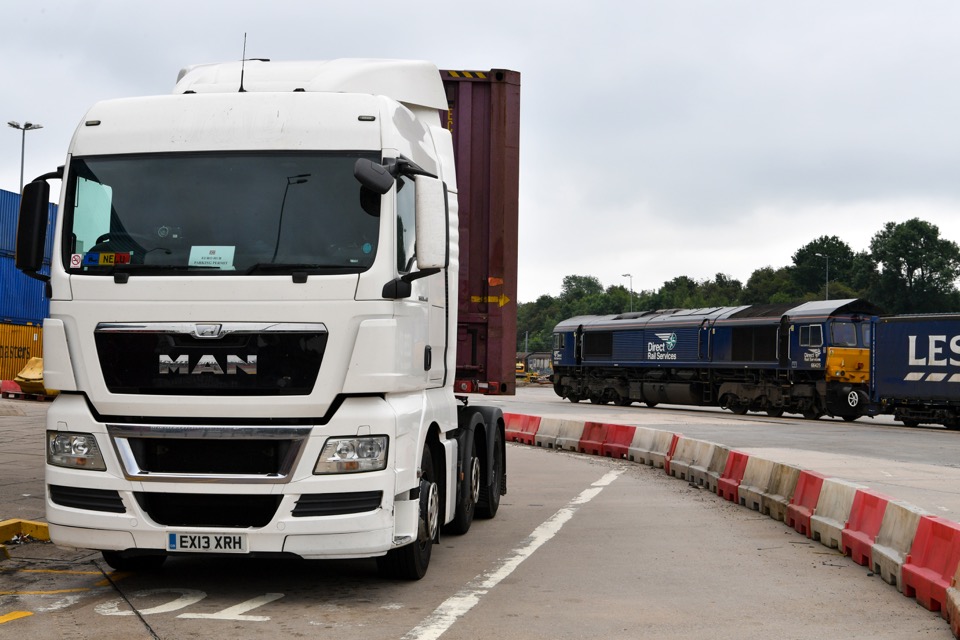
A surge in road movements from ports risks exacerbating congestion on already busy corridors. For example, anyone driving on the A14 between Felixstowe and the Midlands will already be an advocate of great rail capacity. It also runs counter to long-term policy objectives around modal shift and decarbonisation. Yet in the face of unpredictable demand, flexibility tends to trump efficiency. Rail, for all its advantages, cannot yet match that flexibility at scale. If only there was some redundancy built into the system – it’s almost as though the network had been rationalised to the bone and left with no spare capacity in time of need.
A system under stress is the new normal
What we are seeing is a stress test of the UK’s intermodal system. The disruption originating in the Middle East is exposing the interdependencies between maritime and rail logistics and the fragility of the links between them. It also highlights a broader point. Supply chains are only as resilient as their least flexible component. When one part of the system becomes volatile, the pressure is transmitted throughout.
For rail freight, this is both a challenge and an opportunity. If the sector can find ways to increase responsiveness—through more dynamic pathing, greater terminal capacity, and closer integration with port operations—it can position itself as a stabilising force in an unstable world. If not, it risks being sidelined when it is needed most.
There is no immediate prospect of a return to fully stable shipping patterns. Even if traffic through the Suez Canal normalises, the experience of recent months will leave a lasting imprint on how carriers route vessels and how shippers manage risk.
For rail freight, that means adapting to a more volatile demand environment. The war may be far away. But its effects are now arriving, irregularly and unpredictably, at a rail terminal near you.