The full Feasibility Study for the proposed Peaks and Dales Line – a reinstated rail corridor linking the North West and East Midlands between Manchester and Derby, via Chinley, Buxton, Bakewell, and Matlock – has now been formally submitted to the Department for Transport for review through the Better Value Rail Working Group, comprising the DfT, Network Rail, and the Office of Rail and Road.
The submission marks a significant milestone for the project and confirms that no prohibitive technical, environmental, planning or delivery barriers have been identified at feasibility stage that would prevent the corridor progressing to the next phase of development, a Strategic Outline Business Case (SOBC).
The study responds to longstanding and worsening transport and traffic pressures across the Peak District, High Peak, and Derbyshire Dales corridor, including:
- Severe and persistent road congestion on key routes including the A6, A623, A515, and A53.
- Heavy reliance on private car travel within a protected National Park landscape.
- Limited public transport accessibility for rural communities.
- Growing pressure on the visitor economy and sensitive environments.
The Feasibility Study concludes that, following transport hierarchy assessment, rail reinstatement represents the only high capacity, low carbon response capable of addressing these challenges at the required scale.
Using conservative assumptions and benchmarking against comparable UK reinstatement and enhancement schemes assessed under the Department for Transport’s Better Value Rail framework, the study identifies that reinstating the Peaks and Dales Line could:
- Generate £2-£8 billion in additional Gross Value Added (GVA) by 2040.
- Remove approximately 1.0-4.3 million car ‘trips’ per year from the road network (from visitor travel alone).
- Deliver carbon savings of around 15,000-60,000 tonnes of CO₂e per year.
- Provide a viable sustainable travel option for the 13-26 million people who visit the Peak District annually, around 85% of whom currently arrive by car.
- Improve access for the 3.16 million people across the connected regions who do not own or have access to a car.
- Support sustainable access to approximately 17,870 previously identified potential new homes, all located on brownfield land outside the National Park.
- Enable £447-£804 million in potential voluntary Land Value Capture contributions, reducing reliance on public funding.
The study also confirms that only around 11.5 miles of reinstated railway would be required to reconnect a corridor of nearly 50 route miles, representing a highly efficient reuse of historic rail infrastructure. Various upgrade options are being considered across the remainder of the route.
A central finding of the study is that rail reinstatement offers a practical mechanism to protect the Peak District by reducing traffic pressure, improving air quality in sensitive valleys, and enabling a shift towards sustainable visitor access.
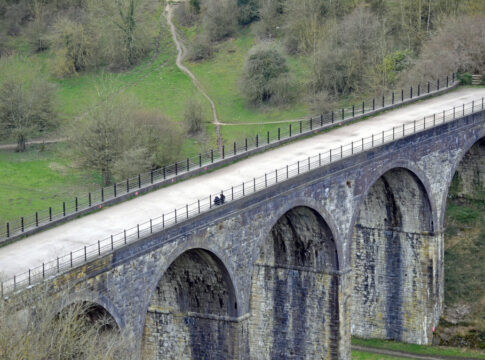
The proposals include an enhanced Monsal Trail Network, ensuring that walking, cycling, and leisure routes are improved and expanded alongside the railway rather than displaced, supporting multimodal access while retaining recreational value.
The study identifies wider strategic benefits beyond the immediate corridor, including:
• Improved east–west connectivity between the North West and East Midlands
• Additional resilience and diversionary capacity for the Hope Valley Line, Midland Main Line and West Coast Main Line
• Alignment with national decarbonisation, modal shift, and integrated transport objectives
The project has secured formal cross party parliamentary support, with more than twenty six MPs across the East Midlands, North West and South Yorkshire having signed a joint letter of support to the Minister for Rail.
Derbyshire County Council is also scheduled to consider a motion of support at its May meeting.
Martyn Guiver, director of operations at Peaks and Dales Line Ltd, commented: “This feasibility work demonstrates clearly that the Peaks and Dales Line corridor is credible and deliverable in principle.
It shows that rail reinstatement is the only intervention capable of addressing congestion, accessibility and environmental pressure at the scale now facing the corridor and provides a robust foundation for progression to a Strategic Outline Business Case.”
With feasibility confirmed, the project can now progress to Strategic Outline Business Case (SOBC) development. This stage will include:
• Detailed option development and comparative assessment
• Formal passenger demand and economic modelling
• Environmental assessment and design refinement
• Further engagement with authorities, stakeholders, and communities
No preferred detailed alignment, station locations or service patterns have been selected at feasibility stage; all options within the established corridor will be assessed proportionately through the Strategic Outline Business Case process in line with Department for Transport guidance.
Image credit: Peaks and Dales Line Ltd