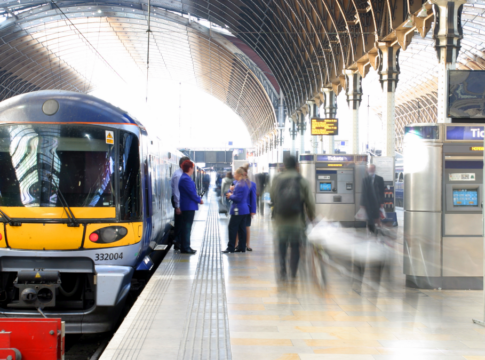
Monitoring by the Rail Safety and Standards Board (RSSB) has found that air quality in stations across Britain is generally good, and where improvements are needed, the rail industry is already acting. The findings form part of the Air Quality Monitoring Network (AQMN), commissioned by the Department for Transport (DfT) to provide transparent, reliable information about station environments for passengers.
Rail is already one of the lowest‑emission transport modes. Government figures show rail accounts for just 4% of domestic transport NOx pollution, with emissions falling by 39% in the decade to 2023. Government and industry continue to work together to reduce rail’s environmental impact further.
Air quality is an important public health issue, and the Government has recognised that high concentrations of nitrogen dioxide and particulate matter can have detrimental health effects. To strengthen transparency, public confidence and identify locations where improvement action was needed, RSSB was commissioned as the rail industry’s independent technical research and standards body, to carry out detailed monitoring across Britain’s railway stations.
The AQMN is the first and largest systematic air quality monitoring network on a mainline railway anywhere in the world. Monitoring focused on around 100 stations where pollution levels for passengers could potentially be higher. The evidence identified around 50 stations that would benefit from an air quality improvement plan, and operators and Network Rail have already begun implementing them.
The data cannot be used to measure air quality for people working in stations, as worker exposure is assessed differently under separate legal requirements.
Examples of how Britain’s railway is addressing air quality include:
- Continued DfT funding for the AQMN until 2030, and commissioning of the UK Health Security Agency (UKHSA) to undertake an exposure assessment for rail passengers.
- Introducing newer, cleaner trains and phasing out older diesel fleets. With the transition to Great British Railways, newer cleaner rolling stock will be introduced on routes with more challenging air‑quality conditions.
- The rail industry, supported by RSSB, has launched an industry wide idling focus group to help reduce emissions from idling diesel trains. These workshops bring together operators, engineers, and environmental leads to share progress, challenges, and best practices since the publication of the RSSB Idling Good Practice guidance. The aim is to support consistent implementation of idling reduction strategies and identify where further collaboration or support is needed.
- One train operator has fitted new train stop/start technology to reduce engine use in stations and on less power‑intensive parts of the network.
- All train operators running diesel fleets are reviewing idling practices, with some already reducing the length of time diesel engines are left running in stations.
- The rail industry is reviewing and adjusting timetables and dispatch arrangements to help reduce the amount of time diesel trains idle in stations.
- Improving ventilation and trialling innovative equipment, including filter columns and pollution‑reducing surfaces, at stations such as Salisbury and Birmingham New Street.
- Investigating alternative power sources to reduce diesel engines being used for train presentation activities and cold starts.
Rachael Everard, RSSB’s director of sustainability, said: “Air quality matters; the air we breathe is important to our health and well-being and to passenger comfort. As an industry, we are committed to creating a railway that has a positive impact on local air quality.
“Our research is helping identify the minority of areas where air quality is an issue on our network. By proactively identifying these locations, rail can act and target improvements quickly. Out of more than 2,500 stations nationwide, 50 needed an air quality improvement plan, and operators are already putting those into practice.”
Image credit: iStockphoto.com/urbancow