Cemex UK and Victa Railfreight have marked a major operational collaboration. The partners have moved 20 million tonnes of aggregates, by rail, from Dove Holes Quarry in Derbyshire since they began working together in 2018. Both companies have called the achievement a milestone that underlines the efficiency of rail freight in handling high-volume aggregate movements.
The achievement also demonstrates the continuing importance of rail infrastructure. The UK government infrastructure agency Network Rail looks after operational safety on the line to Dove Holes, which presents challenging gradients and tight curves. It also emphasises the environmental and operational benefits of heavy industrial operations within an area of natural beauty, and on a line steeped in rail heritage.
A historic and operational hub
Dove Holes Quarry sits within Derbyshire’s High Peaks. It’s part of the Peak District National Park, and covers more than 213 hectares. The quarry complex has been producing limestone since the late 18th century. Its rail spur links to the remains of a former main line connecting Manchester, Nottingham, and London. It was once the route of prestige passenger services. The iconic all-first-class “Blue Pullman” diesel multiple units of the 1960s thundered through. Today, the line serves as a dedicated freight corridor, supporting high-volume aggregate movements across the national network.

Despite modernisation elsewhere, Dove Holes retains traditional signalling, with a lever signal box controlling movements. This operational heritage coexists with contemporary high-capacity modern rail freight operations. Around half of the quarry’s output moves by rail, primarily to long-distance destinations, with the remainder transported by road to nearby regions.
Twenty megatons and jumbo trains
Moving twenty million tonnes of aggregates by rail since 2018 has avoided roundly 520,000 lorry (truck) journeys from local rural roads, according to the partners. As well as the quarry name, Dove Holes is the railhead for other quarry operations in the area. The volume of materials extracted has encouraged rail freight operators to experiment with “jumbo trains”. These very heavy, high-capacity workings are designed to consolidate two loads into one train and save valuable paths on the busy British network.
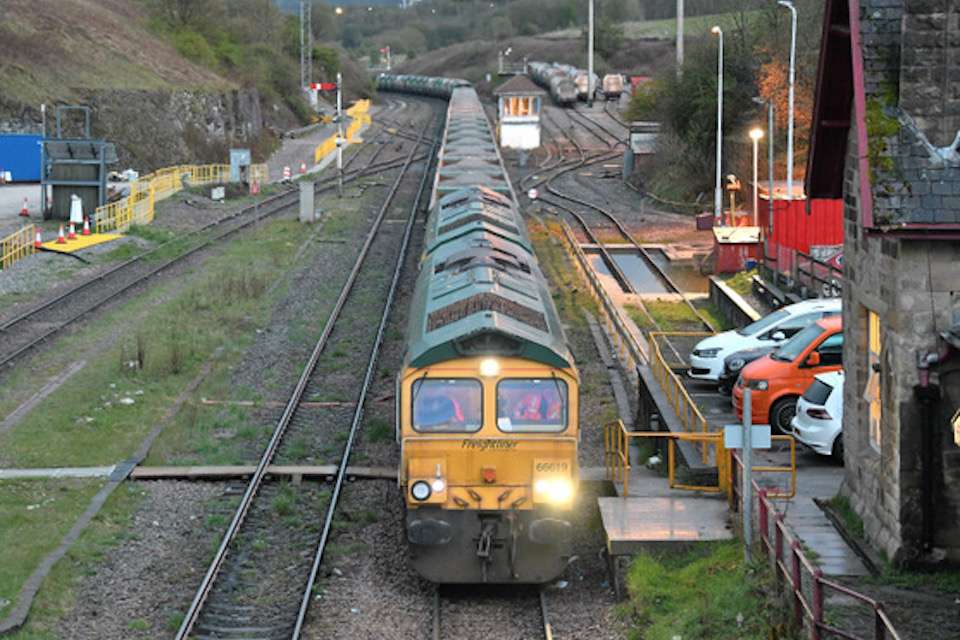
Victa Railfreight manages train arrivals, departures, shunting, and terminal operations at Dove Holes. Since 2018, the company says it has maintained a 99% and full record, ensuring that construction projects in Manchester, Birmingham, and London receive materials reliably. Maybe the missing 1% is the train that came adrift in the south of Manchester in September of 2024. That mishap aside, the milestone coincides with Victa Rail’s 30th anniversary, marking their three decades of specialist freight experience.
Network Rail supports freight capacity
Network Rail’s infrastructure is critical to operations at Dove Holes. The quarry is served via a twisting spur that navigates gradients and curves requiring careful operational coordination. Upgrades planned for the site include a new railhead and mechanised loading systems, designed to reduce internal train movements and increase throughput while accommodating jumbo trains.

Right now, while there are no passenger services to consider, safe operations remain a priority. Coordination between Cemex, Victa Rail, and Network Rail ensures trains are dispatched efficiently, in a quaint demonstration of historic and modern infrastructure working in tandem, supporting high-volume freight. The Blue Pullmans and the line eastwards of the quarry are both long gone.
Logistics and operational collaboration
Cemex UK integrates rail freight into its wider supply chain, with Dove Holes linked to other rail-served sites. These are as close as Salford (the destination of that derailed train in 2024), and as far as Washwood Heath in Birmingham and Somercotes north of Derby. The company’s “Future in Action” programme reinforces the environmental benefits of rail, reducing emissions while maintaining high operational performance.
Rail remains central to the Cemex strategy for delivering reliable, sustainable supply to major UK construction projects. As demand recovers, Dove Holes demonstrates how operational planning, heritage infrastructure, and specialist freight expertise can combine. Twenty million tonnes represents both a logistical and operational triumph. This historic corridor is vital now for modern rail freight operations.