The Swiss Federal Office for Transport (FOT) has introduced new safety rules relating to the wheels of freight wagons. Despite good intentions, the new rules could have far-reaching consequences for the rail freight industry, also beyond Switzerland.
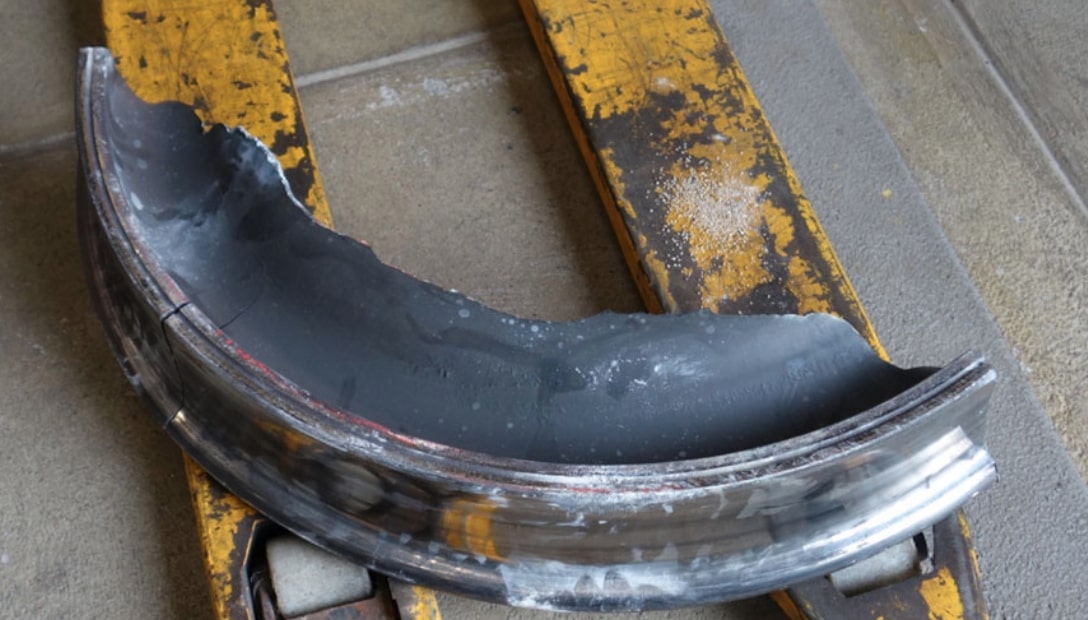
An investigation following the Gotthard Base Tunnel accident found that new composite brake blocks present a systematic risk of wagon wheel breakage. Subsequently, Switzerland started looking for ways to curb that risk. The FOT has now announced new safety rules, but those could turn into a disaster for European rail freight.
The safety measures come in five parts. For one, the FOT wants wheelsets to have a diameter of at least 864 millimetres. The current European standard is 860 millimetres. Moreover, the Swiss government agency wants more regular maintenance.
FOT safety measures for freight wagons in short:
- Minimum wheel diameter of 864 millimetres (EU: 860).
- Technical inspections after 50,000 or 200,000 kilometres, depending on brake shoes and wheel size
- Checks include wheel condition, diameter, heat damage and a sound test
- Each wagon must carry a valid inspection certificate
- Operators encouraged to use modern wheelsets with coloured overheating markers
- Driver training and departure sound tests to prevent overheating
Maintenance intervals
“Depending on the type of brake shoes and wheel diameter, the technical inspection must be carried out after 50,000 kilometers or 200,000 kilometers. Currently, in some cases, these inspections are systematically carried out at a later date.”
As part of maintenance checks, wheels should be visually inspected and the minimum diameter checked. Checks should also determine whether the wheels have suffered heat or other damage, and a sound test should be carried out to identify defective wheels.
In the future, every freight wagon must have a valid certificate of its last technical inspection. This allows railway companies to check whether a wagon has been properly maintained before it is included in a train traveling through Switzerland.
The safety of wagon wheels has become a top issue since the 2023 derailment in the Gotthard Base Tunnel, which caused severe infrastructure damage and kept the tunnel closed for a year. The incident posed a major challenge for rail freight on this crucial route. A derailment on Sweden’s Malmbanan line was also the result of a broken wheel.
Wagon owners are furious
Many voices in the rail freight industry are now protesting the FOT’s new rules. The International Union of Wagon Keepers (UIP) calls it “a rogue move”. UIP points out that Switzerland primarily targets wagon owners and those in charge of maintenance.
“We deplore a one-sided view that basically relieves the other rail system actors of their duties and does not consider safety investments on the side of operations and infrastructure”, the association adds. It also points out that in the case of the Gotthard accident, the investigation found that wagon owners complied with maintenance obligations.
The Swiss rail freight association VAP concurs. “With these new measures, the Federal Office of Transport is placing disproportionately high obligations on wagon owners compared to other stakeholders.” VAP highlights the reduced maintenance intervals as particularly disruptive, because it will “massively impact the availability of freight wagons and the profitability of operations.”
The maintenance interval measure, according to VAP, will lead to short-term bottlenecks in the freight industry and harm Switzerland’s supply security. “This topic was frequently discussed in advance and at the roundtables, but surprisingly little was considered in the FOT’s decision-making process.”
The Swiss association also foresees a reverse modal shift, rail freight’s nightmare scenario, because of the additional costs.

Absurdity
Across the border, Germany’s wagon owner association VPI also sharply criticised the FOT’s new rules. It highlights similar issues as VAP and UIP, and says that the new rules ignore the results of the so-called Joint Network Secretariat (JNS), an initiative by the European Agency for Railways (ERA) that aims at EU-wide harmonisations actions following rail accidents or incidents.
“It reduces to absurdity the relevance of the work of the JNS task force, which is expected to publish its European measures by the end of the year”, UIP also says about the step taken by FOT.
Switzerland wants the measures to be fully implemented by the end of the year. VAP, UIP and VPI all question the viability of that plan. Maintenance companies already lack resources, points out VAP, and the new rules will make that situation worse. More freight wagons will be unavailable more often and for longer periods of time.
“This, too, will initially be felt primarily by the freight forwarding companies, as they will need to purchase more wagons to transport the same volume of goods. As a consequence, more and more shippers are likely to turn away from rail freight transport and transport their goods by road in the medium term”, VAP states.
An obstacle to Rhine-Alpine rail freight
Importantly, the new Swiss rules also endanger cross-European interoperability. With its unilaterally introduced measures, Switzerland deviates from common European standards. Wagon owners may have to establish wagon fleets specifically adapted to Swiss rules, adding another cost factor to the mix. With Switzerland centrally located along one of Europe’s most important rail freight corridors (Rhine-Alpine), the rules impact a key artery for international traffic.
Wagon owners’ union UIP hopes that the focus will shift onto railway undertakings (RU) and the infrastructure manager: “It is unacceptable that RUs keep scaling back their technical on-site inspections and cutting investment in staff education, especially in a system that crucially depends on rigorous controls before, during, and after train operations.”
“We would do well to remember that […] the investigation identified areas for action not only for wagon keepers but also railway undertakings and the infrastructure manager”, UIP notes.
Switzerland has been quick to take bold action following the Gotthard investigation. Rail operator SBB earlier decided to phase out the LL brake blocks that are causing the safety risks.