When most people picture Australia’s data centre boom, they picture Sydney’s west (although not recently), South Australia or more likley Melbourne for its booming data centre developments. A proposal on the northern edge of a Murray River holiday town of around 2,500 people suggests the map is getting wider.
Plans have been revealed for a 350-megawatt data centre campus and industrial precinct at Mulwala, in the NSW Riverina. Proposed by local land-holders and domestic investors under Lambruk Mulwala Futures Pty Ltd, the project would span about 27 hectares alongside the existing Mulwala Solar Farm, close to the town’s substation zone and industrial area.
It is early days. The proponents are planning a first community briefing in Mulwala in December, ahead of formal planning milestones, and have invited residents, farmers and Federation Council to help shape a community benefits program focused on local infrastructure, agriculture and opportunities for young people. There is no public word yet on a tenant, a lodged development application or a confirmed power arrangement. But the idea is worth taking seriously, because it points to where the next wave of digital infrastructure may land.
Why Mulwala makes sense on paper
Data centre siting has always come down to a few fundamentals: land, power and connectivity. Mulwala has a credible story on at least the first two.
The site sits next to an operating solar farm and near an existing substation. The 25MW Mulwala Solar Farm, developed by European Energy Australia and tied to a 2023 power purchase agreement with Google, shows that new generation in this part of the Riverina can be linked directly to data centre demand. A 350MW campus is an order of magnitude larger than that solar farm, so it would not be self-supplied, but proximity to existing grid infrastructure is exactly what developers look for.
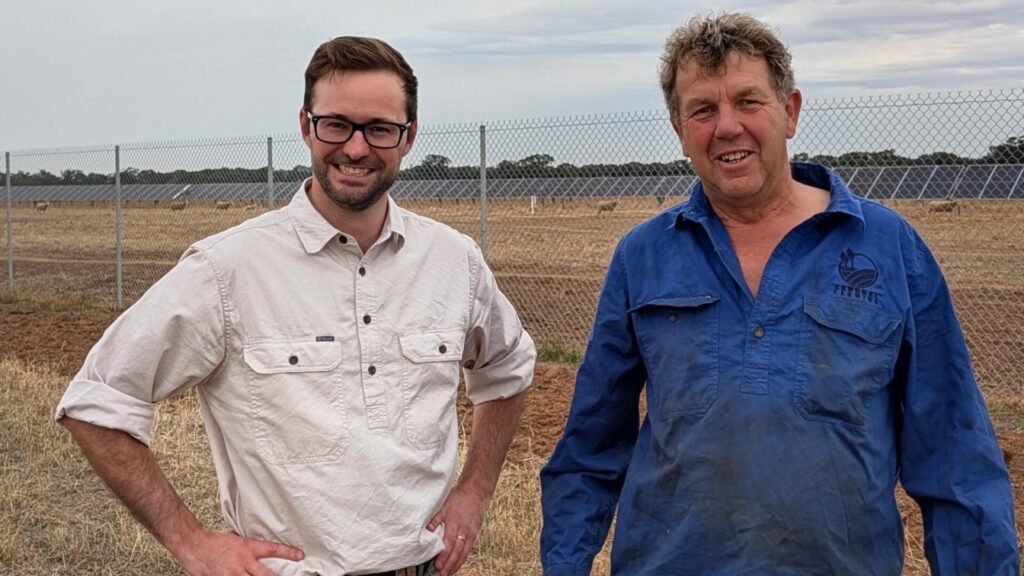
The local argument is also a fair one. Farmer and land-holder Douglas Thomas has pointed out that modern farming already depends heavily on connectivity, so housing digital infrastructure in the region is a logical extension rather than an alien imposition.
The questions that will decide it
A 350MW load is substantial anywhere, and regional communities and networks will want clear answers.
Power. Connecting that much demand will require serious network capacity, and the NSW Government has been tightening its expectations. In March 2026 it released a Data Centre Consultation Paper, aligned with national expectations published by the Australian Government, setting out a principles-based framework for data centre investment across the state. How the Mulwala proposal sits against those principles, particularly on securing new renewable supply rather than leaning on existing capacity, will be a key test.
Connectivity. Power gets the headlines, but a data centre without diverse, high-capacity fibre is just an expensive shed. Mulwala sits on the Victorian border, which could be an advantage for routes toward Melbourne and Sydney, but the campus will need genuinely diverse backhaul to attract serious tenants. This is the part of the story that is easiest to overlook and hardest to retrofit.
Community licence. Regional communities are increasingly asking what large data centres mean for water, housing and services. Goulburn Mulwaree Council, for example, has just pushed for a cumulative impact planning approach rather than case-by-case assessment as data centre interest grows in its own area. Mulwala has its own pressures too, including a recent petition of more than a thousand residents over flood modelling. A project that wants to be welcomed will need to earn that early and visibly.
Local ownership is the interesting twist
What sets this proposal apart is who is behind it. Rather than a global operator or hyperscaler arriving with a pre-signed customer, this is being put forward by local land-holders and domestic investors. That can be a strength, with genuine local buy-in, community benefit built in from the start and patient capital. It can also be a challenge, since the hardest parts of a campus like this, namely anchor tenants, grid connection and financing at scale, are not easy for a new entrant to line up.
What to watch
The December community briefing will be the first real signal of how seriously this is being pursued and how the community responds. After that, the milestones to track are the planning pathway, any grid connection application, the identity of any tenant or operator partner, and the fibre route strategy.
Whether or not Mulwala ultimately gets built at 350MW, the proposal reflects a broader shift. As AI and cloud demand push capacity beyond the capital-city hubs, regional towns with land, existing grid infrastructure and nearby renewable generation are being looked at in a new light. The challenge for the industry is to make sure that when it arrives, it brings the connectivity, power planning and community partnership to match.