Aggregates giant CEMEX and independent rail operations specialist Victa Railfreight have moved the two-millionth tonne of aggregates by rail from Dove Holes Quarry in Derbyshire during September, as part of a flow that has carried more than twenty million tonnes since the partnership began in 2018.
The latest milestone reflects more than the volume of stone extracted from the quarry. It demonstrates how a rail-connected source, dedicated terminal operations and established urban markets can combine to make rail a practical distribution option for a bulk commodity. The two-millionth tonne departed Dove Holes on 24 September aboard a train bound for Salford Hope Street terminal. CEMEX says the quarry produces around three million tonnes of aggregate annually, with about 55% transported by rail. Typical trains comprise 22–26 hopper wagons and can carry up to 2,000 tonnes.
Building a high-volume rail supply chain
Moving 2,000 tonnes by road, as an alternative to a single train, is not as simple as finding the 85 trucks and drivers that might be required to shift that load – at about 23.5 tonnes per truck. For a commodity such as aggregate, moving large volumes in single trainloads concentrates the long-distance part of the supply chain into one operation. The roads around Dove Holes in the Derbyshire Peak District are not really designed to cope with that level of additional individual road movements.

On the largely freight-only lines around the quarry (once part of a mainline between Manchester and London), Victa manages train arrivals, departures and shunting. The operator works with CEMEX’s Dove Holes quarry and rail logistics teams to deliver freight operations. The company reports achieving more than 99% on-time and in-full performance for outbound trains from the site, highlighting the importance of reliability alongside capacity.
Salford is the market at the end of the railway
The business case depends on what happens at the other end of the journey. The CEMEX railhead at Hope Street, Salford, places the aggregate within the Greater Manchester construction market, where it can be stored before being distributed to customers on the final mile by road. CEMEX has invested in the Salford facility, including additional track and upgraded storage bays. The improvements allow hardstone to be delivered by rail and enable wagons to move through the full length of the storage facility.
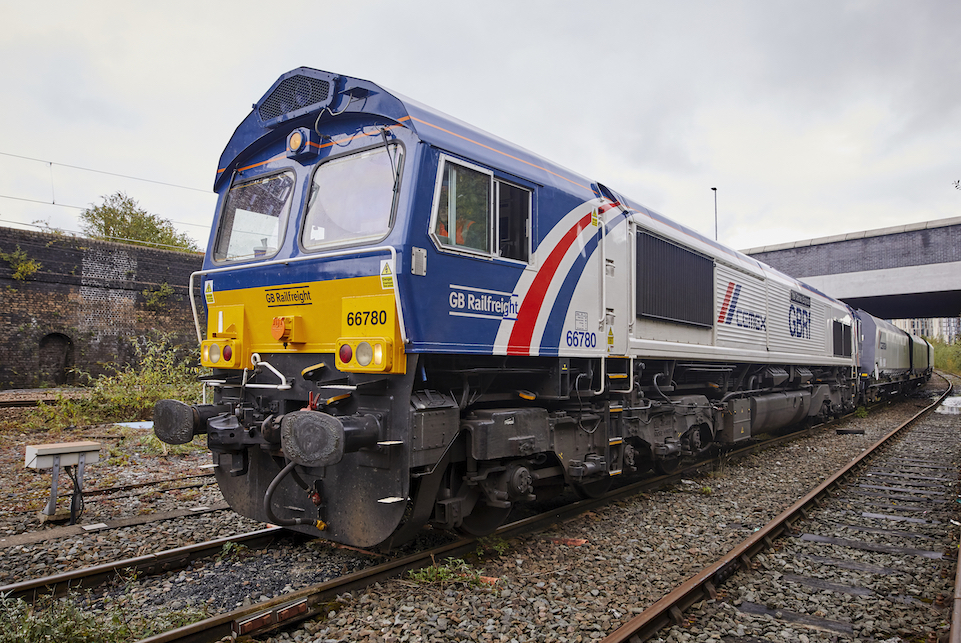
The operation has removed more than 25,000 truck movements from Manchester roads and saved more than 850 tonnes of CO₂, according to CEMEX. The model therefore is not rail replacing road completely. In htis example, Victa Railfreight handles the long-distance trunk movement, while road distribution takes place over shorter distances from the receiving depot. This is particularly relevant for aggregates, where transport costs can have a significant influence on the economics of supplying construction markets.
The railway itself remains a constraint
The Dove Holes operation also demonstrates the infrastructure and operational challenges involved in moving heavy freight by rail. Loaded trains leave the quarry through infrastructure characterised by gradients and tight curves before reaching Chinley and the Hope Valley route towards Manchester. The latter part of the journey is shared with passenger services between Manchester and Sheffield, making the availability of suitable freight paths an important consideration. Aggregate trains are heavy and relatively slow, so their movements have to be planned around passenger services and other traffic. Disruption or an unavailable path can affect quarry loading, terminal operations and customer supply.

At the Manchester end, the Salford terminal is also integrated into a busy urban railway environment. The commercial value of the operation therefore depends on the entire chain working together. Quarry production, train preparation, available network capacity, terminal handling and demand from customers all impact freight services.
Dedication from everyone
For CEMEX, the continuing investment and the scale of the flow indicate that rail has become an established part of the Dove Holes distribution strategy. “Achieving two million tonnes by rail in 2026 is an excellent result and a testament to the dedication of everyone involved in the operation,” said Robert Wilkinson, Logistics Manager UK at CEMEX UK. Debbie Simmons, Managing Director of Victa Railfreight, echoes that sentiment. “Reaching two million tonnes by rail in just nine months this year is a fantastic achievement and one that reflects the commitment, professionalism and teamwork shown by everyone involved in the Dove Holes operation,” she said.
The Dove Holes–Salford flow is one part of a wider network of CEMEX rail movements from the quarry to receiving facilities around the UK. Its scale suggests that, for high-volume aggregates, the commercial case for rail depends less on replacing every road movement than on combining large trainloads with efficient terminals and strong demand at the destination.