The serving of a legal notice by the UK infrastructure manager Network Rail on DB Cargo UK and Touax Rail for a 2020 derailment raises serious questions about the state of relations in the industry. It was six years ago, but for the residents of Llangennech the whole memory of the terrifying derailment and fire is set to be played out in court.
Network Rail has sued both the operator and the rolling stock owner over the environmentally disastrous fuel-train derailment on the edge of Llangennech, in South Wales, on the night of 26 August 2020. The derailment saw 446,000 litres of fuel escape, with some catching fire and the remainder spilling into surrounding wetlands. Around 300 residents were evacuated. The blaze took nearly two days to extinguish, and the railway was closed for more than six months while the infrastructure was rebuilt and environmental damage addressed.
Four years after the RAIB report, the legal argument begins
It comes as no surprise that the condition of the wagon’s braking system was central to the accident. But the circumstances were more complicated than simply a case of “faulty brakes”. The Rail Accident Investigation Branch (RAIB) concluded that one set of wheels on the third wagon became locked, probably because of a defect in the braking system arising from deficiencies in the design and maintenance of its components. The locked wheels developed severe flats and a false flange, which meant the wagons could not safely negotiate Morlais Junction.
The RAIB published its final report into the derailment and fire on 13 January 2022. In November 2020, during its investigation, it had already issued urgent safety advice requiring the organisations responsible for maintaining wagons carrying dangerous goods to review their braking-system maintenance arrangements. Now, more than four years after the RAIB report, Network Rail is taking action.
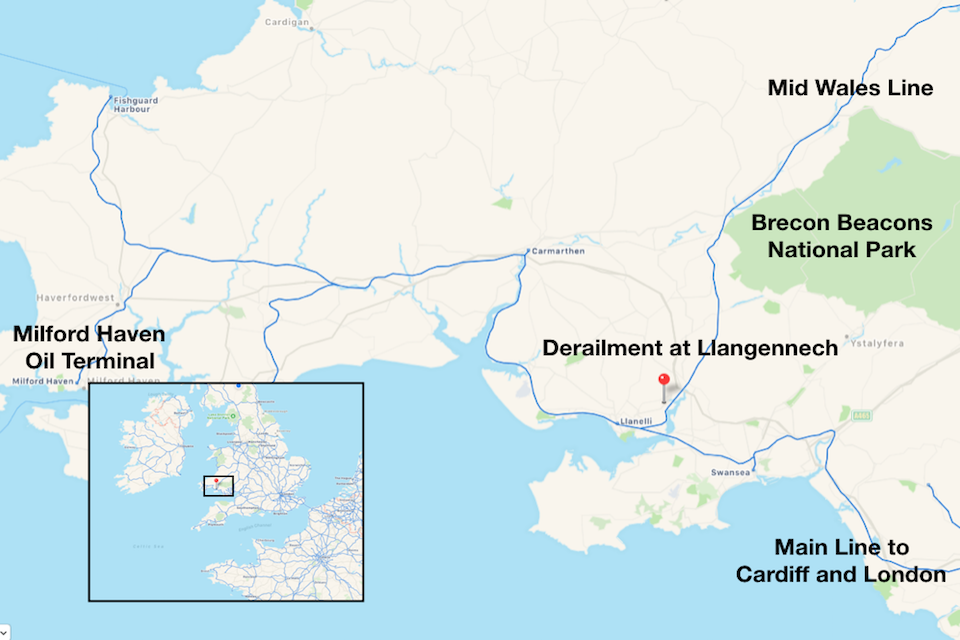
Network Rail has filed a claim in the High Court against DB Cargo UK and Touax Rail. The court documents allege that the wagon had “not been maintained with reasonable care”. Network Rail is seeking damages for negligence from Touax and also alleges that DB Cargo breached a contractual duty to ensure that reasonable care was taken in maintaining the wagon. Lawyers for Network Rail say the claim is expected to recover more than £5 million (€5.8 million). Neither asccused has yet filed a defence and no hearing has taken place.
A railway struggling to learn its lessons
What does it say about the regulation and oversight of the rail freight sector when a public-sector arm’s-length body is required to sue commercial companies over alleged failures that contributed to an environmentally catastrophic derailment? The answer is – nothing good.

Network Rail is a government-owned public-sector organisation and the custodian of Britain’s railway infrastructure. It does not exactly have an unblemished reputation. Might its moral ground be a shifting embankment, if the passenger train operators involved in two potentially catastrophic derailments this month were to sue over shortcomings in track condition and maintenance in the face of a spell of hot weather?
Adding injuries to indictments?
The early indications from the RAIB investigation into the Lewes derailment are that a track geometry irregularity was present before the train derailed. The investigation is examining the condition and maintenance of the track and embankment, the sustained hot weather and the effectiveness of mitigation measures. Thirty people were injured and 20 required hospital treatment, including two with serious injuries.

Less than 24 hours later, a Greater Anglia passenger train derailed near Wickford in Essex. No significant injuries were reported, but the incident added to concerns about the resilience of railway infrastructure during an exceptionally hot and dry summer. Network Rail has said the weather has presented “exceptional challenges” and that its investigations will consider all possible causes and factors.
The cracks in the system are becoming harder to ignore
Given the extreme level of disruption and environmental damage, why is the sum involved relatively small? More than £5 million is certainly not insignificant, but it may be modest when set against the wider consequences of the derailment. That may well be down to the scope of responsibility for Network Rail. The sum sought may largely reflect the additional costs of infrastructure reinstatement and related losses. However, other users of the railway in Mid-Wales may have a case of their own.
Several more questions remain to be resolved. Did DB Cargo UK know this was coming before the recent announcement of the company’s “for sale” notice? What might a successful case mean for other agencies and stakeholders? Could this be the first of several actions – from environmental agencies, community groups and commercial interests, perhaps even the Welsh Government?
Very cross examination
The clean-up may be completed, but there are hands still dirty over the sorry affair. And ultimately, the Llangennech case raises a much bigger question about who takes responsibility when things go wrong on Britain’s fragmented railway. The concept of a “one guiding mind” was central to the thinking behind Great British Railways.
Yet here we are, six years after Llangennech, with responsibility still divided between infrastructure managers, train operators, wagon owners, maintainers and regulators – and the courts being asked to untangle the consequences. A messy derailment whose consequences may ultimately reach far beyond the courtroom – and another uncomfortable reminder that Britain’s fragmented railway still has no single mind capable of taking responsibility when things go wrong.