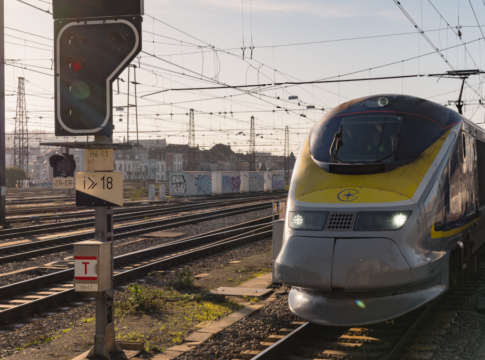
Eurostar has received authorisation from the European Union Agency for Railways (ERA) to bring the first e300 train fitted with the ERTMS/ETCS onboard system into service. The first commercial journey of an ERTMS-equipped e300 train took place on Friday July 17th 2026.
The authorisation, which came on 6 July, marks a major milestone in the modernisation of Eurostar’s historic fleet, bringing it in line with the highest European standards for safety and interoperability.
The programme to modernise eight e300 trains will complete the installation of the ERTMS/ETCS onboard system across Eurostar’s entire fleet. It will support the continuity and performance of operations in the medium term by extending the service life of the trains and improving interoperability, as demand for international rail travel continues to grow and railway systems across Europe become increasingly harmonised. As ERTMS continues to be rolled out across Europe, it now covers a large proportion of the network operated by Eurostar.
The authorisation follows a rigorous process centred on the conversion of a prototype train, which successfully completed static and dynamic testing in partnership with MASTERIS, SNCB and SNCF Voyageurs Matériel.
With this milestone, the programme enters its final phase before the gradual introduction into commercial service of the modernised e300 fleet. The programme will now accelerate, with an optimised approach that maintains commercial capacity by taking only one trainset out of service at a time.
Integrating ERTMS onto the e300 fleet has been a significant technical undertaking. The project has drawn on the combined expertise of Eurostar’s engineering teams and industrial partners to adapt safety-critical technology to existing rolling stock, within a constrained environment and for trains operating at speeds of more than 300 km/h.
Following this approval, Eurostar is now moving into the series production phase. Industrial work is being carried out at SNCB workshops in Namur, where the first modifications are already under way, marking the project’s transition into large-scale deployment.
Zelda Crambert, director of rolling stock at Eurostar, said: “Securing this authorisation reflects our ongoing commitment to safety, European interoperability and the performance of our fleet. By equipping 100% of its fleet with ERTMS signalling, Eurostar is fulfilling its pioneering role as a backbone of European rail. We would like to thank all of our partners for their contribution to this complex and strategically important project.”
The e300 modernisation programme forms part of Eurostar’s wider industrial roadmap and will support the fleet’s transition to the new Celestia trains, which are scheduled to enter service from 2031.
The new fleet will comprise up to 50 Avelia Horizon trains manufactured by Alstom, representing a €2 billion investment by Eurostar.
Image credit: Eurostar