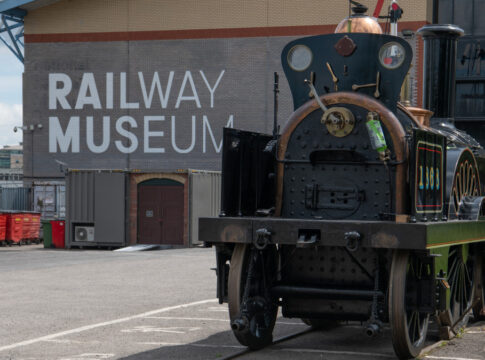
A complex nighttime conservation operation involving specialist teams, equipment and expertise from across the Science Museum Group has seen the historic locomotive Columbine return home to York after 26 years.
Following an epic journey of more than 200 miles from its previous home at the Science Museum in London, Columbine has returned to the National Railway Museum where it has been reunited with its tender – which had been based at the Science and Innovation Park in Swindon – for the first time since 2000.
Both locomotive and tender are now on display in the NRM, on the turntable in Great Hall, giving visitors the free and rare opportunity to see the complete vehicle in its entirety.
The delicate and complex move of the locomotive – which is 4.5 metres long, 3 metres high and weighs approximately 18 tonnes – took place through the early hours of the morning of Wednesday 17th June, and involved a specialist team of 26 people including conservation and logistics experts, as well as dozens of pieces of specialist equipment including an electric forklift and large low-loader to transport the locomotive through London and off to York.
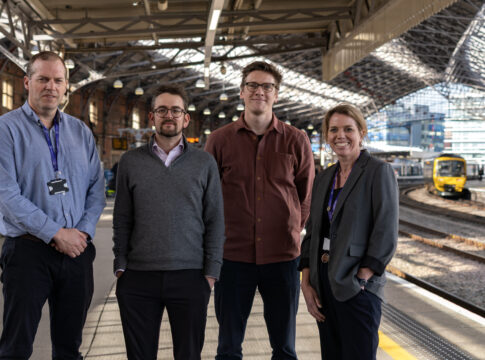
Becky Peacock, Conservation and Collections Care Manager at the National Railway Museum, visited the Science Museum to supervise the move.
“The return of Columbine to York and its reunification with its tender is a significant milestone, both for the locomotive itself and for the National Collection,” she said. “This project has brought together specialist expertise from across the Science Museum Group, from conservation and collections care to transport logistics and installation. We’re delighted that visitors can once again experience Columbine as a complete vehicle and appreciate its important place in Britain’s railway story.”
Columbine was removed from the National Railway Museum in 2000 when it became part of the Science Museum’s popular Making the Modern World gallery in London. While the original intention was for both locomotive and tender to move south, space constraints meant only the locomotive could be accommodated. The tender was instead relocated to the Science Museum Group’s Science and Innovation Park in Swindon, where it remained until this week. More than two decades later, both elements have now completed separate journeys back to York, where they have been reunited and installed on public display.
Columbine is one of the most significant locomotives in the National Collection. Built as the first example of the standard Crewe-type locomotive with six-foot driving wheels, it played an important role in the evolution of British locomotive engineering. At a time when many locomotives relied on inside cylinders and crank axles that could prove vulnerable, engineers W. B. Buddicom and Francis Trevithick developed an innovative outside-cylinder design. Their work would go on to influence British locomotive design for more than four decades.
The locomotive is displayed without its cab, reflecting how it would have appeared in the early 1870s and providing visitors with a clearer view of its pioneering engineering. Now back on display in York, Columbine will help tell the story of Britain’s railway innovation and engineering excellence to new generations of visitors.
Visitors can plan a day out to see Columbine at the National Railway Museum by booking a free museum ticket on the website: https://www.railwaymuseum.org.uk
Image credit: Trustees of the Science Museum Group