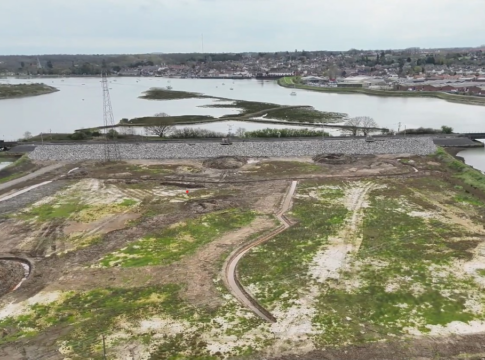
A former Suffolk wetland at Cattawade has been restored back to its original state in the first project of its kind in the East of England, to increase biodiversity and improve climate resilience along the railway.
The almost seven hectare site was drained nearly 180 years ago to protect the railway embankment of the London to Norwich line, and in the process destroyed a wetland habitat and the ecosystem that was important for native birds.
The wetland restoration carried out by QTS on behalf of Network Rail, utilised ‘nature-based’ solutions including placing almost 4000 tonnes of granite and other erosion-resistant rocks along the embankment to create a protective ‘rock armour’ wall. Channels were dug across the site to enable water to flow across the area, and a series of two-metre ‘mounds’ were created just above the waterline so wetland birds will be able to nest and lay their eggs.
Network Rail will be following on from this success by working to increase biodiversity at 14 other sites across the East of England. It marks the next stage of the region’s environment strategy, which aims to replenish biodiversity across its land holdings where possible, potentially creating more than 116 hectares of new ‘biodiverse’ sites by 2035 as part of our wider Greener Railway Strategy.
According to the Wildfowl and Wetlands Trust (WWT) 75% of the UK’s wetlands have been lost in the last 300 years and the Office for National Statistics states that wetland birds decreased by 15% in the UK between 1975 and 2019. So the project is a local solution to a national problem.
John Minshull, Network Rail’s senior asset engineer said: “This restoration project shows what can be achieved when environmental ambition and engineering come together.
“There was a real collaboration and drive between all teams to recreate a habitat that’s vital for wildlife while increasing the resilience of the railway against climate change.
“With this year’s Earth Day theme being Our Power, Our Planet, this project is a powerful example of how we can work with nature rather than against it.”
Network Rail’s Eastern region head of sustainability, Russell Knight commented: “We know that biodiversity is reducing across the country, and as a major land owner, Network Rail has the opportunity and the ambition to play its part in revitalising biodiversity where it can, working in partnership with the Wildlife Trust.
“By returning this area to its former condition, it will help prevent flooding elsewhere in the area as nature itself can play a massive role in helping us offset the challenges of climate change.”
The 6.9-hectare site is encouraging species of wading birds to return to Cattawade, such as curlews, avocets, and oystercatchers, along with the sea aster mining bee – a rare species rarely found outside of Anglia and the southeast coast.
The wetland also slows the flow of the water impacting the embankment, meaning that the recently restored rock armour is even more effective and the long-term resilience against climate change is improved.
While there’s more work to be done, the work at Cattawade marks an important step in taking action to make the railway more sustainable for future generations, as well as giving back to the communities it serves and reducing the impact of climate change.
Image credit: Network Rail