More paths, and not just for passengers. Work on the TransPennine Route Upgrade (TRU) continues to gather pace. A new phase of engineering activity is underlining both the scale of the project and the growing importance of rail freight within it. Long regarded as a largely passenger-focused scheme, the programme is now demonstrating how freight has become integral to both delivery and long-term operation.
Across the Pennines, the TRU has quietly evolved into one of the UK’s largest infrastructure projects. In industry terms, it rivals the Elizabeth Line in scope, while offering more immediate delivery certainty than High Speed 2. Its steady progress and its expanding freight dimension have led to it being described as Britain’s best-kept civil engineering secret.
Intensive West Yorkshire phase
Throughout this coming May and June, engineering teams will focus on the Huddersfield to Leeds corridor, deploying more than 120 engineering trains across multiple work phases. The activity includes renewing over eleven kilometres of track, installing thousands of sleepers, and laying close to 50,000 tonnes of ballast, alongside preparatory works for electrification.
From early May, 56 engineering trains will support 6.2 kilometres of track renewal and the installation of more than 21,000 tonnes of ballast. A further phase, extending into late June, will see an additional 66 engineering trains deliver more than five kilometres of track upgrades, alongside drainage works and the installation of 67 overhead line masts. The programme remains on schedule, despite a recent tunnel fire setback.
Freight plays a growing role in delivery
The scale of material movement highlights the central role of rail freight in delivering the programme. Moving tens of thousands of tonnes of ballast and construction materials by rail has reduced reliance on road haulage, while enabling continuous, high-volume supply directly to work sites across the route.

Measured mile for mile, the level of freight activity compares with that seen on High Speed 2, albeit with far less public attention. The use of engineering trains as a primary logistics tool has allowed the project to maintain momentum, demonstrating how freight can underpin major infrastructure delivery without the need for extensive parallel logistics networks.
Long-term freight benefits becoming clearer
While the TRU programme was initially presented as a passenger-focused upgrade, the benefits for freight are becoming more evident as designs are delivered. Electrification, longer platforms, and enhanced capacity between key centres will support more flexible pathing and improved network resilience.
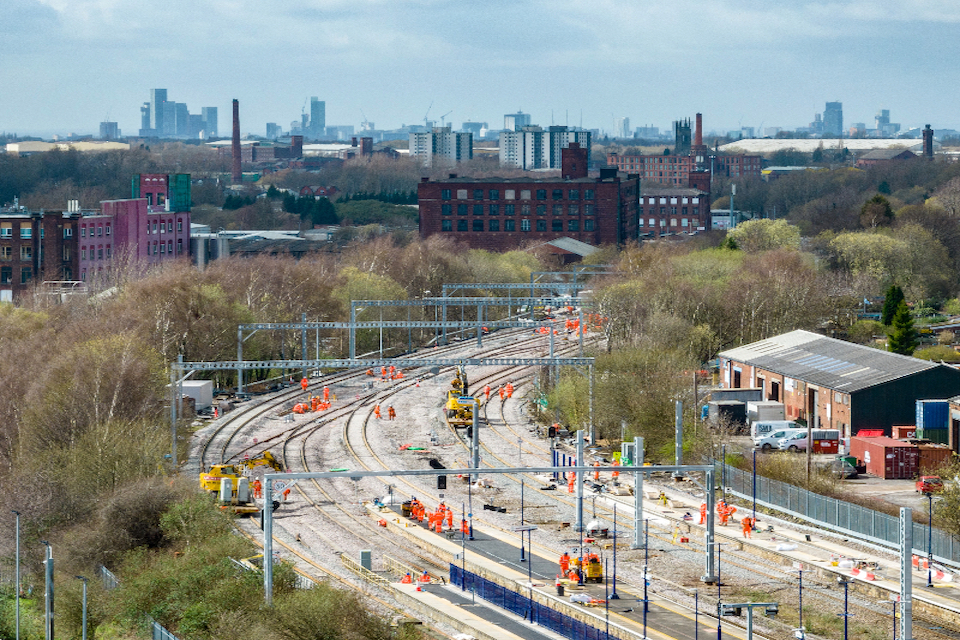
Capacity enhancements, backed by significant investment, are also strengthening freight capability across the Pennines. The eventual outcome is still years away, but the provision being made for more consistent journey times and greater route availability, particularly during engineering works or disruption on core corridors, is a benefit that helps answer the government-promoted desire to increase rail freight traffic by 75% by 2050.
Wider social benefits
Alongside track and systems upgrades, the rail freight sector is facilitating station upgrades, including long-overlooked centres such as Batley and Dewsbury. Longer platforms and improved accessibility are the capital works, but a programme of ancillary works is built in too. Huddersfield station is undergoing extensive remodelling, including structural and passenger facility improvements, as part of a wider transformation due for completion in 2027.
“Significant progress has been made between Huddersfield and Leeds in recent months, and this next series of upgrades will allow us to take another step forward in what is a key stretch of the route and an important enabler for wider TRU plans across the North,” said Sophie Leishman, TRU sponsor. “Our teams will be working around the clock during these two months. I’d like to thank them as well as our local communities as we deliver these huge improvements to the railway.”