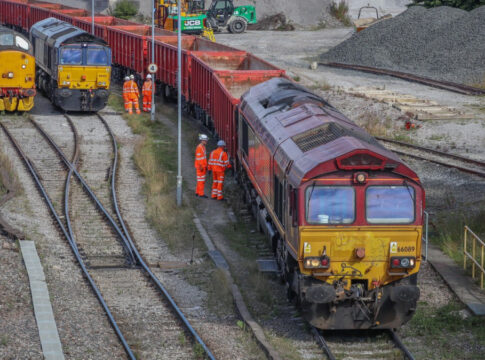
A major project to build a rail freight terminal serving the Rungis International Market in Paris has hit the buffers. The facility’was supposed to be managed by VIIA but its parent company, Rail Logistics Europe (RLE), part of the SNCF Group, confirmed to RailFreight.com that it had withdrawn its involvement.
“After extensive studies, it was determined that the economic and technical conditions were not in place to proceed with the multimodal terminal project,” a spokesperson for RLE revealed. The decision was taken last year but does not appear to have been made public, only coming to light as a result of an enquiry by RailFreight.com. Semmaris was also approached for comment.
The project, representing an investment of 36 million euros, was first unveiled in 2021 with an important stage reached in 2024 when Semmaris, the public agency running the Rungis market awarded VIIA the concession to run the future terminal. Semmaris’ CEO, Stéphane Layani, said at the time that VIIA had presented a project, based on a viable economic model.
Wasted potential
The project had made provision for six round-trip trains a day to operate from the terminal by 2030 with annual traffic of 120,000 containers a year. Initial plans had focused on launching three daily rail freight services from the new terminal: Barcelona-Rungis-Antwerp-Rotterdam, Avignon-Dunkirk-Rungis and Dunkirk-Rungis.
The terminal was to have provided huge potential for modal shift with almost 60,000 trucks a year kept off the roads, contributing to a significant reduction in CO2 emissions. The only scheduled rail freight service carrying perishable freight from southern France to Paris-Rungis had been the so-called train des primeurs carrying fresh fruit and vegetables.
The seasonal service ran five days weekly between October and June but was withdrawn in 2024. It was one of more than 20 routes relinquished by Fret SNCF within the framework of its discontinuity plan agreed by France and the European Commission in response to suspicions that the company had benefited from illegal state aid over a prolonged period.