The recently published Rail Project Prioritisation Strategy – 2025, the implementation plan flowing from the All-Island Strategic Rail Review, places renewed focus on passenger service enhancements across Ireland and Northern Ireland. However, freight, long a minor player in the island’s rail planning, finally gets its own points of emphasis. The strategy builds on the Review’s vision to grow rail freight’s contribution to the economy and better integrate port and rail infrastructure, even as practical freight commitments remain limited in the short run.
The parent document, the All-Island Strategic Rail Review, sets out a suite of strategic objectives aimed at growing rail freight’s share of transport on the island. Key proposals include strengthening rail connectivity to major ports, reducing track access charges to make rail freight more competitive, and developing first/last-mile rail access solutions — particularly for Dublin Port — to enable efficient intermodal transfer and underpin more sustainable logistics chains.
Freight on the agenda — from ports to hinterlands
The Review’s freight goals are mainly quantitative. Under full implementation, around two-thirds of the island’s freight tonnage would move through rail-served ports, a dramatic increase on the current sub-1% rail freight mode share. One of the most tangible freight projects already underway is the reinstatement of the 42km Limerick–Foynes rail line, long dormant since the early 2000s but now being rebuilt to reconnect Shannon Foynes Port with the national rail network. The €65 million project, a key element of Iarnród Éireann’s Rail Freight 2040 strategy, is expected to see freight services begin this year.

The work is framed as a crucial part of building sustainable, intermodal freight corridors between port and hinterland, and is explicitly designed so that future passenger services could be introduced if circumstances warrant. This reinstatement will be the most significant restoration of freight rail in Ireland for decades and is widely seen as a bellwether for the potential role of rail freight in broader economic and transport planning.
Not just passengers first, not just freight last
The ‘freight first’ nature of the Foynes project is in stark contrast to the almost excessively passenger-focused plans in Great Britain. However, it should be stressed that much of the Rail Project Prioritisation Strategy centres on boosting passenger capacity, resilience and journey times: new passing loops, platforms, intercity electrification and improved frequencies, which dominate the early interventions and medium-term major projects. For freight advocates, this means that while there is explicit recognition of freight’s role and potential, most immediate project delivery is in the passenger sphere, and freight projects beyond Foynes still await deeper policy and funding commitments.
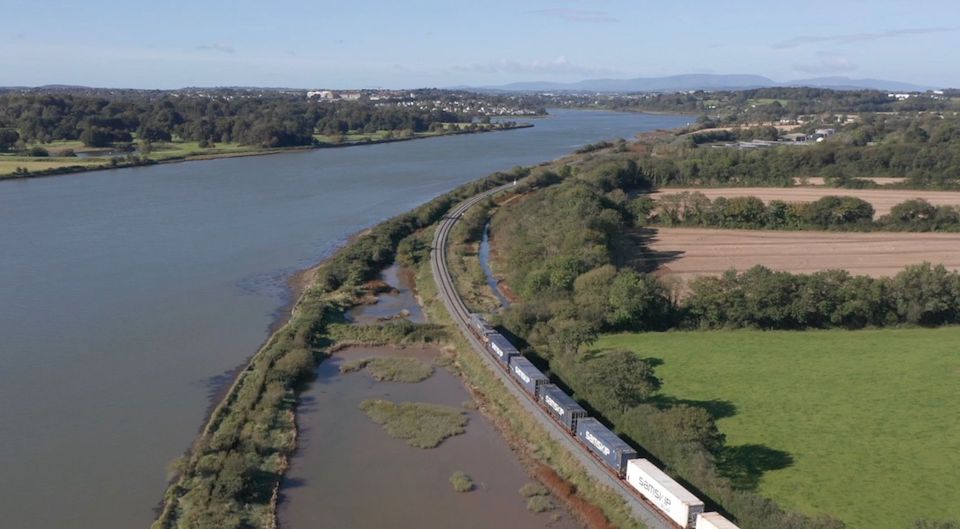
Alongside physical rail links, the Review encourages development of first/last-mile solutions — particularly for complex urban freight gateways like Dublin Port — to overcome one of rail freight’s traditional barriers: the gap between the rail network and port terminals or industrial estates. The prioritisation approach recognises that boosting rail freight activity demands not just long-distance lines but connectivity into road and port infrastructure, and new inland terminals close to major cities. In this respect, Britain can claim a lead over Ireland, in that recent freight development (especially intermodal) does go hand in hand with road access.
Northern Ireland freight — vision but limited action
Freight services have effectively disappeared from the rail network in the UK territory of Northern Ireland. Over a period of decades, freight traffic declined, and lines were closed. Belfast’s Adelaide intermodal terminal was the last significant infrastructure to go – and it’s now, ironically, the site of a critical passenger maintenance depot.
While the strategy and Review envisage future enhancements — including potential reconnection of underserved regions and ports — there is little in the current prioritised programme that immediately restores freight on these corridors. The long-term vision includes reinstating cross-border routes such as Portadown to Derry/Londonderry and even extending access toward Letterkenny and beyond, which, in theory, could support future freight movements; however, realisation of these ambitions remains decades away and hinges on political and planning progress in both jurisdictions (the UK and Ireland).
The island’s rail strategy charts an ambitious 2050 vision in which rail freight plays a much stronger role in the movement of goods, enhances port connectivity, and integrates with broader transport and environmental goals. But for the rail freight sector, the next steps will be critical. Turning the Review’s strategic freight recommendations and prioritisation signals into deliverable, funded infrastructure projects. It may be Foynes the first, but let’s hope that it’s not also Limerick the last.