Victoria’s new train timetable was more than three years in the making, with an additional 1200 weekly trips starting from Monday just the first step in unlocking the benefits of the Metro Tunnel.
The Metro Tunnel will become fully operational on Sunday, kicking off a new timetable that will change services on large parts of the network.
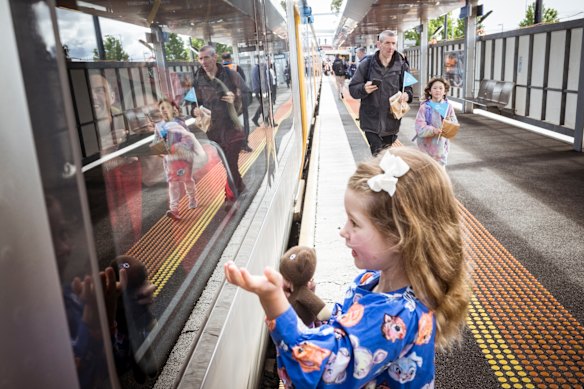
The Sunbury, Cranbourne and Pakenham lines will all come out of the City Loop and move to the Metro Tunnel, running 1000 extra weekly services that will allow most stations to have a “turn up and go” schedule where trains come at least once every 10 minutes across the day.
Frankston line services will return to the City Loop, while the Werribee and Williamstown lines will temporarily go directly to Flinders Street before joining the Sandringham line later in the year to create a new end-to-end cross city service around Port Phillip Bay.
Hundreds more extra trips will appear across other rail, bus and tram routes as part of a broader timetable revamp to capitalise on these changes, which the government has dubbed “the big switch”.
The Department of Transport’s executive director of modal planning, Stuart Johns, told The Age the new timetable was a generational change that began three-and-a-half years ago.
“That just underscores the complexity of this timetable,” he said.
The department uses a computer program, the Victorian Integrated Transport Model, that harnesses data such as patronage and population figures to forecast where demand for public transport will change over time.
Projected over five-year periods, it allows planners to understand how people will move around the states as it grows, and travel habits shift.
Other advanced software helps timetable designers plan around constraints in the network, such as determining where trains merge or split at junctions, and how to minimise wait times at these railway intersections.
But Johns said designing a good timetable was about more than following an algorithm, and needed to be backed by feedback such as when people needed to attend important appointments.
“The model can be quite blunt in sort of spitting out a number that says you need to provide ‘X’ number of services per day. We need to humanise it as well,” he said.
“The first train that we put into the timetable was a train in Gippsland that we know is popular with school students, and then we started to build the timetable from there.”
When Premier Jacinta Allan first announced the opening date for the Metro Tunnel, she said there would be a “new timetable in place everywhere” as part of the big switch.
Since its release, there have been complaints that lines in Melbourne’s east, such as Belgrave, Lilydale, Alamein and Glen Waverley, would not have any changes come February.
There were also no planned changes on the Hurstbridge and Mernda lines, and extra services on the Upfield and Craigieburn lines will come later this year.
Johns said timetables were constantly adapting and improving, and that the Metro Tunnel was a “foundational” piece of infrastructure that would give them capacity to grow and add trains as needed for decades to come.
Transport Infrastructure Minister Gabrielle Williams agreed that February 1 was “just the beginning”.
“We built the Metro Tunnel to unlock space on the network so we can keep adding more services on more lines, not just now, but for years to come,” she said.
Later this year, the department will deliver a new timetable providing extra trips on the Upfield and Craigieburn line on evenings and weekends, reducing maximum wait times from up to 40 minutes to 20 minutes across the day.
He said the world was different to what the Metro Tunnel business case had imagined a decade ago, but one of its most exciting features was a “turn up and go” service along the lines that use the tunnel where commuters at most stations don’t have to look at the timetable to know a train is less than 10 minutes away.
At 10.30am on any given day, it is a 20-minute wait for a trip from Water Gardens to Sunshine. Trains on that corridor will now come every 10 minutes at that time.
“That’s really about providing options for all different types of travel patterns, not just the traditional AM and PM peak,” Johns said.
“It’s such a big change, the key message that we’ve got for our passengers is use the Transport Victoria website or app to plan your journey … plan your journey and be prepared for what is the biggest change in a generation on our rail network.”
The Age