Next week’s Budget offers the government a genuine opportunity to chart a long-term course for freight. Whether it chooses to take that opportunity is quite another matter. As the Chancellor, Rachel Reeves, rises on 28 November, the sector will be listening closely for signals that Britain is finally ready to back the industries that keep the economy moving. But the signs so far suggest this may be another short-term fiscal manoeuvre — the kind of rapid course-correction that might work for a nimble hatchback, but not for a nation that relies on long, heavy trains to carry long-term economic momentum. RailFreifght.com UK Editor Simon Walton hopes for stamina too..
Rail freight operators understand momentum better than most. A freight train isn’t something you swerve on a whim. It requires a path, a plan, and steady application of power to get thousands of tonnes rolling in the right direction. Once that momentum is built, you protect it; you don’t introduce friction for the sake of a quick political gain, and you certainly don’t weave from side to side to demonstrate control. Unfortunately, Westminster’s fiscal behaviour of late has felt a little too much like “fish-tailing” — sudden policy shifts, short-term tax tweaks, and an increasingly reactive approach to economic turbulence. It’s difficult to run a railway that way, and impossible to run a freight railway.
A Budget that lands on the logistics front line
For the logistics sector, this Budget is not an abstract Westminster ritual. It is a material concern, and in some cases an existential one. Logistics UK has already warned that any rise in the cost of doing business — whether through fuel duty, employer National Insurance Contributions or business rates — will ultimately land on the consumer. A tax on logistics, they say, is a tax on everyone. Rail freight operators would add that it is also a tax on decarbonisation, modal shift, and economic resilience.
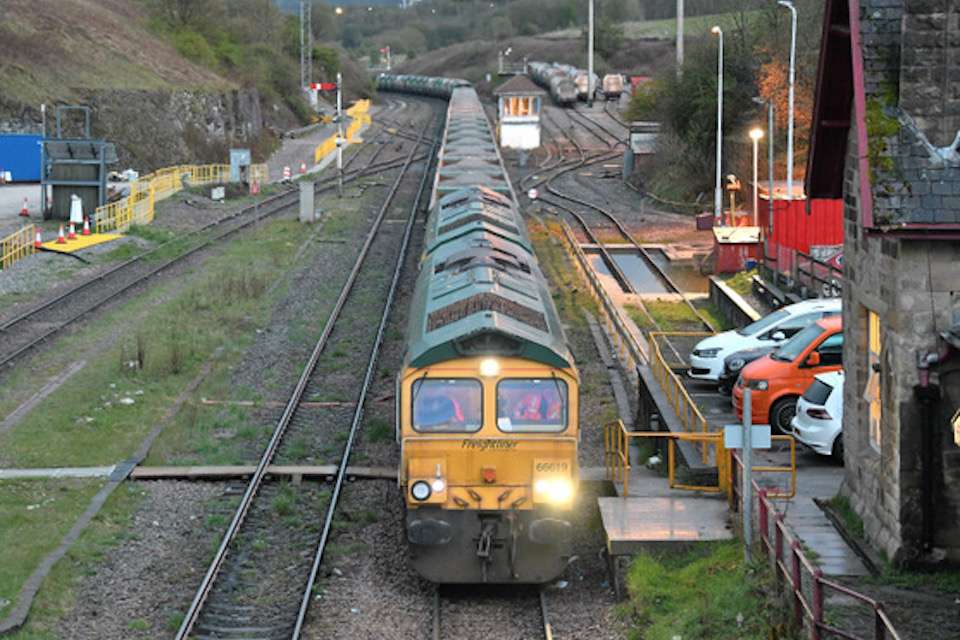
But taking lorries off the roads is not about putting truckers on the dole. It is about reducing truck route miles. The sector already suffers from chronic driver shortages, and there are far more “last mile” and urban delivery jobs than there are drivers to fulfil them. A healthy rail freight sector works best alongside a healthy road haulage sector, with each doing what it does most efficiently. Strengthening rail does not weaken road; it allows road to focus on the work only road can do.
The Rail Freight Group has spent the past year reiterating what should by now be obvious to ministers: rail freight is a force multiplier. Every additional freight path supports jobs, cuts emissions, and bolsters supply-chain certainty. But none of that happens without long-term policy alignment — something the industry has been waiting for since rail reform was first announced.
A Budget that took freight seriously would commit to giving Great British Railways a statutory freight duty; it would embrace the principle of a long-term freight growth target; and it would provide the clarity investors need to commit capital to locomotives, terminals and digital infrastructure. The sector is not asking for handouts. It is asking for certainty.
What a freight-focused Budget would really look like
The Chancellor may well choose to focus on headline-grabbing reliefs and fiscal adjustments designed to stabilise a volatile macro-environment. There is political logic to that approach. But it risks missing some quiet wins for freight — measures that would cost far less than a tax giveaway yet deliver far more value in the long term.
For instance, resolving the long-running distortion between road and rail energy costs would immediately strengthen the business case for modal shift. Committing to targeted upgrades at pinch-points — the sort of incremental capacity enhancements that unlock whole freight corridors — would demonstrate a serious commitment to growth, even if the wider capital envelope stays tight. Providing stability around access charges, track access rights and future pathing would give operators and customers the confidence to plan beyond the next twelve months.

Business at large will view this Budget through the usual lens of taxation, productivity and investment. Rail freight views it through those lenses too, but with an added layer: the recognition that freight is a strategic system. You can’t grow rail freight in bursts. You can’t incentivise modal shift with temporary reliefs. And you can’t expect operators to modernise, decarbonise and expand when policy signals swing like a pendulum every fiscal cycle. Just as you can’t drive a freight train with sudden braking and steering inputs, you can’t run a national economy with abrupt, short-term interventions and expect long-term stability.
Hoping for stability in a stop-start economy
If there is a note of optimism to be found, it lies in the fact that freight policy has finally entered the public conversation. The sector’s leaders — from trade bodies to operators — are speaking with unusual clarity and unity about what is needed: consistency, predictability, and a strategic framework that recognises the economic value of rail freight. Their argument is not one of special pleading. It is one of national interest. A stable, well-supported freight sector underpins everything from supermarket shelves to steelworks, construction, energy security and exports.
So as the Chancellor prepares her red briefcase, the freight sector will brace itself for another set of short-term manoeuvres — while hoping, perhaps unrealistically, for something more statesmanlike. A Budget for freight would not need to be flashy. It would simply need to acknowledge that momentum matters, stability matters, and that you don’t run a railway — or an economy — by yanking the controls to prove you’re in charge. Rather unlike Rachel Reeves failed to achieve for passengers a year ago. Steady power, steady planning and steady policy: that’s how you keep a freight train on course. And that’s how you build an economy that can carry its load, mile after mile, without the constant risk of fishtailing into trouble.