Last month’s Implementing Decision for the Turin-Lyon project sparked further discussion on the mastodontic cross-border initiative. Despite some doubts persisting, Paolo Foietta, President of the Turin-Lyon Intergovernmental Committee, reiterated how this is a historical decision. “The current line is dead. We either build a new one or goods will go back to the highway”, he said in an exclusive interview with RailFreight.com.
After the European Commission published the Implementing Decision, there were worries about the deployment of enough financial resources, the timeline for the opening and the utility for rail freight. Foietta, however, pointed out that all of these worries have no foundations, as the future Base Tunnel between Italy and France will provide a railway fit for the 21st century.
From 7% to 50% rail modal share
Let’s start with rail freight. Currently, only 7% of the freight exchanged between Italy and France travels on rail. The vast majority runs along the Frejus Railway, a mountainous route built over 150 years ago. The figure is this low because the current infrastructure cannot accommodate any more traffic due to safety reasons. “The line is full with 50 trains per day, 30 for freight and 20 between passengers and empty runs.”, Foietta stressed.
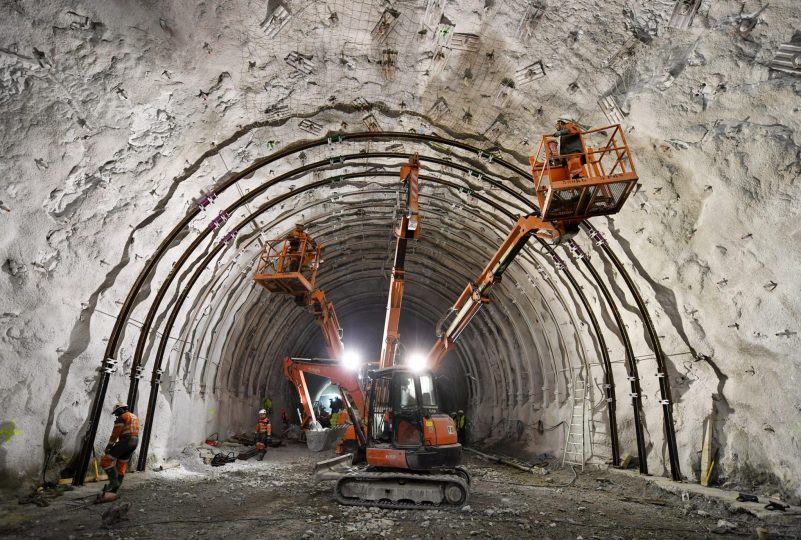
Once the Base Tunnel under Mont Cenis opens in 2033, it will be possible to run 162 trains every day between France and Italy. “With these numbers, it would already be possible to shift up to 50% of the goods to rail, compared to the current 7%”, he said. Earlier, Alberto Poggio, one of the biggest opponents to the project, said that the current line is used at only one-seventh of its capacity. Foietta strongly disagrees. “There is no possibility to move more trains along the old line”, he said “it was confirmed by French and Italian authorities as well”.
Of course, one problem remains. The opening of the tunnel is planned for 2033, eight years from now. Rail freight transport between Italy and France has been struggling for quite some time, especially after the Frejus line was closed for 19 months between 2023 and 2025 due to a landslide, something that the tunnel will prevent. Can the sector survive this limbo? Foietta certainly hopes so. “The situation is fragile, but we have the intention of keeping some trains. I always say that running some trains is better than running no trains”.
Unfair criticism
Another point raised by Foietta is that the Turin-Lyon project is always considered as a whole railway line rather than just the Base Tunnel between Susa and Saint-Jean de Maurienne. This, according to him, is an unfair perspective, as the main project should only concern the tunnel.
“When we talk about similar projects such as the Gotthard or the Brenner it is always just about the tunnels. It is never about the Genoa-Rotterdam or Verona-Munich line”. One might argue that calling the project Turin-Lyon rather than Mont Cenis Base Tunnel might have contributed to this development, but that is more of a marketing problem.
Foietta’s words were in response to criticism on the access routes to the tunnel, especially on the French side. France has always been clear that the connection from the future tunnel to Lyon is not a priority, and that the line to Dijon will be dealt with first. “Of course, to reach full capacity potential, it will be necessary to complete all access routes, but the Base Tunnel will already bring exponential advantages”. And the tunnel will open on time, Foietta ensured.

Numbers do not add up
A final, but nonetheless important, remark made by Foietta was on some of the financial estimates made, for example by Poggio, on the total costs for the Base Tunnel and access routes. “The total cost for the Base Tunnel was certified by TELT (the entity in charge of the project) in August 2024 and it is set at 11 billion euros (2012 value), which translates to 14 billion euros, and not 18 like Poggio said”.
Moreover, Foietta found some inconsistencies with Poggio’s claims on the costs for the access routes. “We knew that the upgrade of the line to Dijon will cost 800,000 euros, not 8,2 million euros. The same can be said for the Italian access routes: it is not 3,2 but 2,3 billion euros”, he said.
Plus, the Implementing Decision forces the French and Italian government to create a strategic plan for the whole line, not only the cross-border tunnel, Foietta highlighted. This move means that projects for both the Base Tunnel and access routes can be financed by the EU up to 50%. “It is the first time this happens in Italy and one of the first ones in Europe”, he concluded, underlining the significance of this step.